Choosing the right bubble hash bag sizes is not only about selecting a bucket capacity. It is also about understanding how bag volume and mesh size work together in a filtration workflow. Capacity determines how much material, water, and ice can be processed in one cycle, while mesh size determines how particles are separated during drainage and collection. For operators working with solventless extraction, the right combination can improve consistency, reduce handling problems, and support cleaner separation across different batch sizes.
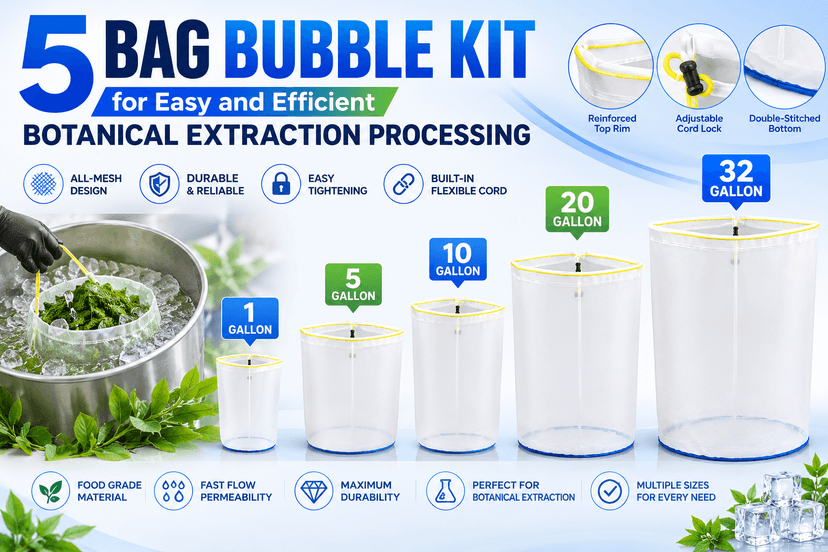
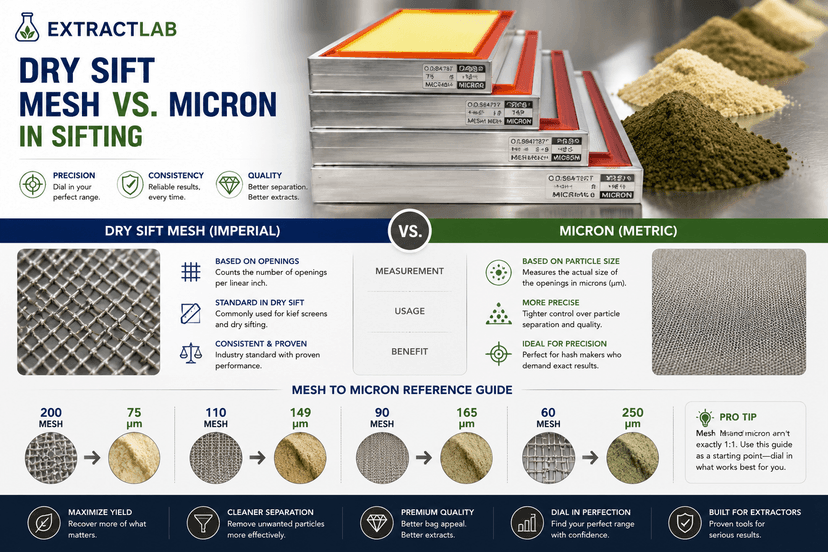
Common capacity options include 1 gallon bubble hash bags, bubble bags 5 gallon systems, and bubble bags 32 gallon configurations. Each size serves a different production need. Small bubble bags are suitable for testing and low-volume use, 5 gallon bubble bags are widely used for standard bucket-based workflows, and large bubble bags are designed for higher-throughput processing. At the same time, mesh sizes such as 25μm, 45μm, 73μm, 90μm, 120μm, 160μm, 190μm, and 220μm define the filtration stages inside the bag system.
Understanding Capacity in Bubble Hash Bag Sizes
The gallon size of a bubble bag refers to the container or vessel it is designed to fit. For example, bubble bags 5 gallon bucket systems are made for standard five-gallon containers. This size is popular because it provides a practical balance between processing volume and manual handling. Operators can process meaningful batches without dealing with the weight and cleaning requirements of much larger systems.
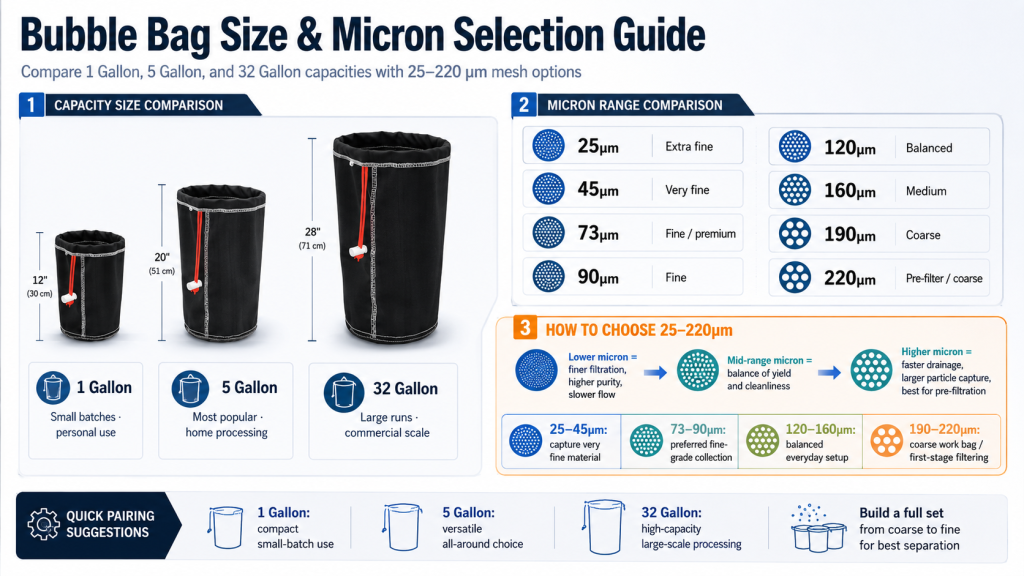
1 gallon bubble hash bags are designed for very small batches. These small hash bags are useful for sample testing, process development, and limited material runs. They require less water and ice, take up less workspace, and are easier to rinse after use. For users who need to compare material behavior or test different washing conditions, small bubble bags provide strong control with minimal waste.
Bubble bags 5 gallon systems are more suitable for regular small to mid-volume processing. They are large enough for repeated use while still being manageable for one operator. 5 gallon bubble hash bags can be stacked in a standard bucket, drained efficiently, and cleaned without requiring a large production area. This makes them a practical choice for users who need reliable filtration capacity without moving into industrial-scale equipment.
Bubble bags 32 gallon systems are designed for larger operations. These large bubble bags allow more material to be processed in one cycle, reducing the number of repeated washes required. However, they also require more water, more ice, more workspace, and stronger handling practices. Wet bags can become heavy, so seam strength, mesh stability, and operator safety become increasingly important as capacity increases.
Comparing Small Bubble Bags, 5 Gallon Bags, and Large Bubble Bags
Small bubble bags are best suited for precision and testing. 1 gallon bubble hash bags allow users to evaluate material quality without committing a large batch. They are also useful for training because the process is easier to observe and control. Since less material is involved, mistakes are less costly, and cleaning can be completed quickly after each cycle.
The limitation of small hash bags is capacity. They are not efficient when larger volumes must be processed. Repeating many small cycles increases labor, cleaning time, and process variation. For this reason, small bubble bags are best used for trial runs, small personal batches, or product development rather than regular high-volume workflows.
5 gallon bubble bags offer a more versatile middle ground. Bubble bags 5 gallon bucket workflows are widely used because standard buckets are easy to source and simple to manage. This size supports controlled washing, effective drainage, and practical collection without excessive equipment demands. For many users, 5 gallon bubble hash bags are the most efficient starting point because they provide enough capacity for useful production while remaining easy to handle.
Large bubble bags, including bubble bags 32 gallon systems, are appropriate when production volume becomes the main priority. They reduce repeated handling and improve throughput, but they also require more disciplined workflow control. Larger bags should not be chosen simply because they hold more material. If batch sizes are too small, oversized bags can waste water and ice while making cleaning more difficult. The best capacity is the one that matches the actual processing volume.
Mesh Size Options from 25μm to 220μm
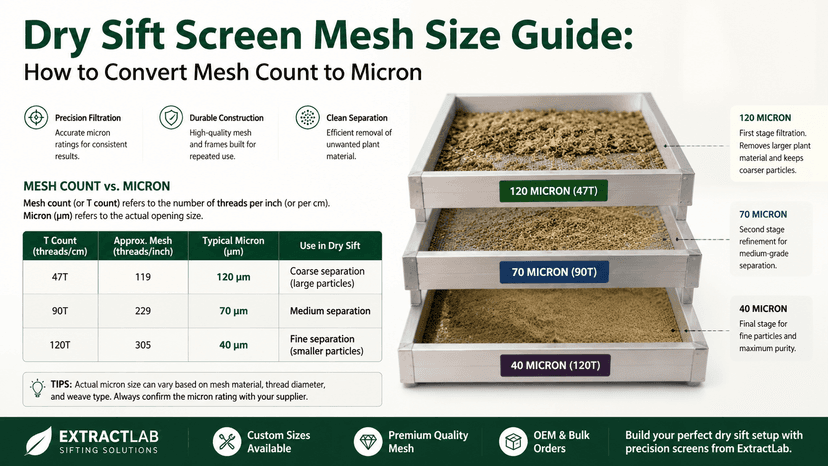
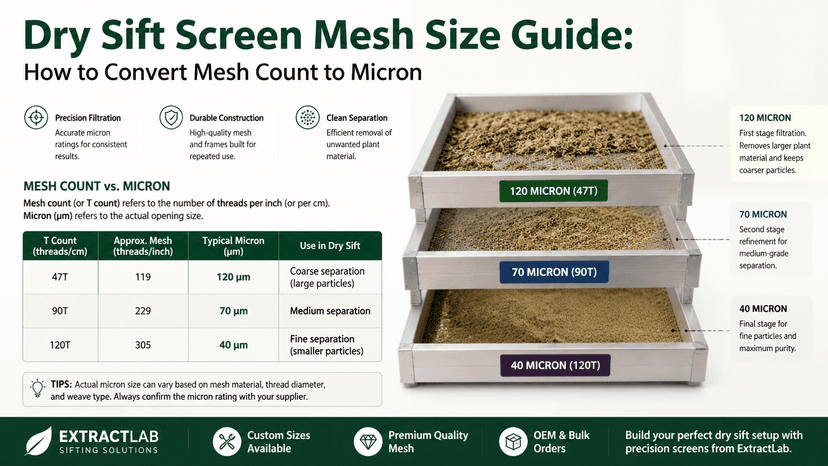
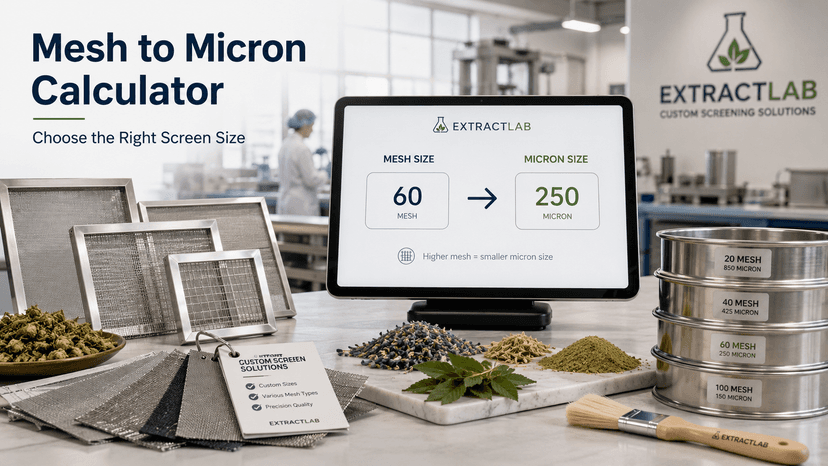
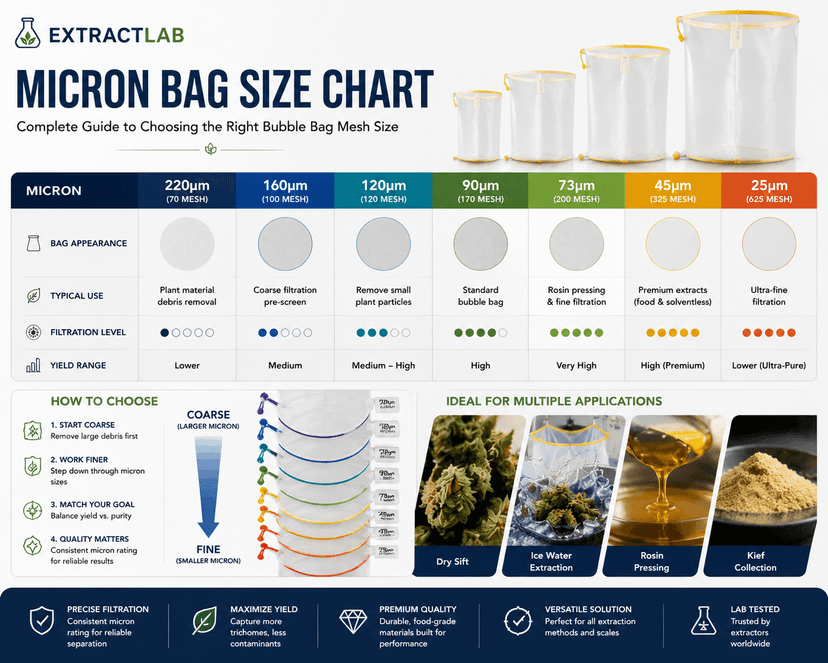
Mesh size is measured in microns. A larger micron number means larger openings in the mesh, while a smaller micron number means finer filtration. In a multi-bag system, different mesh sizes perform different functions. The typical range includes 25μm, 45μm, 73μm, 90μm, 120μm, 160μm, 190μm, and 220μm. These ratings help separate material into different particle ranges during filtration.
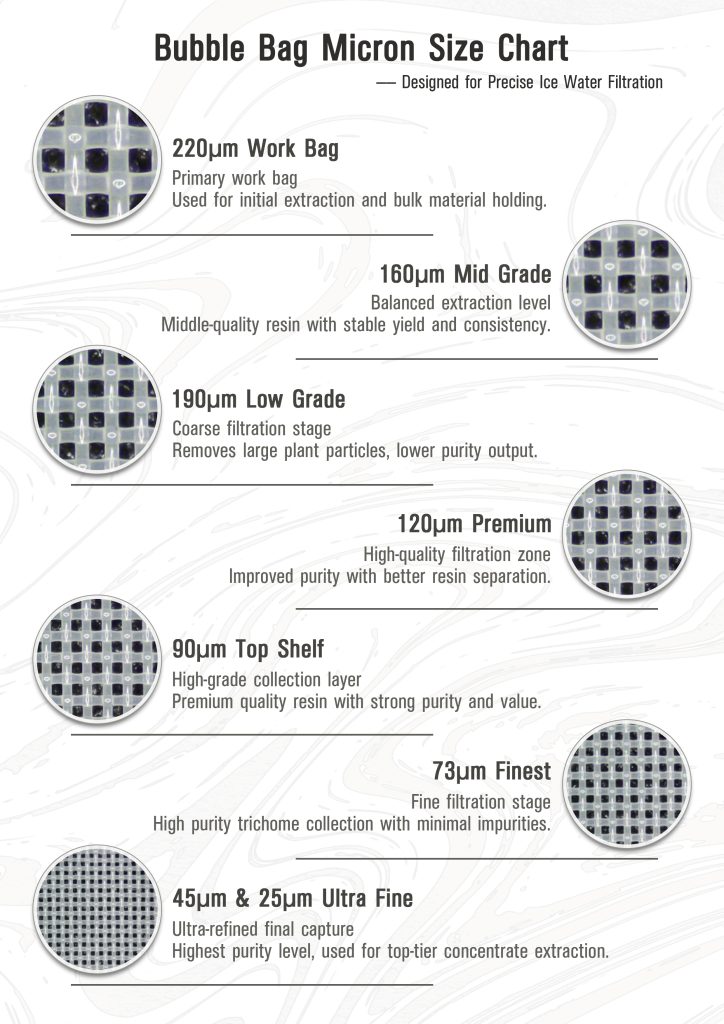
The 220μm bag is commonly used as a work bag or coarse filter. It holds larger plant material while allowing water and smaller particles to pass through. The 190μm and 160μm bags provide additional coarse separation and may capture larger particles depending on the material and agitation level. These upper mesh sizes help protect finer collection layers from overload.
Mid-range mesh sizes such as 120μm, 90μm, and 73μm are often used for primary collection. These bags can capture valuable particle ranges while helping reduce larger contaminants. The 73μm bag is especially common in many filtration sets because it often provides a useful balance between collection efficiency and material cleanliness. However, the best-performing mesh size can vary depending on starting material and process conditions.
Finer mesh sizes such as 45μm and 25μm collect smaller particles. These bags can be important for complete recovery, but they may drain more slowly and require more careful cleaning. Fine mesh can clog if too much plant material reaches the lower layers, which is why proper bag order and controlled agitation are essential. Whether using small bubble bags, 5 gallon bubble bags, or large bubble bags, mesh size must be selected according to the desired separation result.
How Capacity and Mesh Size Work Together
Capacity and mesh size should be evaluated separately, but they must work together in practice. A 73μm mesh bag can be made in a 1 gallon, 5 gallon, or 32 gallon size. The filtration rating may be the same, but the workflow will be very different. A 1 gallon 73μm bag is suitable for small test batches, while a 32 gallon 73μm bag is built for large-volume processing.
In bubble bags 5 gallon systems, the full mesh range from 25μm to 220μm can support a complete filtration workflow without making the process too difficult to manage. This is one reason bubble bags 5 gallon bucket setups are widely used. They provide enough capacity to make each wash productive while still allowing the operator to handle each mesh layer carefully.
For bubble bags 32 gallon systems, mesh stability becomes even more important. Large volumes create more pressure during drainage, and heavier material loads can stress the seams and mesh panels. If the mesh stretches or deforms, the effective micron rating may change. This can reduce separation accuracy and create inconsistent results across batches.
For 1 gallon bubble hash bags, the challenge is different. Small hash bags are easier to control, but they process limited material. The micron sequence still matters, even in small formats. A well-structured small set can help users understand how material separates across 25μm, 45μm, 73μm, 90μm, 120μm, 160μm, 190μm, and 220μm layers before scaling up to larger systems.
Choosing the Right Bubble Hash Bag Size
The right size depends on batch volume, available workspace, handling requirements, and filtration goals. If the main purpose is testing, 1 gallon bubble hash bags are usually the most efficient choice. They reduce waste and allow closer control over small amounts of material. These small bubble bags are also easier to clean and inspect after use.
For regular use, 5 gallon bubble bags provide a practical standard. Bubble bags 5 gallon bucket systems fit common containers, support full micron setups, and remain manageable for most operators. 5 gallon bubble hash bags are suitable for users who need repeatable processing without the extra demands of large equipment. They are also a useful baseline before moving into larger production formats.
For high-volume workflows, bubble bags 32 gallon systems can improve efficiency by reducing the number of cycles required. These large bubble bags should be selected when the operator has enough material, workspace, and handling capacity to justify the larger format. They can support better throughput, but they also require stronger construction and more disciplined cleaning practices.
Buyers should avoid choosing based only on the largest available capacity or the most complete mesh set. A practical system should match the real workflow. Small hash bags are efficient for samples, 5 gallon bubble bags are efficient for standard bucket-based production, and bubble bags 32 gallon systems are efficient for larger operations. The mesh range should then be selected according to the required separation detail.
Long-Term Performance and Practical Value
Durability becomes more important as bag size increases. Small bubble bags experience less physical stress, while large bubble bags must support heavier water and material loads. For bubble bags 32 gallon systems, reinforced seams, stable mesh, and strong sidewalls are essential. For 5 gallon bubble hash bags, these features still matter because repeated use can gradually weaken poor-quality construction.
Cleaning also affects long-term value. Fine mesh sizes such as 25μm and 45μm require careful rinsing because small openings can clog more easily. Mid-range bags such as 73μm, 90μm, and 120μm should be rinsed promptly after use to prevent residue buildup. Coarser bags such as 160μm, 190μm, and 220μm should also be cleaned thoroughly because trapped plant material can affect future drainage.
Proper storage helps preserve mesh accuracy. Bags should be completely dry before they are stored, especially large bubble bags that may retain moisture in folds or seams. Clean, dry storage reduces odor, mold risk, and material degradation. With correct maintenance, a well-made set can provide stable filtration performance over many cycles.
Bubble hash bag sizes should be selected by balancing capacity, mesh configuration, and operating conditions. 1 gallon bubble hash bags and other small hash bags are ideal for testing and controlled small batches. Bubble bags 5 gallon systems and bubble bags 5 gallon bucket workflows provide the most practical middle ground for routine use. Bubble bags 32 gallon systems serve larger operations that need higher throughput. By understanding how 25μm, 45μm, 73μm, 90μm, 120μm, 160μm, 190μm, and 220μm mesh sizes interact with small bubble bags and large bubble bags, buyers can choose a filtration system that supports cleaner separation, better workflow efficiency, and stronger long-term reliability.