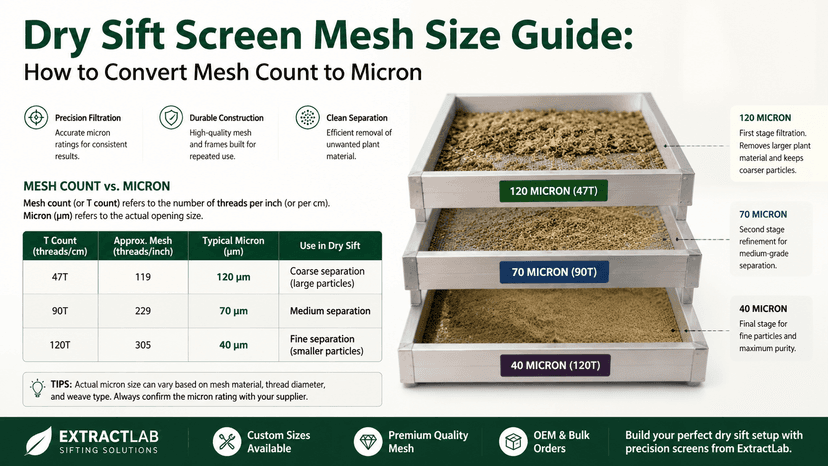
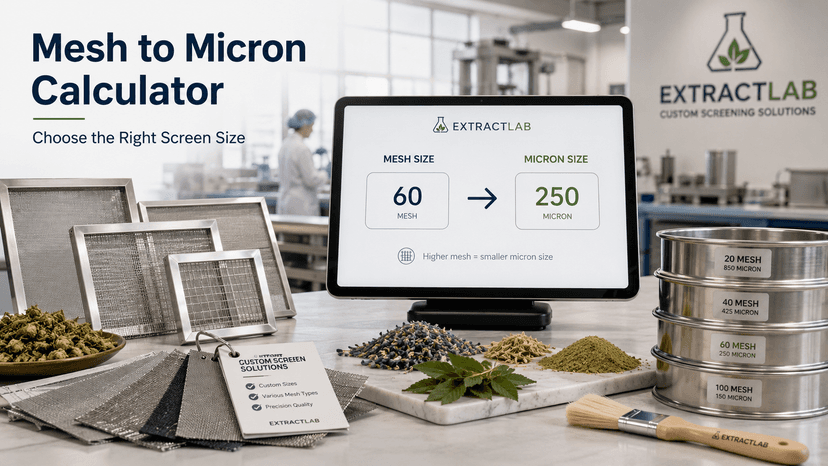
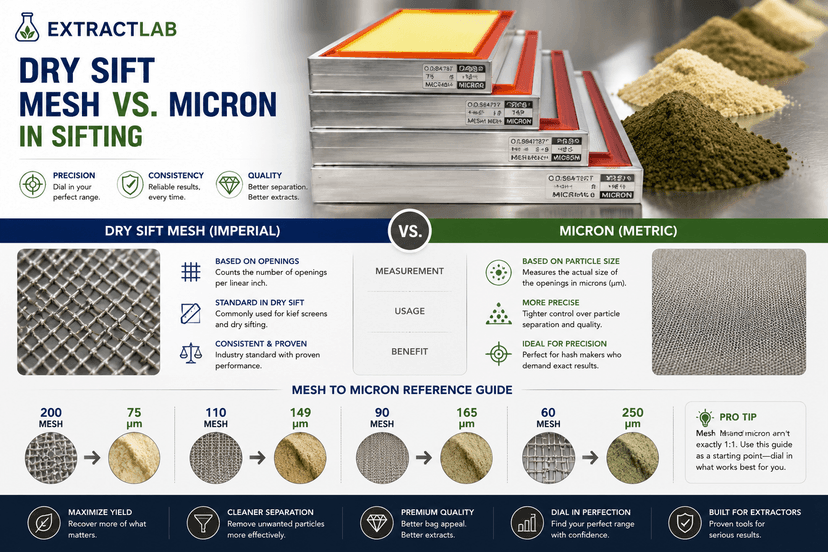
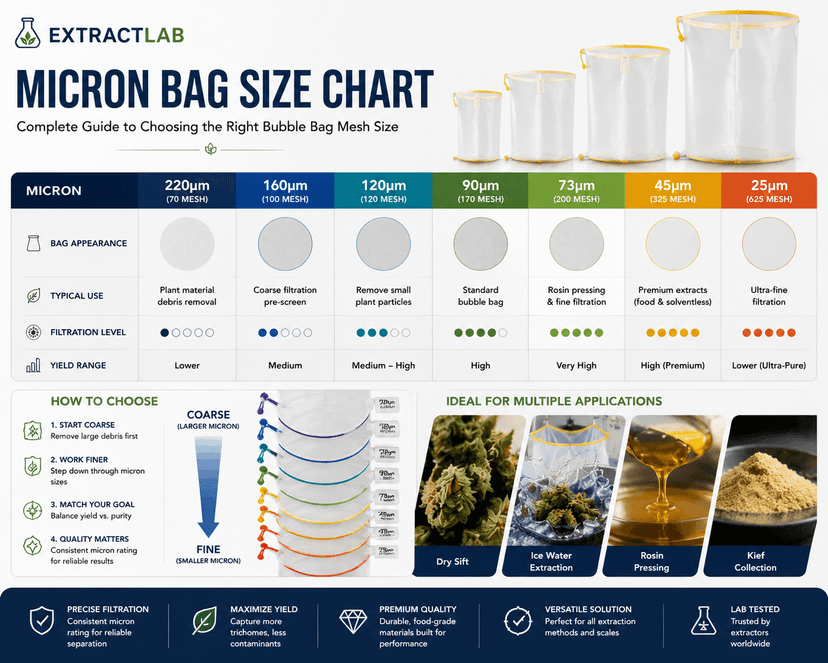
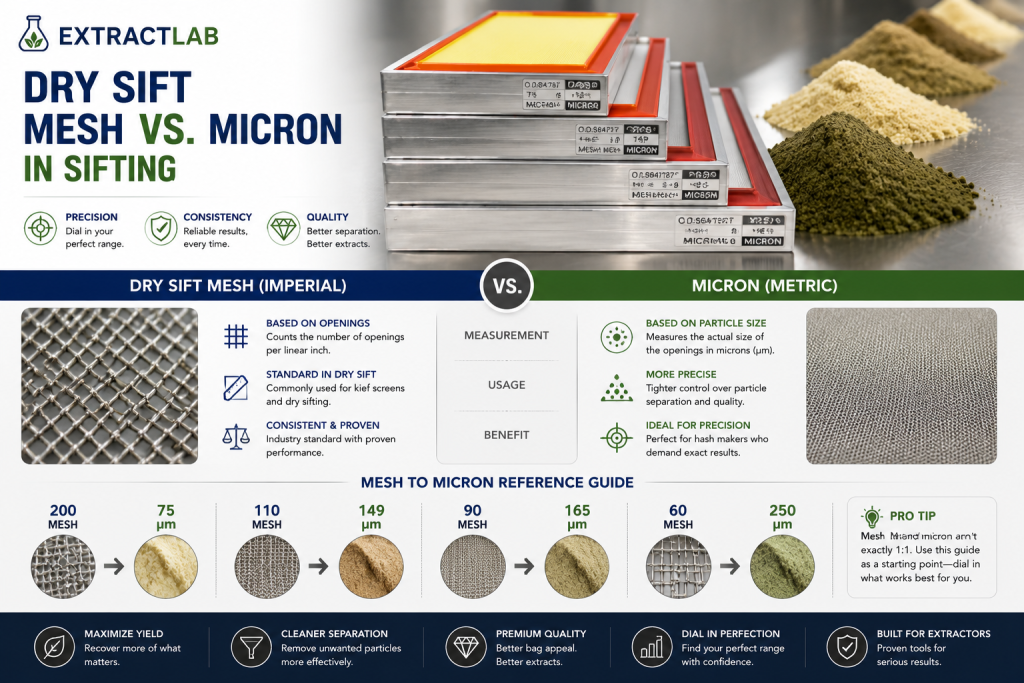
When it comes to processing botanical materials, consistency is everything. Whether you are running a commercial extraction facility or a specialized research lab, achieving a pure yield relies entirely on selecting the correct filtration screen. However, sourcing screens can become confusing due to the two different measurement standards used across the industry: US Mesh and Microns.
To help you eliminate the guesswork and fine-tune your separation process, EXTRACTLAB has compiled this definitive micron sizing chart and dry sift mesh size chart. As a premier manufacturer of industrial-grade filtration solutions and botanical extraction equipment, we understand that a fraction of a millimeter can make the difference between a premium product and a contaminated batch.
Understanding the Difference: Mesh vs. Micron in Sifting
Before diving into the conversion tables, it is critical to understand what these units actually measure and why the industry utilizes both.
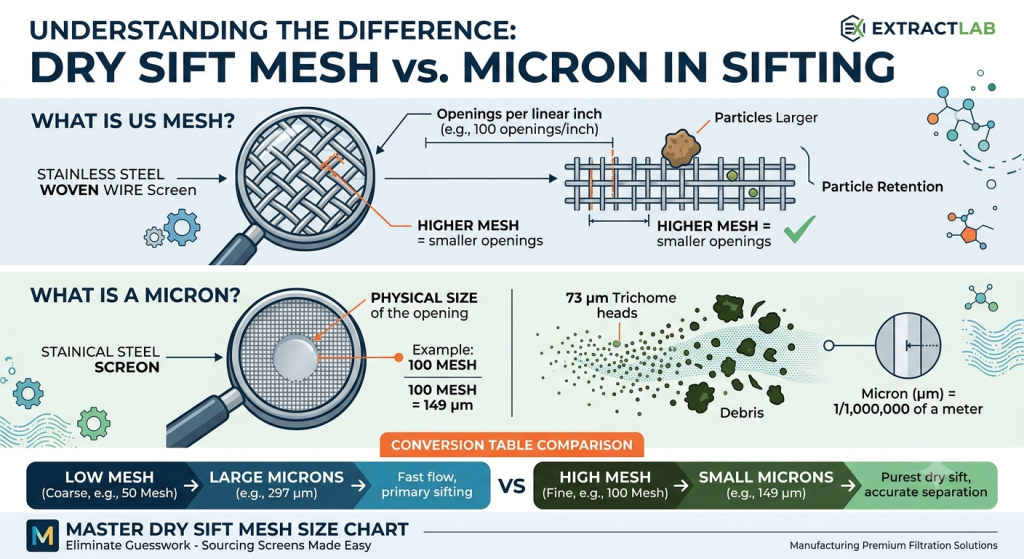
What is US Mesh?
Mesh size refers to the number of openings per linear inch of a screen. For example, a 100 mesh screen means there are exactly 100 openings across one linear inch. Consequently, as the mesh number increases, the openings become smaller, and the wire weave becomes significantly tighter.
What is a Micron?
A micron (micrometer, abbreviated as µm) is a precise metric unit of length equal to one-millionth of a meter. Unlike mesh numbers, microns measure the actual physical size of the opening itself. Therefore, a smaller micron rating means a smaller particle-retention window.
Why Do You Need a Conversion Chart?
Because wire thickness varies depending on the material used (such as stainless steel, nylon, or polyester), the theoretical mathematical formula for converting mesh to microns doesn’t always perfectly align with real-world applications. A dedicated dry sift mesh size chart bridges this gap, giving procurement teams and laboratory technicians the exact physical dimensions they need to source the correct replacement screens.
The Master Dry Sift Mesh Size Chart & Micron Sizing Chart
The following table provides the exact conversion metrics utilized by engineers and botanical processors globally. This dataset covers the critical range needed for primary plant material separation down to the finest purification stages.
| US Standard Mesh # | Micron Rating (µm) | Inches (in) | Millimeters (mm) | Typical Sifting/Extraction Target |
| Mesh 20 | 841 µm | 0.0331 in | 0.841 mm | Raw Biomass Sizing / Large Debris Removal |
| Mesh 30 | 595 µm | 0.0232 in | 0.595 mm | Primary Botanical Separations / Coarse Sifting |
| Mesh 40 | 420 µm | 0.0165 in | 0.420 mm | Seed and Large Stalk Interception |
| Mesh 50 | 297 µm | 0.0117 in | 0.297 mm | Fine Plant Matter and Fiber Isolation |
| Mesh 60 | 250 µm | 0.0098 in | 0.250 mm | Pre-filtration Layer / Biomass Pre-conditioning |
| Mesh 80 | 177 µm | 0.0070 in | 0.177 mm | Outer Gland Isolation / Coarse Botanical Contaminants |
| Mesh 100 | 149 µm | 0.0059 in | 0.149 mm | Premium Dry Sift Primary Capture Screen |
| Mesh 120 | 125 µm | 0.0049 in | 0.125 mm | High-Yield Botanical Extraction / Mid-tier Collection |
| Mesh 140 | 105 µm | 0.0041 in | 0.105 mm | Fine Gland Target Zone / Ultra-clean Dry Sifting |
| Mesh 200 | 74 µm | 0.0029 in | 0.074 mm | Elite Fine Fraction Separation / Micron Polish |
| Mesh 230 | 63 µm | 0.0024 in | 0.063 mm | Micro-particle Polish / Residue Collection |
| Mesh 325 | 44 µm | 0.0017 in | 0.044 mm | Extreme Fine Particulate Retention / Spent Material Trapping |
Note: Beyond 325 Mesh, the physical space between the woven wires becomes so minute that the industry relies exclusively on micron or sub-micron designations to maintain dimensional accuracy.
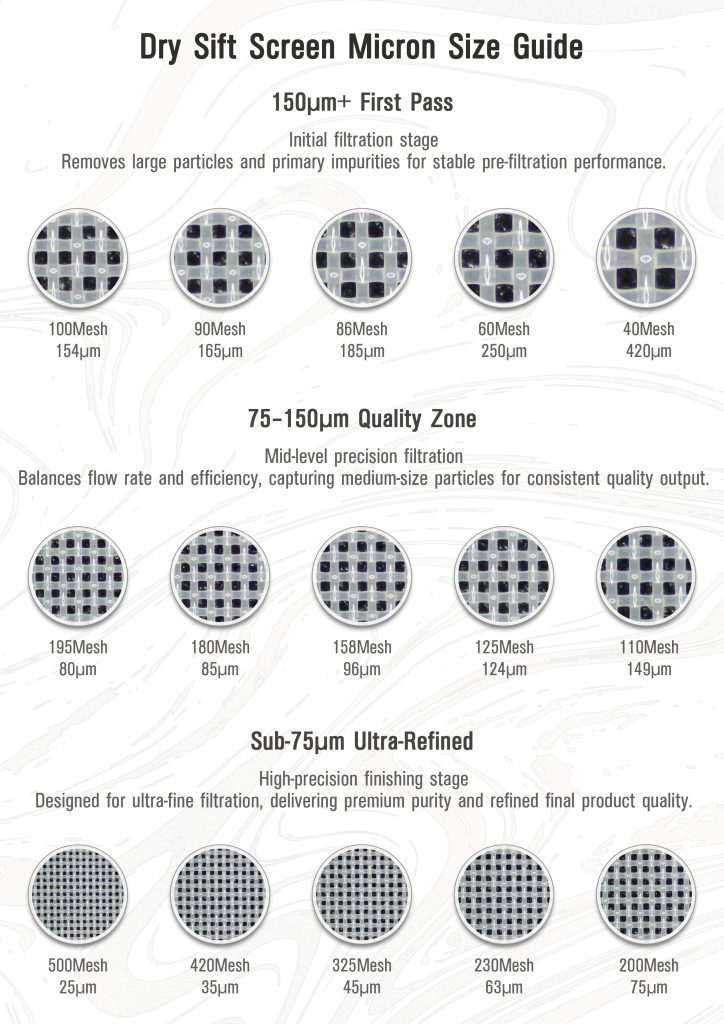
Industrial Applications for Micron-Rated Sifting Screens
Choosing the right combination from our dry sift mesh size chart is heavily dependent on your specific target yield and processing environment. At EXTRACTLAB, we engineer high-performance screens tailored for several key sectors:
1. Botanical Pollen and Oil Extraction
In the botanical extraction sector, purity dictates market value. Processors use a multi-tiered stacking method (using a sequence of screens ranging from 250 microns down to 74 microns) to selectively separate delicate botanical trichomes, plant pollens, and glandular heads from coarser plant fibers, stalks, and chlorophyll-heavy debris.
2. Pharmaceutical and Laboratory Sifting
Pharmaceutical laboratories require absolute precision and strict adherence to certified standards. Our high-mesh stainless steel sifting frames ensure that active pharmaceutical ingredients (APIs) are processed through exact apertures, minimizing the risk of cross-contamination or uneven particle size distributions that could affect dissolution rates.
3. Food Processing and Herbal Extracts
From processing powdered nutritional supplements to refining herbal powders, managing particle size ensures consistency in product texture, solubility, and quality. Stacking multi-layer vibratory screens allows facilities to separate premium fine powders from oversized chunks in a single continuous process.
Why EXTRACTLAB is the Preferred Manufacturer for Global B2B Sourcing
As an established source and direct factory supplier, EXTRACTLAB does more than distribute catalog parts. We manage the entire manufacturing cycle—from wire drawing and precision weaving to final frame fabrication. This direct control ensures that commercial operations receive consistent, top-tier filtration components.
Certified Tensioning and Weave Uniformity
Standard, low-cost off-the-shelf screens often suffer from loose weaves or tension drops over extended use. This defect causes the apertures to warp, allowing larger contaminant particles to bypass the filtration barrier. EXTRACTLAB utilizes automated electronic tensioning machinery during assembly to guarantee that every square inch of our screen matches the specified micron sizing chart parameters exactly.
Medical and Food-Grade Material Options
We offer screening materials designed for challenging operational environments:
- 304 & 316L Stainless Steel: Exceptional tensile strength, acid/alkali resistance, and capable of enduring high-temperature sanitation protocols.
- Precision Nylon & Polyester Monofilament: Offers flexibility, excellent abrasion resistance, and precise micron alignment for vibratory sifters and gravity-fed extraction systems.
Fully Custom Engineering and Direct Compatibility
Every processing facility utilizes unique machinery. Whether your system requires replacement screens for industrial dry sift tumblers, custom-sized circular separator screens, or specialized laboratory sifting frames, EXTRACTLAB delivers bespoke solutions. We build customized screen borders, hook styles, and magnetic strip integrations to match your existing hardware infrastructure perfectly.
Technical Performance Specifications
To assist your engineering team in completing system qualifications, here are the baseline mechanical and chemical standards applied across our industrial sifting lines:
- Aperture Tolerance: Compliant with ASTM E11 and ISO 3310-1 standards, ensuring less than a ±5% variation across ultra-fine mesh ranges.
- Wire Diameters: Optimized to provide the highest percentage of open area (flow rate efficiency) while maintaining heavy-duty wear resistance.
- Frame Construction Options: Rigidity-reinforced stainless steel hoops, custom double-stitched canvas borders, or food-grade polyurethane encapsulation seals.
- Chemical Compatibility: Fully stable across solvent exposures (including ethanol, butane, and isopropyl alcohols), maintaining zero leaching or chemical structural breakdown.
Optimizing Your Sifting Workflow: Tips from the Engineers
Using the data from a micron sizing chart is only the first step. To maximize the operational life of your screen and secure the highest possible purity, implement these industrial best practices:
- Utilize Multi-Stage Stacking: Never attempt to sift raw material directly through an ultra-fine 74-micron screen. The screen will blinding or clog almost instantly. Always use a coarser “scalping screen” (such as 250 or 420 microns) upstream to catch large fiber matrices first.
- Monitor Static and Temperature: In dry sifting applications, ambient heat can cause botanical resins to become sticky and clog the screen. Operating in cold environments or utilizing specialized anti-static grounding connections on your sifting machinery will drastically improve throughput.
- Implement Gentle Ultrasonic Cleaning: For fine wire meshes (100 mesh and finer), manual scrubbing can destroy the wire alignment. Use ultrasonic baths with compliant cleaning solutions to dislodge micro-particulates safely.
Request a Custom Quote from EXTRACTLAB Today
Finding the right balance between processing speed and product purity requires reliable, high-performance equipment. Now that you have reviewed our micron sizing chart and dry sift mesh size chart, let our engineering team translate those numbers into custom hardware for your facility.
Stop dealing with inconsistent screen sizing and premature wear from middleman suppliers. Partner directly with an experienced production manufacturer. Contact EXTRACTLAB today to discuss your technical specifications, request material samples, or obtain a volume-discounted quotation for your custom sifting grids and replacement filters.
Get in Touch with Our Specialists:
- Corporate Inquiry Form: Click the “Request A Quote” button below to upload your technical drawings.
- Direct Engineering Consultation: Email our technical team for immediate support on custom micron developments.