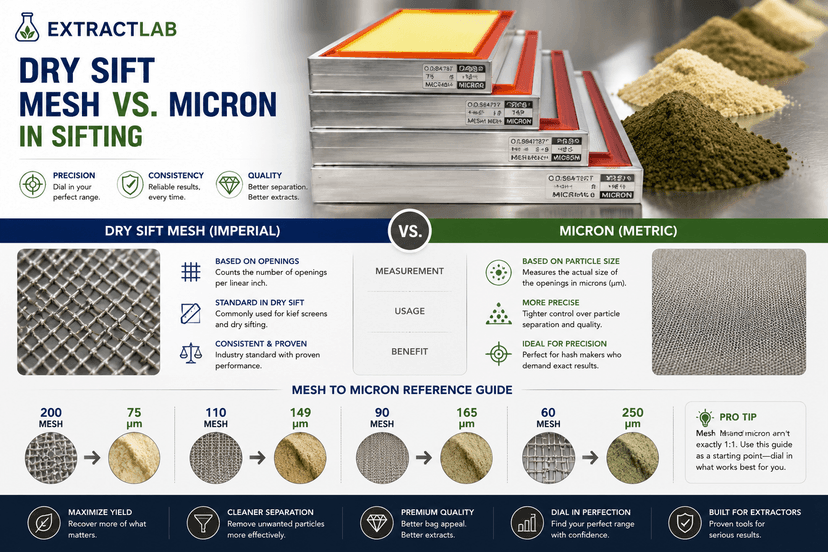
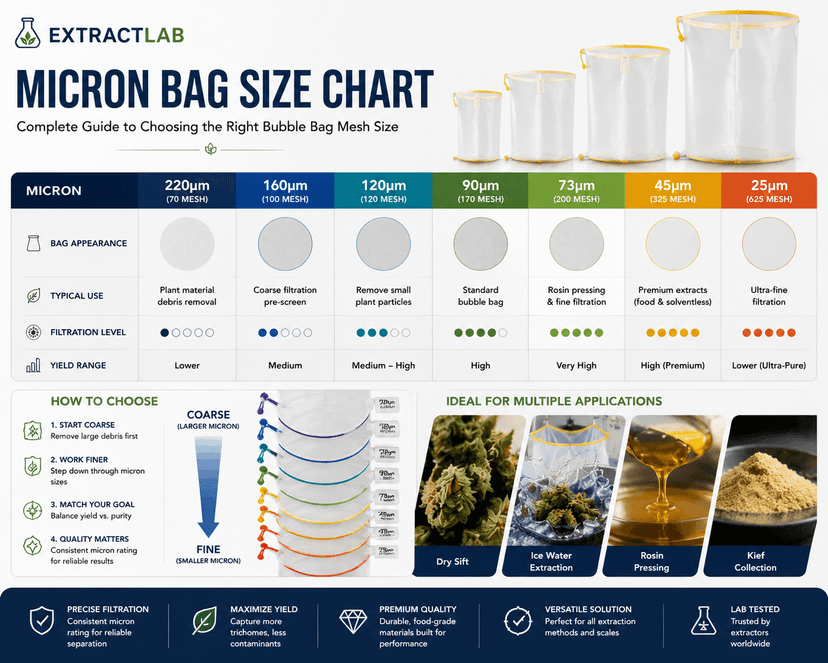
In modern solventless processing workflows, selecting the correct equipment size is just as important as selecting the right filtration material. One of the most common purchasing considerations among industrial and small-scale operators is bubble bags by gallon size, which directly determines batch capacity, workflow efficiency, and processing consistency.
Different gallon sizes are designed for different operational needs. A laboratory may only require compact systems for testing, while production facilities often rely on larger-volume configurations for continuous processing. Understanding how these sizes compare helps operators build a more efficient and scalable workflow.
At EXTRACTLAB, we design and manufacture scalable filtration systems ranging from small laboratory units to industrial-grade solutions. As a direct manufacturer and supplier, we also support OEM customization for different production environments, making our systems adaptable for global buyers.
Understanding Bubble Bags by Gallon Size
The term bubble bags by gallon size refers to the physical capacity of the filtration system. This measurement determines how much plant material, water, and ice can be processed in a single cycle.
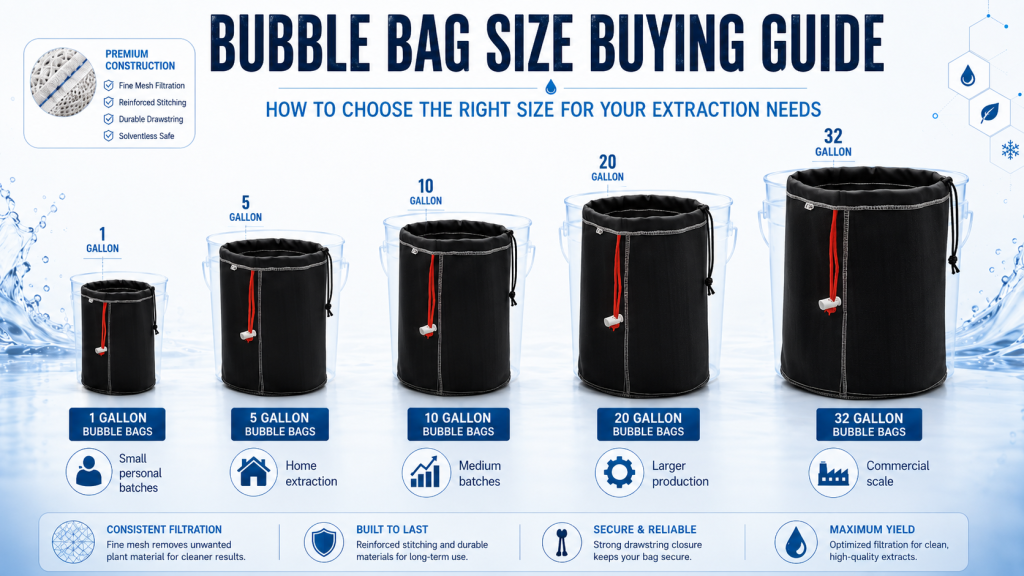
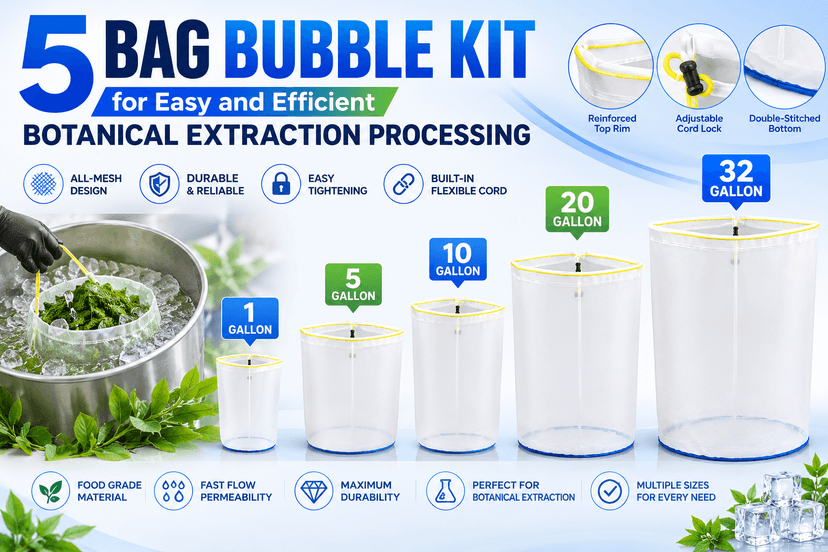
Common configurations include:
- 1 gallon systems for small-batch testing
- 5 gallon systems for standard workflows
- 10–15 gallon systems for mid-scale production
- 32 gallon systems for industrial-scale operations
Each size serves a different operational purpose, but all rely on the same principle: multi-layer micron filtration for controlled separation.
For example, a 1 gallon system is ideal for R&D environments, while a 32 gallon system is designed for high-volume production where efficiency and throughput are critical.
Why Gallon Size Matters in Filtration Performance
Choosing the correct gallon size is not only about capacity—it also affects process stability, material handling, and final output quality.
1. Workflow Efficiency
Smaller systems require more cycles to process the same amount of material, while larger systems reduce repetition and labor.
2. Heat and Temperature Control
Larger water volumes maintain more stable cold conditions, improving consistency during processing.
3. Filtration Consistency
Proper sizing ensures even agitation and balanced particle movement across micron layers.
4. Scalability
Operators can scale production more easily when moving from 5 gallon to 32 gallon systems.
Bubble Bags by Gallon Size Breakdown
1 Gallon Bubble Bags – Precision Testing & R&D
1 gallon systems are designed for controlled experimentation and small-scale processing. They are widely used in laboratory environments where precision is more important than volume.
Key advantages:
- Minimal material waste
- Fast cleaning and handling
- Ideal for testing different micron configurations
These systems are often used to validate process parameters before scaling up.
5 Gallon Bubble Bags – Industry Standard Workflow
The 5 gallon configuration is one of the most widely used formats in the industry. It provides a balance between capacity and manageability, making it suitable for routine production.
Advantages:
- Compatible with standard buckets
- Efficient for daily workflows
- Easy to operate and clean
Many operators consider this size the foundation of their production system before moving to larger setups.
10–15 Gallon Bubble Bags – Mid-Scale Production
Mid-size systems are designed for operators who require increased throughput without moving directly to industrial equipment.
Benefits include:
- Reduced batch repetition
- Improved workflow continuity
- Balanced handling requirements
These systems are often used by growing businesses scaling their production capacity.
32 Gallon Bubble Bags – Industrial-Grade Output
The 32 gallon system represents the highest level of capacity in standard bubble filtration setups. It is designed for industrial environments where efficiency and consistency are essential.
Key advantages:
- High-volume processing capability
- Fewer cycles required for large batches
- Better temperature stability in cold water workflows
EXTRACTLAB’s 32 gallon systems are engineered for heavy-duty use and consistent performance under continuous operation conditions.
Micron Structure and Filtration Control
While gallon size determines capacity, micron size determines separation quality.
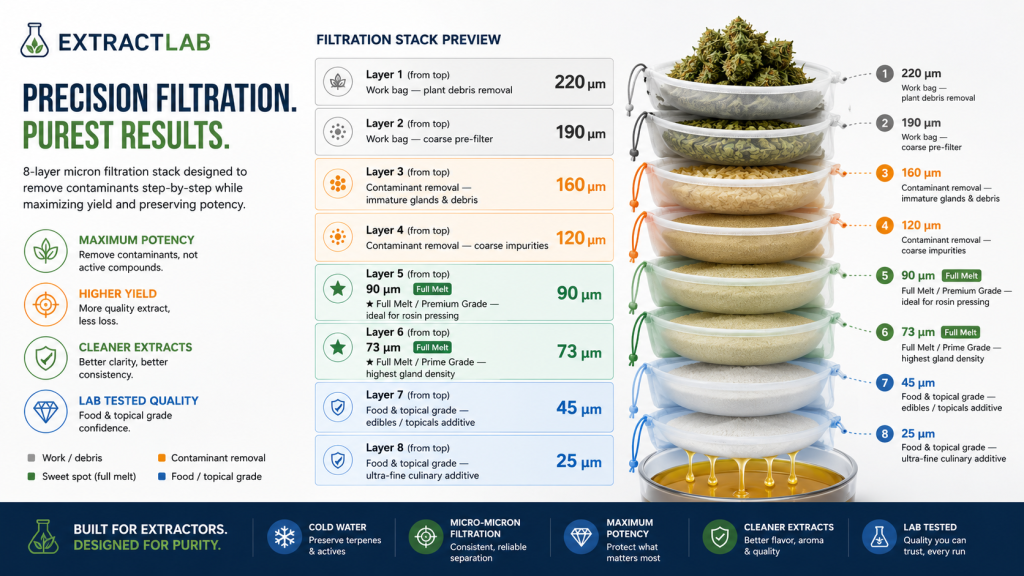
A typical multi-layer system includes:
- 220 micron – coarse separation
- 160 micron – pre-filtration
- 120 micron – general filtration
- 73 micron – primary collection zone
- 45 micron – fine filtration
- 25 micron – ultra-fine separation
This structured approach ensures controlled particle size separation across multiple stages.
Each layer plays a specific role in ensuring consistency and reducing contamination between grades.
Technical Advantages of EXTRACTLAB Systems
As a professional manufacturer, EXTRACTLAB focuses on delivering industrial-grade filtration solutions designed for performance, durability, and scalability.
Product Advantages:
- Factory-direct manufacturing for consistent quality control
- Custom micron configurations available
- OEM/ODM support for global distributors
- Reinforced mesh construction for long-term durability
- Scalable systems from 1 gallon to 32 gallon formats
Our engineering approach ensures each system maintains stability under real production conditions.
Application Scenarios
Bubble bags by gallon size are used across multiple industries and operational environments.
Laboratory Research
Used for controlled testing and process optimization.
Small Business Production
5 gallon systems are widely used for daily production workflows.
Industrial Extraction Facilities
32 gallon systems support large-scale continuous processing.
Product Development
Used to test raw material behavior under different conditions.
Why Industrial Buyers Prefer Scalable Systems
Modern production environments require flexibility and scalability. Instead of relying on a single fixed system, operators increasingly adopt modular setups based on gallon size.
Key reasons include:
- Easier production scaling
- Reduced operational bottlenecks
- Improved cost efficiency per batch
- Better control over workflow consistency
This is why bubble bags by gallon size has become a key decision factor for procurement teams and production managers.
How to Choose the Right Gallon Size
Selecting the right system depends on three main factors:
1. Production Volume
Small batches require smaller systems, while high-output environments benefit from 32 gallon setups.
2. Labor Capacity
Larger systems require fewer cycles but may need more handling strength and workspace.
3. Workflow Goals
R&D, scaling, and industrial production each require different system sizes.
Conclusion
Bubble bags by gallon size provide a scalable approach to modern filtration systems. From small laboratory setups to industrial-scale production, each configuration plays a specific role in optimizing workflow efficiency and output consistency.
By selecting the right system size and micron configuration, operators can significantly improve process stability, reduce labor, and enhance overall production quality.
Work with EXTRACTLAB
EXTRACTLAB is a professional manufacturer and global supplier of industrial filtration systems. We provide scalable bubble bag solutions ranging from 1 gallon laboratory units to 32 gallon industrial systems, with full OEM and customization support.
If you are looking for reliable, factory-direct bubble bags by gallon size, contact our team for:
- Bulk pricing and wholesale supply
- Custom micron configurations
- OEM branding solutions
- Industrial production consultation
📩 Get in touch with EXTRACTLAB today to request a quote and build a filtration system tailored to your production needs.