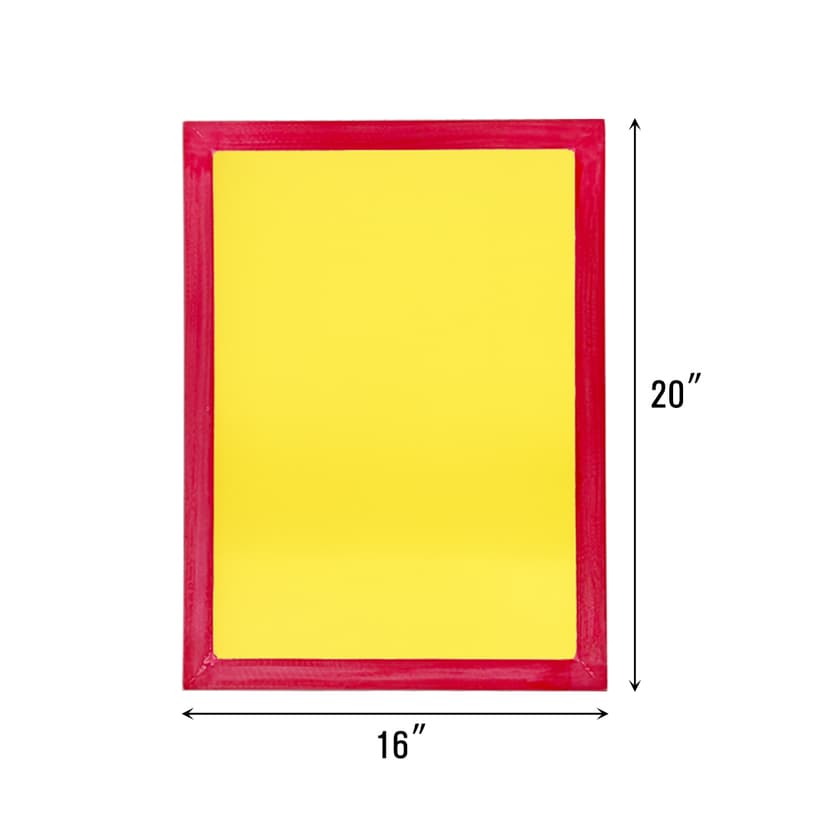
Is a 16 × 20 inch dry sift screen automatically interchangeable with a 400 × 500 mm frame? No. Exact unit conversion gives 406.4 × 508 mm. The rounded metric description refers to different dimensions unless the supplier explicitly uses it only as a nominal product label. Confirm the manufacturing drawing before placing a replacement order.
This guide addresses unit conversion and drawing approval for dry sift screens. The separate frame size versus usable area guide explains which physical boundaries to measure. Here the question is how to preserve an agreed dimension when buyers and suppliers use different units.

Separate a product name from a manufacturing dimension
The 16 × 20 inch product listing identifies an aluminum-frame screen with polyester mesh and custom size options. Its catalogue name is a useful starting reference. It does not establish every outside, clear-opening or profile dimension, nor does it provide a universal manufacturing tolerance.
Before converting a size, identify what the number describes. Converting an outside width does not turn it into a usable opening. A correct calculation attached to the wrong reference faces can still produce an incompatible order.
Use exact conversion before deciding how to display it
One inch equals exactly 25.4 millimeters. Multiply inches by 25.4 to obtain millimeters; divide millimeters by 25.4 to obtain inches. Thus 16 inches equals 406.4 mm and 20 inches equals 508 mm. These calculations convert the nominal labels; they are not measurements of a delivered EXTRACTPHYTO frame.
In the comparison above, 400 mm is 6.4 mm shorter than 16 inches, while 500 mm is 8 mm shorter than 20 inches. Calling the two sizes equivalent can therefore hide a fit problem. Whether that difference matters depends on the actual support, stack interface and approved tolerances, not on how similar the catalogue descriptions look.
Choose a controlling unit system
A drawing can show both units for convenience, but identify which values govern manufacture and acceptance. For example, an inch-controlled drawing may show a rounded metric equivalent marked “reference only.” If the buyer instead requires metric dimensions, issue a metric-controlled drawing and obtain explicit supplier acceptance.
Do not let the supplier manufacture to one rounded value while the receiving team rejects against another. Put the unit note on the approved drawing and carry its revision into the quotation and purchase order. If two displayed dimensions conflict, resolve the conflict before approval rather than assuming the tighter-looking number takes precedence.
Convert tolerances as well as nominal values
A tolerance is an agreed acceptance range, not the number of decimal places shown. As a mathematical example only, a hypothetical 10.000 ± 0.010 inch requirement converts to 254.000 ± 0.254 mm. The interval is 253.746 to 254.254 mm. It is not equivalent to 254 ± 0.01 mm.
This example is not a recommended screen tolerance or an EXTRACTPHYTO capability claim. Ask the supplier and the responsible engineering team to agree achievable limits and appropriate measurement methods. If rounded limit dimensions are needed, approve them explicitly so rounding does not silently widen or narrow acceptance.
Check the revision package before ordering
- Product reference and the physical faces defining each dimension.
- Controlling units and clearly marked reference conversions.
- Agreed tolerances or limits, without unsupported precision.
- Frame height, profile and interface details where fit matters.
- Mesh specification recorded separately from frame dimensions.
- Drawing revision, approval date and supplier confirmation.
For replacement frames, use the stacking-interface guide alongside the drawing. Equal converted length and width do not establish identical corners or locating features. Keep superseded drawings out of the purchase package and ask the supplier to identify any proposed dimensional change.
Can a photograph resolve a dimensional dispute?
An annotated photograph can identify the measured faces and show a scale, but perspective and unclear measurement points limit its precision. Use agreed measurements and the controlling drawing for acceptance. Keep original readings in their recorded units and retain the calculation used for conversion.
Request an order-specific quotation
EXTRACTPHYTO is a China-based manufacturer of botanical separation equipment. Send your purchasing requirements with your company, quantity, destination and your dimensioned drawing, controlling units and fit requirements. Confirm available configurations, inspection scope, costs and lead time in writing.
Alternatively, email [email protected]. Proposed checks in this guide must be agreed for your order; they are not a claim that every order includes a particular report or test.