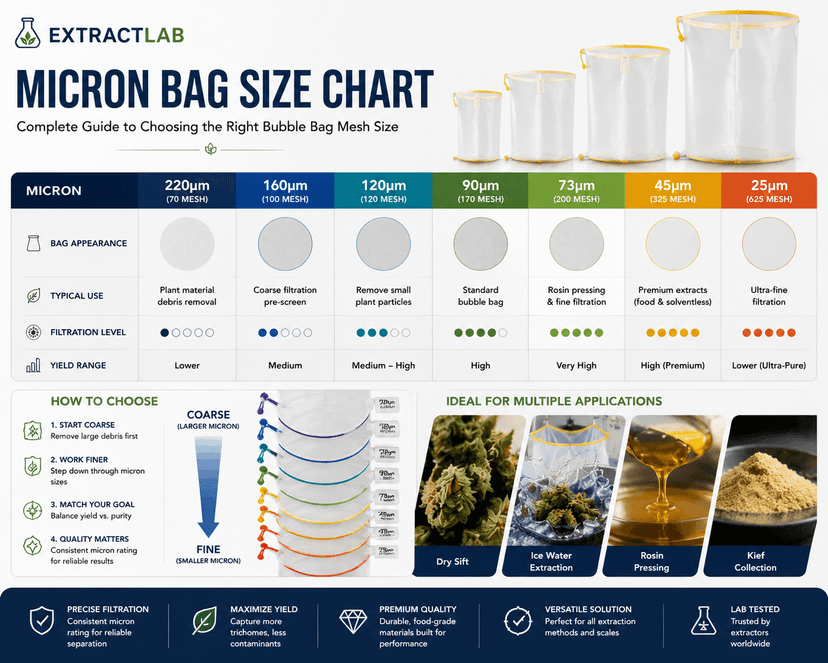
z1Choosing the right screen is usually the first challenge when building a dry sifting setup. A screen that is too coarse may allow unwanted plant particles to pass through, while a screen that is too fine may reduce throughput and make the process unnecessarily slow.
The confusion becomes greater when suppliers describe their screens using different measurements. One product may be listed as 120 micron, another as 120 mesh, and a third as 47T. Although these numbers may look interchangeable, they describe different characteristics of the screen.
This guide explains how mesh count, T count, and micron ratings are related, how to evaluate a three-screen setup, and how to collect sifted botanical material when a glass table is not available.
What Is a Dry Sift Screen?
A dry sift screen is a woven mesh panel used to separate dry botanical material according to particle size. The screen is typically stretched over a rigid frame so that smaller particles can pass through the openings while larger pieces remain above the mesh.
A professional dry sift screen generally consists of four main elements:
- Precision-woven mesh
- A rigid aluminum or wooden frame
- Consistent screen tension
- Secure bonding or fastening around the frame
The actual opening size of the mesh determines what can pass through the screen. This makes the aperture rating more important than the overall dimensions or color of the screen.
For repeatable separation, the screen should maintain a uniform opening size across the entire working area. Uneven tension, damaged threads, or inaccurate mesh can produce inconsistent results from one section of the screen to another.
Mesh Count vs. Micron: What Is the Difference?
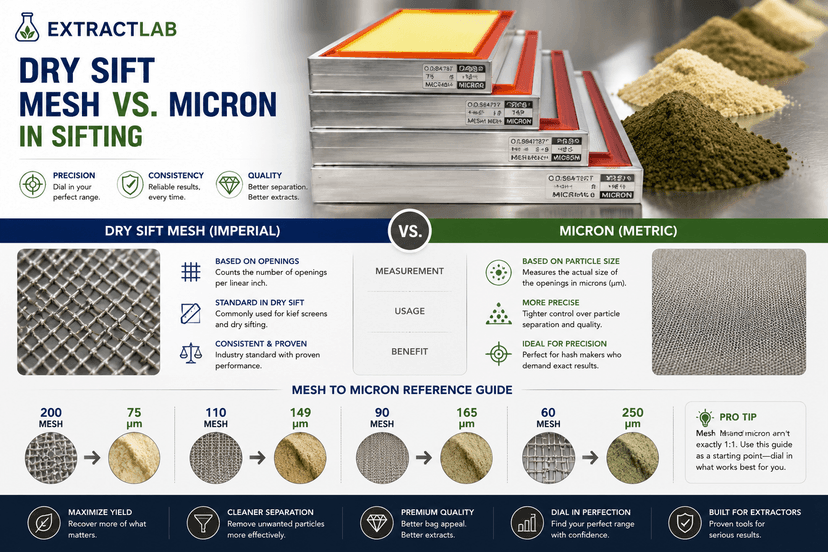
Mesh and micron are both used to describe screens, but they do not measure the same thing.
What Does Micron Mean?
A micron, written as μm, is one-thousandth of a millimeter. When a screen is described as 120 micron, the number should refer to an opening measuring approximately 120 microns across.
Micron is therefore a direct description of the aperture through which particles must pass.
As the micron rating becomes smaller, the screen becomes finer:
- 150 micron has relatively large openings
- 120 micron has medium-sized openings
- 70 micron has smaller openings
- 40 micron has very fine openings
For buyers, micron is usually the clearest specification because it relates directly to the size of the opening.
What Does Mesh Count Mean?
Mesh count usually refers to the number of threads or openings across one linear inch of fabric.
A lower mesh count generally indicates a coarser screen. A higher mesh count generally indicates a finer screen.
However, mesh count alone does not reveal the exact opening size. Two fabrics can have the same mesh count but different apertures if they use different thread diameters.
For example, a screen made with thin threads provides more open space than a screen woven with thicker threads at the same count.
This is why a simple equation such as “120 mesh equals a specific micron rating” is not sufficiently accurate for purchasing precision dry sift screens.
What Does “T” Mean on Screen Mesh?
The letter T is commonly used in the screen-printing and technical textile industries to describe the number of threads per centimeter.
For example:
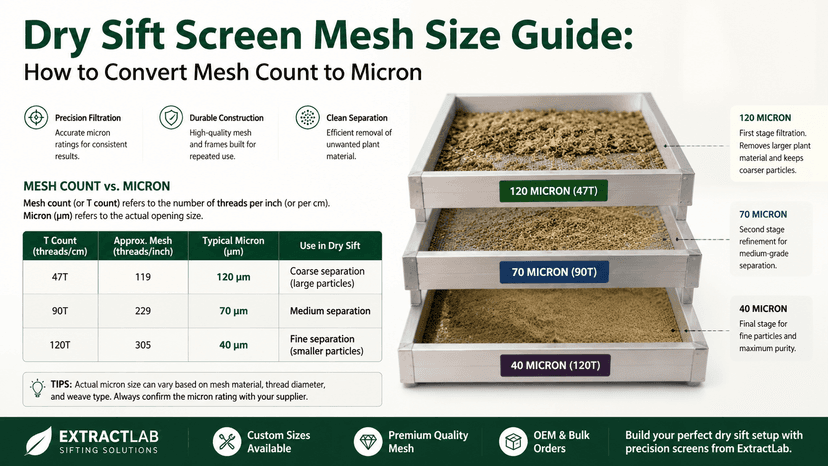
- 47T means approximately 47 threads per centimeter
- 90T means approximately 90 threads per centimeter
- 120T means approximately 120 threads per centimeter
To estimate the equivalent thread count per inch, multiply the T count by 2.54:
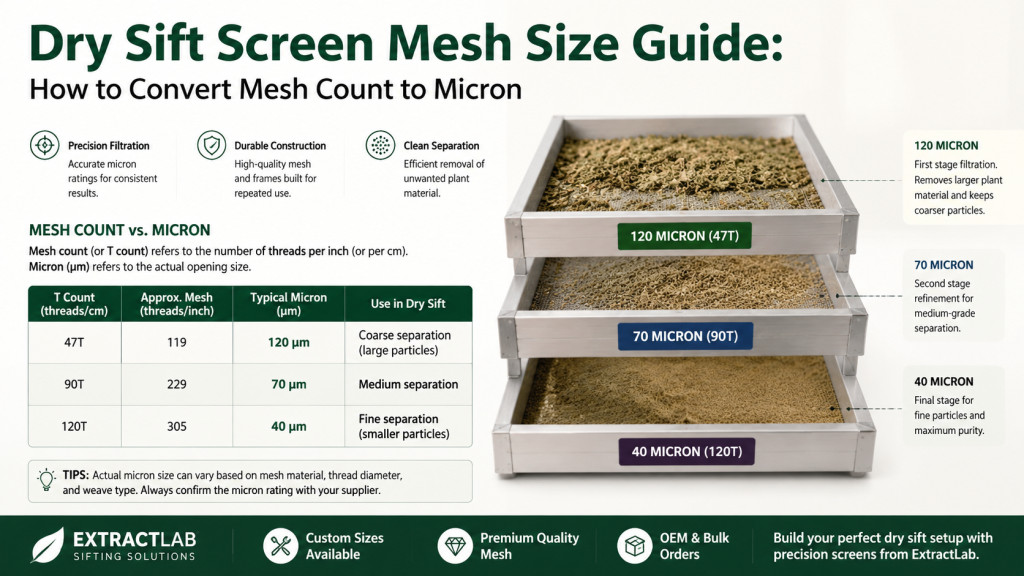
| T Count | Approximate Threads per Inch |
|---|---|
| 47T | 119 threads per inch |
| 90T | 229 threads per inch |
| 120T | 305 threads per inch |
This conversion only tells you the thread count. It does not calculate the open space between the threads.
The actual micron opening still depends on the diameter of the woven filament. Before ordering, ask the supplier for the nominal aperture in microns, thread diameter, open-area percentage, and manufacturing tolerance.
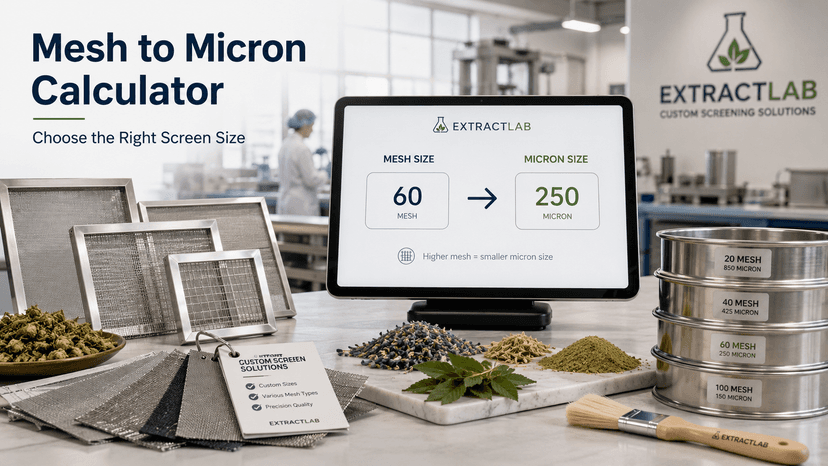
Can Mesh Count Be Converted Directly to Micron?
Mesh count can be used for a rough comparison, but it should not be treated as a precise micron conversion.
A basic theoretical calculation sometimes divides 25,400 microns—the length of one inch—by the number of openings per inch. However, this calculation does not subtract the space occupied by the threads.
A more realistic relationship is:
Approximate aperture = spacing between threads − thread diameter
Because thread diameter varies, there is no universal conversion covering every nylon, polyester, stainless steel, or multifilament screen.
For dry sifting equipment, the safest purchasing process is:
- Select the desired aperture in microns.
- Confirm that the micron value refers to the actual opening, not the particle-retention claim.
- Ask for the mesh or T count as a secondary reference.
- Confirm the filament diameter and open area.
- Request a specification sheet or sample when consistency is critical.
A professional manufacturer should be able to provide these details before production.
Is a 120, 70, and 40 Micron Screen Set a Good Choice?
A proposed shopping list of 120 micron, 70 micron, and 40 micron can form a useful three-stage system. Each screen performs a different function, allowing the material to be separated into progressively finer fractions.
However, the ideal combination depends on the starting material, moisture level, desired throughput, and the particle range you want to retain.
120 Micron Screen: Primary Separation
A 120-micron screen is a practical starting point for many dry botanical separation processes.
Its relatively open structure provides:
- Faster material movement
- Higher throughput
- Reduced risk of immediate clogging
- Efficient removal of larger plant fragments
- A useful first collected fraction
When used as the first working screen, 120 micron helps separate smaller particles without forcing all material directly through a very fine mesh.
For larger batches, this can make the process more efficient and reduce unnecessary loading on the finer screens.
70 Micron Screen: Intermediate Refining
A 70-micron screen creates a finer separation stage. It can be placed after the 120-micron screen to classify material that has already passed through the coarser opening.
This size offers a balance between refinement and workable flow. It may be used to:
- Separate medium-fine particles
- Improve consistency
- Divide the output into more controlled grades
- Reduce the amount of very fine plant dust in the selected fraction
For many users, this becomes the most important screen in a three-screen stack because it creates a meaningful separation between the coarse and fine fractions.
40 Micron Screen: Fine Classification
A 40-micron screen is considerably finer and should normally be treated as a final classification or cleaning screen rather than the first screen in the process.
Its advantages include:
- Fine particle separation
- More selective classification
- Removal of very small dust-like material
- Greater control over the final fraction
The trade-off is lower throughput. Fine screens are more sensitive to overloaded material, moisture, static, and excessive pressure.
If the material is pushed aggressively against a 40-micron mesh, the screen may blind or clog, and unwanted particles may be forced through. Gentle processing is generally more effective than pressing harder.
Should the Three Screens Be Used in a Stack?
The screens can be used individually or as part of a progressive workflow.
A practical sequence is:
Stage 1: Work Over the 120-Micron Screen
Begin with the coarsest screen. This allows smaller particles to pass while keeping larger botanical fragments above the mesh.
Avoid overloading the working area. A thin, even layer usually produces better separation than a deep pile of material.
Stage 2: Refine Through the 70-Micron Screen
Move the material collected below the first screen to the 70-micron screen. This divides the intermediate fraction from the finer material.
At this stage, use lighter movement than on the first screen. The goal is classification, not force.
Stage 3: Finish With the 40-Micron Screen
Use the 40-micron screen to separate the finest fraction or to remove very small particles from the material retained above it.
The exact fraction to keep depends on the botanical material and the objective of the process. It is therefore useful to collect each grade separately, inspect it, and document the results before combining anything.
Do You Need a Glass Table?
A glass table is convenient, but it is not essential.
The main requirement is a smooth, clean, nonporous collection surface that does not shed fibers or hold residue. The surface should also be easy to sanitize and large enough to sit beneath the screen frame.
Suitable alternatives include:
Stainless Steel Collection Tray
A food-grade stainless steel tray is one of the most practical options for repeated use.
It is:
- Durable
- Nonporous
- Easy to clean
- Resistant to scratching under normal handling
- Available in many standard sizes
A shallow stainless tray can also help contain loose particles around the edges.
Tempered Glass Panel
Instead of purchasing a complete glass table, a separate tempered glass panel can be placed on a stable workbench.
The edges should be polished or protected, and the panel must be thick enough for the frame and working pressure. Ordinary thin window glass is not recommended because it may crack or create sharp edges.
Smooth Food-Grade Plastic Tray
A rigid, smooth HDPE or polypropylene tray may be suitable for small-scale trials.
Avoid heavily scratched plastic because particles can remain inside the scratches and make cleaning more difficult.
Removable Collection Plate
A rigid collection plate fitted directly beneath the screen is often more convenient than working over an open table. It allows each fraction to be removed and transferred separately.
For a custom screen system, the collection plate can be manufactured to match the internal dimensions of the frame.
What Surfaces Should Be Avoided?
Avoid collecting directly on:
- Unfinished wood
- Cardboard
- Fabric
- Textured plastic
- Painted surfaces that may flake
- Dirty or scratched workbenches
These surfaces can hold residue, introduce fibers, or make it difficult to recover fine particles cleanly.
How Screen Construction Affects Separation Quality
Micron size is important, but it is not the only specification that determines performance.
Mesh Tension
A properly tensioned screen provides a stable, flat working surface. Loose mesh flexes under movement, reducing control and allowing material to collect in low areas.
Consistent tension also helps the operator use lighter, more even motion.
Thread Diameter
Thread diameter affects open area and mechanical strength.
Thinner threads can provide more open area and easier passage at a given mesh count, but they may be less resistant to rough handling. Thicker threads improve durability but reduce the available opening.
The correct balance depends on frame size, intended workload, and required aperture.
Open Area
Open area is the percentage of the screen surface that consists of apertures rather than threads.
A higher open-area percentage generally supports faster throughput. However, it must be balanced with adequate fabric strength and stable weaving.
Frame Material
Aluminum frames are frequently selected for professional dry sift screens because they are rigid, dimensionally stable, and easy to clean.
Wooden frames may be suitable for occasional use, but they can absorb moisture, change shape, or release fibers if they are not properly sealed and maintained.
Bonding and Edge Sealing
The mesh must be securely fixed to the frame. Poor bonding can allow tension loss, edge lifting, or contamination from loose adhesive.
Commercial screens should have clean, fully sealed edges with no exposed mesh strands in the working area.
Common Mistakes When Buying Dry Sift Screens
Buying by T Count Alone
A listing that says only “90T” does not provide enough information to confirm that the screen has a 70-micron opening.
Always request the actual aperture.
Assuming Every Conversion Chart Is Universal
Conversion charts may refer to stainless steel test sieves, nylon bolting cloth, polyester screen-printing mesh, or another material. These fabrics do not necessarily use the same thread diameter.
Use charts as references, not as substitutes for a manufacturer’s specification sheet.
Starting With an Extremely Fine Screen
Beginning with a 40-micron screen may slow the process and increase clogging. A coarser first stage usually provides better control.
Using Too Much Pressure
Hard scraping or pressing does not necessarily improve separation. It can damage the mesh and force unwanted material through the openings.
Combining Every Fraction Immediately
Keep the material collected from each screen separate until it has been inspected. This makes it easier to evaluate which mesh sizes are producing useful results.
Choosing a Custom Dry Sift Screen Set
Standard screen sets are convenient, but a custom configuration may be more suitable for commercial production, private-label sales, or specialized botanical processing.
At ExtractLab, dry sift screens can be manufactured according to the customer’s required:
- Micron aperture
- Mesh or T count
- Frame dimensions
- Screen depth
- Mesh material
- Frame material
- Screen tension
- Color identification
- Branding and packaging
- Number of screens per set
For buyers considering a 120-, 70-, and 40-micron system, we recommend specifying each product primarily by its verified micron aperture. The corresponding T count should be confirmed after the mesh fabric and filament diameter have been selected.
This prevents confusion when comparing fabrics from different mills or suppliers.
Why Source Dry Sift Screens From ExtractLab?
ExtractLab is a manufacturer and supplier of precision sifting solutions for botanical processors, equipment companies, distributors, and private-label brands.
Our manufacturing capabilities include:
Verified Mesh Specifications
Mesh materials can be selected according to aperture, thread count, filament diameter, and open-area requirements.
Custom Frame Sizes
Screens can be produced for benchtop testing, small-batch processing, or larger commercial workflows.
Multi-Screen Sets
Custom sets can combine coarse, intermediate, and fine screens in a logical sequence.
OEM and Private-Label Support
We support custom logos, packaging, product labeling, and branded screen sets for distributors and established equipment brands.
Production Consistency
Controlled material sourcing, screen tensioning, frame assembly, and final inspection help maintain consistent specifications from batch to batch.
Final Recommendation
A three-screen set consisting of 120 micron, 70 micron, and 40 micron is a reasonable starting configuration for progressive dry botanical separation.
The 120-micron screen provides the primary separation stage, the 70-micron screen refines the intermediate fraction, and the 40-micron screen performs fine classification.
However, do not order the screens based only on the suggested labels of 47T, 90T, and 120T. Those values describe thread density, not guaranteed aperture size. Ask the supplier to confirm the actual micron opening, filament diameter, open area, and tolerance for each fabric.
You also do not need a complete glass table. A smooth stainless steel tray, tempered glass panel, or purpose-built removable collection plate can provide a clean and practical collection surface.
Request a Custom Dry Sift Screen Set
Need help selecting the right mesh progression for your botanical material or processing volume?
ExtractLab manufactures standard and custom dry sift screen sets with verified micron apertures, durable frames, consistent screen tension, and OEM branding options.
Explore our sifting solutions or contact the ExtractLab team with your preferred micron sizes, frame dimensions, order quantity, and application requirements. We can recommend a suitable screen configuration and prepare a custom quotation for your project.