20 Ton Rosin Press: A Commercial Buyer’s Guide to Pressure, Plates and Machine Selection
A 20 ton rosin press is a popular choice for commercial processors that need substantially more pressing force than compact desktop machines while still maintaining a manageable equipment footprint.
With up to approximately 40,000 lb of theoretical pressing force, a 20-ton system can support larger heated platens, higher batch capacities, and more demanding production workflows.
However, tonnage alone does not determine machine performance.
For commercial buyers, distributors, extraction equipment brands, and processing facilities, choosing the right 20 ton rosin press machine requires evaluating platen size, pressure distribution, heating accuracy, hydraulic configuration, frame strength, voltage, production frequency, and customization options.
EXTRACTLAB supplies extraction hardware and works with B2B buyers looking for commercial pressing, filtration, and customized extraction solutions.
This guide explains what to consider before purchasing a 20-ton rosin press and how to compare different machine configurations.
What Is a 20 Ton Rosin Press?
A 20 ton rosin press is a heated pressing machine capable of generating up to 20 tons of force through a hydraulic, pneumatic, electric-hydraulic, or similar pressure system.
Twenty tons is equivalent to approximately:
- 40,000 lb of force
- 17,800 kg-force
- 178 kN of force
This does not mean all 20-ton presses deliver identical performance.
Actual processing conditions depend on:
- Heated platen dimensions
- Effective pressing area
- Hydraulic pressure
- Frame rigidity
- Plate alignment
- Material loading
- Pressure application speed
- Temperature settings
- Pressing time
For this reason, professional buyers should evaluate pressure per unit area, not simply maximum machine tonnage.
Why Choose a 20 Ton Rosin Press?
Twenty-ton machines sit in an attractive middle ground between compact presses and large industrial extraction systems.
They can be suitable for:
- Commercial botanical processing
- Medium- to high-volume production
- Extraction laboratories
- Small production facilities
- Equipment distributors
- OEM extraction equipment brands
- Product development facilities
- Commercial solventless processing workflows
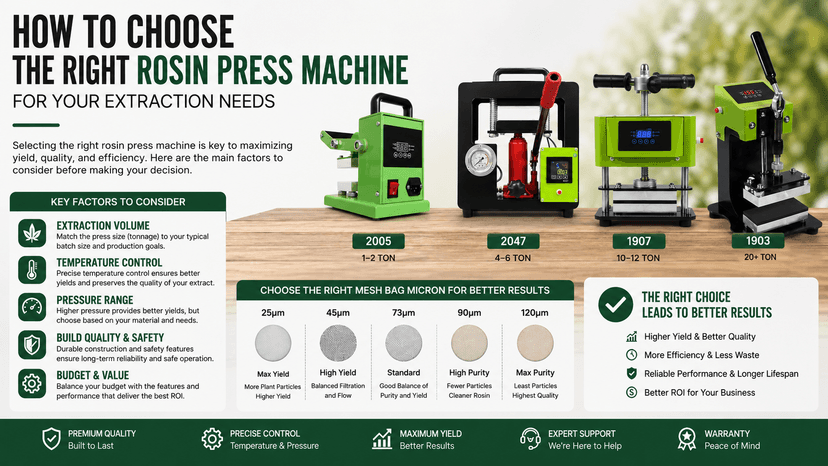
Compared with smaller 4-ton, 6-ton, or 10-ton presses, a 20 ton hydraulic rosin press gives buyers more flexibility to use larger pressing areas while maintaining sufficient available force.
This can be particularly valuable when batch sizes increase.
Is 20 Tons Enough for Commercial Rosin Pressing?
For many commercial workflows, yes.
A 20-ton press can provide enough available force for a wide range of platen sizes and batch configurations.
However, the correct answer depends on plate area.
For example, consider two different 20-ton machines:
| Machine | Platen Size | Maximum Force |
|---|---|---|
| Press A | 3 × 5 in | 20 ton |
| Press B | 6 × 10 in | 20 ton |
Although both machines have the same maximum tonnage, Press B spreads that force across a much larger area.
This means the potential pressure at the material surface can be very different.
That is why buyers should avoid asking only:
“How many tons is the press?”
A better question is:
“What pressure will the machine deliver over my intended pressing area?”
20 Ton Hydraulic Rosin Press
The 20 ton hydraulic rosin press is one of the most common configurations in this capacity range.
Hydraulic systems can deliver strong pressing force while maintaining relatively simple mechanical construction.
A hydraulic press may use:
- Manual hand pump
- Bottle jack
- External hydraulic pump
- Electric hydraulic pump
- Integrated powered hydraulic system
Each configuration has advantages.
Manual Hydraulic System
A manual hydraulic system is typically simpler and less expensive.
Advantages may include:
- No air compressor required
- Straightforward maintenance
- Good pressure control
- Lower system complexity
- Suitable for intermittent commercial operation
The main limitation is operator workload.
If dozens or hundreds of cycles must be completed every day, manual pumping can reduce production efficiency.
Electric Hydraulic System
An electric hydraulic pump reduces manual work and can make the pressing cycle more consistent.
It may be better suited to:
- Frequent daily operation
- Commercial production
- Higher throughput requirements
- Reduced operator fatigue
- Repeatable production workflows
For B2B equipment sourcing, buyers should clarify whether the pump is included with the press or supplied separately.
20 Ton Pneumatic Rosin Press
A pneumatic 20-ton press uses compressed air to drive the pressing system.
This configuration can be attractive for commercial facilities that already operate an industrial air supply.
Advantages can include:
- Fast operation
- Reduced manual labor
- Repeatable cycle control
- Easier workflow standardization
- Good suitability for frequent production
However, the press may require a suitable compressor.
Before purchasing, confirm:
- Required air pressure
- Compressor capacity
- Air consumption
- Maximum operating pressure
- Cycle rate
- Connection specifications
If compressed air is not already available, the cost and footprint of the compressor should be included in equipment planning.
Electric 20 Ton Rosin Press
A fully or partially electric 20 ton rosin press machine can further reduce operator involvement.
Depending on the design, electric operation may control:
- Press movement
- Hydraulic pump
- Pressure
- Heating
- Timer
- Cycle settings
Higher-end commercial machines may also include touchscreen interfaces or programmable operating parameters.
An electric system is often worth considering when repeatability and workflow efficiency are more important than minimizing initial equipment cost.
Heated Plate Size for a 20 Ton Rosin Press
Heated platen size is one of the most important specifications.
Common commercial plate dimensions can include:
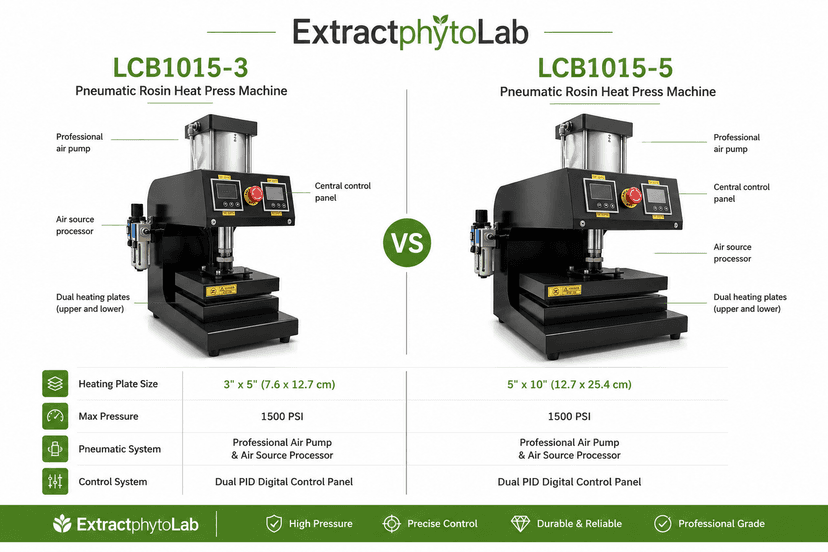
- 3 × 5 in
- 3 × 8 in
- 4 × 7 in
- 4 × 10 in
- 5 × 7 in
- 6 × 10 in
- Custom sizes
There is no universally correct plate size.
The right dimensions depend on:
- Batch size
- Bag dimensions
- Material loading
- Pressing method
- Production goals
- Required pressure
- Machine frame design
Bigger Plates Are Not Always Better
It is tempting to choose the largest possible platen.
However, increasing platen area means the same 20 tons of force must be distributed over a larger surface.
For example:
A 3 × 5 inch plate has:
15 square inches of surface area
A 6 × 10 inch plate has:
60 square inches of surface area
That is four times the surface area.
The same maximum pressing force therefore produces very different theoretical pressure levels.
Commercial buyers should match plate size to actual batch requirements rather than automatically selecting the largest platen available.
Why Platen Pressure Matters More Than Tonnage
Maximum tonnage is useful for comparing machine capacity, but process performance is more closely related to pressure over the actual material area.
A simplified calculation is:
PSI = Applied Force ÷ Pressing Area
For example, if 20 tons represents approximately 40,000 lb of available force:
If the effective pressing area is 20 square inches:
40,000 ÷ 20 = 2,000 PSI
If the effective pressing area is 40 square inches:
40,000 ÷ 40 = 1,000 PSI
These calculations are theoretical and do not account for mechanical losses, actual hydraulic pressure, loading conditions, or machine design.
They do show why platen size and material area matter.
This is an important question to discuss with a 20 ton rosin press manufacturer before selecting a machine.
Dual Heated Plates
Most professional rosin presses use both an upper and lower heated platen.
Dual heating helps expose the material to controlled temperature from both directions.
Commercial buyers should evaluate:
- Heater layout
- Number of heating elements
- Plate material
- Temperature sensor placement
- Plate insulation
- Controller accuracy
- Heating uniformity
Aluminum is commonly used for heated platens because it offers good thermal conductivity and manageable weight.
However, plate design and heater placement are just as important as the material itself.
Temperature Control
Stable temperature is essential for repeatable processing.
A commercial press may use:
- Single controller
- Dual digital controllers
- PID controllers
- Independent upper/lower temperature zones
- Multi-zone control systems
A dual PID system can allow the upper and lower platens to be monitored independently.
When comparing machines, ask about:
- Temperature range
- Temperature accuracy
- Heating time
- Sensor type
- Temperature variation across the plate
- Controller type
- Replacement controller availability
A digital display alone does not guarantee even heating.
The key issue is how closely actual platen temperature matches the selected value across the usable surface.
Pressure Gauge
A pressure gauge can make a 20-ton press easier to operate consistently.
Without a gauge, operators may know the machine’s maximum capacity but have limited feedback about actual hydraulic pressure during each cycle.
A pressure gauge can help with:
- Repeatable settings
- Operator training
- Process documentation
- Batch consistency
- Pressure comparison
For commercial use, pressure feedback is generally more valuable than simply knowing the theoretical maximum tonnage.
Frame Strength and Alignment
A 20-ton machine generates substantial mechanical force.
The frame therefore needs sufficient rigidity to maintain alignment during operation.
Buyers should evaluate:
- Steel frame thickness
- Reinforcement
- Welding quality
- Cylinder mounting
- Platen mounting
- Base stability
- Structural deflection
- Overall machine weight
If the frame flexes excessively under load, plate alignment can change.
This may result in uneven pressure distribution.
For B2B sourcing, ask the supplier for:
- Actual machine photographs
- Welding details
- Frame dimensions
- Material thickness
- Operating videos
- Load testing information
These details are more useful than relying only on promotional images.
20 Ton Rosin Press for Commercial Production
A commercial machine should be evaluated differently from equipment used only occasionally.
Important considerations include:
Duty Cycle
How many pressing cycles will the machine complete per hour or per day?
Heat Recovery
How quickly do the plates return to the target temperature after each cycle?
Operator Workload
Will each cycle require manual pumping, or can the system operate using electric or pneumatic assistance?
Maintenance
Can heating elements, sensors, pumps, seals, gauges, and controllers be replaced?
Repeatability
Can different operators reproduce similar pressure, temperature, and timing?
Production Expansion
Can the machine configuration support future increases in production?
These factors are often more important to commercial buyers than initial machine price.
20 Ton vs. 10 Ton Rosin Press
A 10-ton press may be sufficient for small batches or smaller platen areas.
A 20-ton press provides more available force and can support larger pressing configurations.
| Feature | 10 Ton Press | 20 Ton Press |
| Maximum theoretical force | Approx. 20,000 lb | Approx. 40,000 lb |
| Typical use | Small/light commercial | Commercial |
| Large platen compatibility | More limited | Greater flexibility |
| Machine size | Usually smaller | Usually larger |
| Hydraulic requirements | Lower | Higher |
| Production flexibility | Moderate | Higher |
A 20-ton machine is not automatically better.
If the actual material requires relatively low pressure and small plates, a 10-ton system may be more economical.
20 Ton vs. 30 Ton Rosin Press
Moving from 20 tons to 30 tons increases available pressing force by approximately 50%.
A 30-ton machine may be useful when:
- Larger platens are required
- Larger batches are processed
- Higher pressure is necessary
- Industrial production is planned
However, higher tonnage usually means:
- Larger frame
- Higher cost
- Greater machine weight
- Larger hydraulic components
For many medium commercial operations, 20 tons can provide a practical balance between capacity and equipment size.
20 Ton Rosin Press Voltage Options
Commercial presses may be offered in different electrical configurations.
Typical requirements include:
- 110V / 120V
- 220V / 230V
- 50 Hz
- 60 Hz
Electrical specifications affect:
- Heating elements
- Controllers
- Plugs
- Wiring
- Power consumption
International buyers should always provide the destination country when requesting a quotation.
Do not assume a standard machine can simply be plugged into any electrical system.
What Should You Look for in a 20 Ton Rosin Press Manufacturer?
For B2B buyers, supplier capability matters almost as much as the machine itself.
Manufacturing Capability
Confirm whether the supplier can manufacture or customize:
- Press frames
- Heated plates
- Hydraulic systems
- Control boxes
- Electrical components
- Machine housings
Customization
Commercial buyers may require:
- Custom plate sizes
- Different voltages
- Custom colors
- OEM logo
- Private-label packaging
- Different hydraulic pumps
- Additional pressure gauges
- Modified frames
- Custom accessories
Quality Control
Before shipment, the machine should be checked for:
- Heating operation
- Plate alignment
- Temperature control
- Pressure operation
- Hydraulic leakage
- Electrical function
- Frame condition
- Controller function
Spare Parts
Ask whether replacement parts are available for:
- Heating elements
- Temperature sensors
- PID controllers
- Pressure gauges
- Hydraulic components
- Switches
- Power supplies
This is particularly important for distributors and repeat commercial buyers.
OEM and Custom 20 Ton Rosin Press Manufacturing
Not every buyer needs an off-the-shelf machine.
Distributors, extraction brands, and equipment suppliers may want a custom 20 ton rosin press produced around their own requirements.
Possible OEM options can include:
- Custom logo
- Private labeling
- Machine color
- Control panel design
- Custom platen dimensions
- Voltage configuration
- Pump selection
- Packaging
- Instruction manuals
- Accessories
EXTRACTLAB works with buyers who need extraction hardware configured around commercial and OEM requirements.
For custom projects, provide technical specifications before quotation.
What Information Should You Send for a Quote?
To receive a useful quotation for a 20 ton rosin press, provide:
Plate Size
For example:
- 3 × 5 inch
- 4 × 7 inch
- 6 × 10 inch
- Custom dimensions
Pressure System
Choose or specify:
- Manual hydraulic
- Electric hydraulic
- Pneumatic
- Automatic
Voltage
Provide:
- 110V
- 220V
- Other requirement
Also include frequency and destination market.
Batch Size
Explain the approximate amount or pressing area required per cycle.
Production Frequency
For example:
- Occasional use
- Several cycles per day
- Continuous commercial production
Quantity
Specify whether you require:
- One machine
- Trial order
- Wholesale order
- Distributor order
- OEM production
Customization
Include any requirements for:
- Branding
- Packaging
- Color
- Controls
- Plate dimensions
- Pump configuration
More detailed RFQ information usually leads to a more accurate equipment recommendation.
Accessories for a 20 Ton Rosin Press
Commercial pressing often requires more than the machine itself.
Depending on the workflow, buyers may also need:
- Rosin filter bags
- Filter mesh
- Pre-press molds
- Pressing frames
- Parchment
- Collection tools
- Heat-resistant accessories
- Replacement heaters
- Pressure system components
EXTRACTLAB supplies filtration and extraction hardware that can be integrated into commercial pressing workflows.
Matching the press, filter bag dimensions, mesh specification, and pre-press format can simplify equipment setup and procurement.
Frequently Asked Questions About 20 Ton Rosin Presses
How much force does a 20 ton rosin press produce?
A 20-ton press has a theoretical maximum force of approximately 40,000 lb, or roughly 178 kN.
Actual usable pressure depends on hydraulic configuration, platen size, pressing area, and machine design.
Is a 20 ton rosin press good for commercial use?
Yes. Twenty-ton presses are commonly suitable for medium commercial applications because they provide substantial available force without requiring the size of much larger industrial presses.
The correct machine still depends on production volume and platen area.
What size plates should a 20 ton press use?
There is no single correct size.
Common configurations can range from approximately 3 × 5 inches to larger commercial plate sizes.
Larger plates increase pressing area but reduce the available force per square inch when the same total force is applied.
Hydraulic or pneumatic: which is better?
Hydraulic machines are generally straightforward and can provide strong, controllable pressure.
Pneumatic machines can reduce manual labor and improve workflow speed if a suitable air supply is available.
Commercial users should choose according to production frequency and facility infrastructure.
Does a 20 ton rosin press need a pressure gauge?
A machine can operate without one, but a pressure gauge is useful for process repeatability.
Commercial processors may benefit from having measurable pressure feedback instead of relying solely on operator feel.
Can EXTRACTLAB customize a 20 ton rosin press?
Custom projects can be evaluated according to required plate dimensions, pressure system, voltage, machine design, order quantity, branding, and packaging specifications.
Send your requirements to EXTRACTLAB for project evaluation.
Is 20 tons better than 12 tons?
Not necessarily.
A 20-ton machine provides greater available force, but the required tonnage depends on the actual pressing area and workflow.
A smaller machine may be sufficient for smaller batches.
Source a 20 Ton Rosin Press From EXTRACTLAB
A 20 ton rosin press can provide an effective balance of pressing force, platen flexibility, and commercial production capability.
However, the best machine should not be selected based on tonnage alone.
Before purchasing, evaluate:
- Effective pressing area
- Heated plate dimensions
- Hydraulic or pneumatic system
- Pressure monitoring
- Temperature stability
- Frame construction
- Voltage
- Production frequency
- Maintenance requirements
- OEM customization
EXTRACTLAB supplies extraction hardware for B2B, commercial, wholesale, and customized processing applications.
If you are sourcing a 20 ton hydraulic rosin press, commercial heat press, custom pressing system, or related filtration equipment, provide your technical requirements for factory evaluation.
For a more accurate quotation, include your required platen dimensions, pressure system, voltage, destination market, quantity, production requirements, and customization needs.
Contact EXTRACTLAB to discuss your 20 ton rosin press project and request a factory quotation.