Choosing the right rosin press manufacturer is an important decision for commercial extractors, equipment distributors, processing facilities, and private-label brands.
A rosin press is not simply a heated machine with a pressure rating. For commercial use, buyers need to consider pressing force, heated platen size, temperature stability, frame construction, operating method, production frequency, electrical requirements, maintenance, and customization options.
EXTRACTLAB supplies extraction hardware for commercial and custom processing workflows, including rosin press equipment, filtration components, extraction bags, frames, and related hardware. For buyers sourcing a complete pressing solution, the goal should be to select equipment that matches actual production requirements rather than purchasing only on the basis of tonnage or price.
What Does a Rosin Press Manufacturer Provide?
A professional rosin press manufacturer produces heated pressing equipment designed to apply controlled heat and pressure to botanical materials.
A typical rosin press includes:
- A reinforced steel frame
- Upper and lower heated platens
- Heating elements
- Temperature controllers
- A hydraulic, pneumatic, electric, or manual pressing system
- Pressure adjustment components
- Timers or operating controls
- Electrical and safety components
Although most presses use the same basic combination of heat and pressure, machine performance can vary significantly.
For commercial buyers, the most important factors usually include:
- Stable pressing force
- Consistent platen temperature
- Parallel plate movement
- Reliable temperature control
- Strong frame construction
- Repeatable operating cycles
- Easy maintenance
- Appropriate production capacity
This is why working directly with an experienced rosin press machine manufacturer can be especially valuable when a standard retail press does not meet production requirements.
Types of Rosin Press Machines
Different pressing systems are suitable for different production environments.
Manual Rosin Press
A manual rosin press uses hand-operated force to close the heated plates.
Manual machines are generally:
- Compact
- Simple to operate
- Easy to maintain
- Suitable for low-volume processing
- Useful for sampling and product development
They can be a practical option for smaller production environments where operators do not need to complete large numbers of press cycles each day.
For continuous commercial production, however, manual operation may become inefficient.
Hydraulic Rosin Press
A hydraulic rosin press uses a hydraulic cylinder or jack to generate pressing force.
Hydraulic systems are commonly used for commercial extraction because they can provide substantial force with relatively straightforward mechanical construction.
Depending on the design, a hydraulic press may be manually pumped or powered by an electric hydraulic system.
Hydraulic presses are commonly selected for:
- Larger batches
- Higher pressing force
- Larger heated platens
- Commercial production
- Repeated processing cycles
- Custom extraction workflows
Common machine ratings can include:
- 5 ton
- 10 ton
- 20 ton
- 30 ton
- 50 ton or higher
However, tonnage should never be evaluated alone.
A 20-ton press with a small platen creates a different pressure profile from a 20-ton machine using a much larger platen.
For this reason, EXTRACTLAB recommends evaluating pressing force together with platen area, batch size, material configuration, and production frequency.
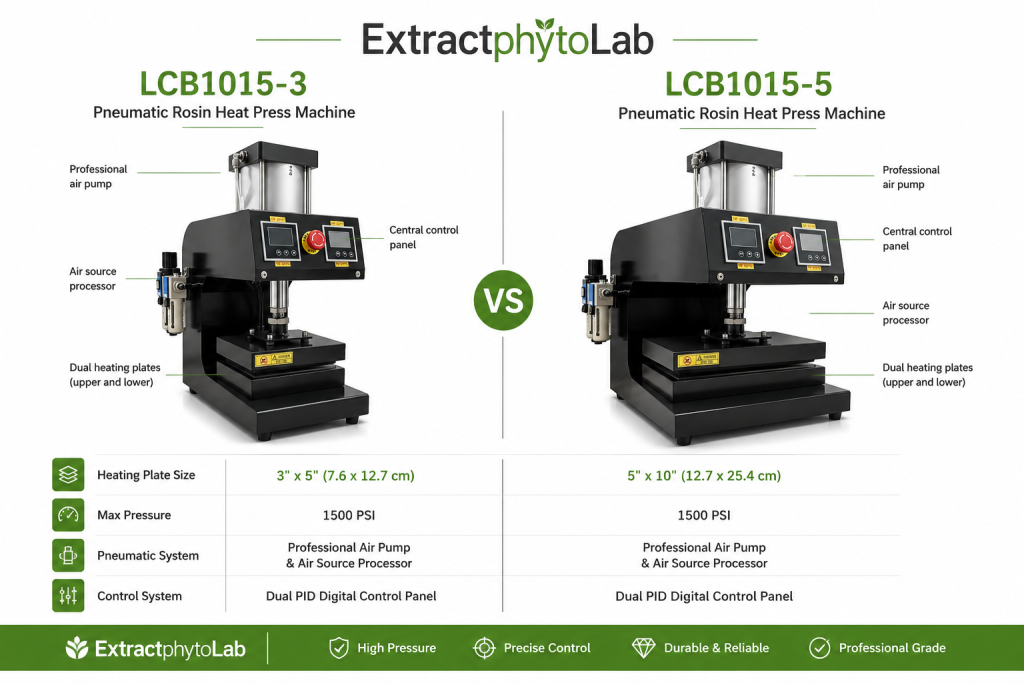
Pneumatic Rosin Press
A pneumatic rosin press uses compressed air to operate the pressing mechanism.
This type of equipment can be suitable for production environments where operators need consistent and repeatable pressing cycles.
Potential advantages include:
- Reduced manual labor
- Faster operation
- Consistent plate movement
- Repeatable press cycles
- Easier integration into commercial workflows
Before purchasing a pneumatic press, buyers should confirm:
- Required air pressure
- Air consumption
- Compressor requirements
- Maximum pressing force
- Cycle frequency
Pneumatic systems can be particularly useful for facilities that already operate compressed-air equipment.
Electric Rosin Press
An electric rosin press uses an electrically powered drive or hydraulic system to reduce manual operation.
Depending on the configuration, electric presses may control:
- Plate movement
- Pressure
- Heating
- Timing
- Operating cycles
Commercial buyers often choose electric equipment when they want:
- Easier operation
- Reduced operator fatigue
- More consistent cycles
- Digital controls
- Cleaner production-line integration
When comparing electric rosin presses, buyers should also evaluate electrical standards, motor specifications, control components, replacement parts, and serviceability.
Commercial Rosin Press vs. Small Desktop Press
A commercial rosin press is designed for a different working environment than a small desktop machine.
Desktop presses can be useful for occasional pressing, product testing, or small batches.
Commercial equipment should be evaluated for:
- Daily operating frequency
- Duty cycle
- Frame rigidity
- Pressure repeatability
- Heating recovery
- Temperature stability
- Batch size
- Operator efficiency
- Maintenance access
- Component durability
For businesses that operate equipment throughout the day, reliability and repeatability can have a greater effect on operating cost than the initial purchase price.
A low-cost machine that requires frequent adjustment, reheating, or maintenance can quickly become more expensive in a commercial environment.
Important Rosin Press Specifications
Before requesting a quotation, buyers should understand the main technical specifications used to compare machines.
Pressing Force
Press capacity is commonly expressed in tons.
Typical equipment categories may include:
| Press Capacity | Typical Application |
|---|---|
| 1–5 ton | Small-batch or testing applications |
| 6–10 ton | Light commercial processing |
| 10–20 ton | Medium commercial production |
| 20–50 ton | Higher-volume commercial processing |
| 50+ ton | Industrial or custom applications |
These categories are only general references.
The correct machine size depends on:
- Heated platen dimensions
- Batch size
- Material quantity
- Desired pressure
- Production frequency
- Pressing workflow
A professional commercial rosin press manufacturer should ask about these details before recommending a machine.
Heated Platen Size
The size of the heated plates determines the available pressing area.
When evaluating a rosin press, buyers should consider:
- Platen width
- Platen length
- Plate thickness
- Maximum opening
- Heating element layout
- Surface flatness
- Temperature uniformity
- Plate alignment
Larger plates can increase processing area, but size alone does not guarantee better performance.
Uneven heating can create different processing conditions between the center and edges of the platen.
For commercial extraction, temperature consistency across the pressing surface is an important factor.
Temperature Control
Accurate temperature control helps maintain repeatable processing conditions.
A commercial press may use separate temperature controllers for the upper and lower plates.
Buyers should ask about:
- Temperature range
- Temperature accuracy
- Heating time
- Sensor type
- Upper and lower plate control
- Temperature deviation
- Celsius and Fahrenheit settings
- Controller replacement options
If the machine will be used for repeated production batches, temperature stability becomes especially important.
Pressure Control
Maximum tonnage does not tell buyers how easy it is to reproduce the same pressing conditions.
Depending on the machine, pressure may be adjusted or monitored through:
- Hydraulic gauges
- Pressure regulators
- Mechanical settings
- Digital displays
- Programmable control systems
For commercial workflows, repeatability can be more important than simply having the highest available pressure.
When requesting a quote, buyers should explain how often the machine will operate and how much process consistency is required.
Frame Construction
The press frame must remain stable while force is applied.
Important structural considerations include:
- Steel thickness
- Frame reinforcement
- Welding quality
- Cylinder mounting
- Platen support
- Base stability
- Surface treatment
- Machine weight
Frame deformation can affect plate alignment and pressure distribution.
This becomes increasingly important as machine capacity and platen dimensions increase.
Commercial buyers should request actual production photos, machine videos, and structural specifications when evaluating a supplier.
How to Choose a Rosin Press Manufacturer
Machine specifications are only part of the purchasing decision.
B2B buyers should also evaluate the supplier’s manufacturing, customization, quality-control, and technical-support capabilities.
1. Confirm Manufacturing Capability
Before ordering, determine whether the supplier is an actual manufacturer, equipment assembler, trading company, or retailer.
Working directly with a manufacturer can provide more flexibility for:
- Custom platen sizes
- Pressure configurations
- Electrical standards
- Machine dimensions
- Branding
- Packaging
- Accessories
- Spare parts
- OEM orders
EXTRACTLAB focuses on supplying extraction hardware for buyers that require practical product specifications and factory quotation support.
For custom projects, buyers should provide as much technical information as possible during the initial inquiry.
2. Evaluate Customization Options
Commercial processing requirements vary widely.
A standard machine may be suitable for some buyers, while others need modified equipment.
Common customization requirements include:
- Custom platen dimensions
- Different press capacities
- Hydraulic or pneumatic configurations
- Electric operating systems
- 110 V or 220 V electrical options
- Custom control panels
- Machine colors
- Private-label branding
- Logo plates
- Custom packaging
- Accessories
- Plug specifications
For distributors and equipment brands, customization may also include OEM labeling and packaging.
A reliable custom rosin press manufacturer should clearly explain which specifications can be modified and whether engineering changes require minimum order quantities.
3. Review Quality Control Procedures
A rosin press combines mechanical, electrical, heating, and pressure components.
Quality inspection should therefore cover multiple areas.
Typical checks may include:
- Frame condition
- Welding quality
- Fastener installation
- Platen alignment
- Heating performance
- Temperature controller operation
- Pressure system function
- Electrical wiring
- Switch operation
- Surface finish
- Trial pressing
- Packaging inspection
For larger orders, buyers can also define their own inspection criteria before production begins.
4. Confirm Electrical Requirements
Electrical specifications vary between destination markets.
Before production, buyers should confirm:
- Voltage
- Frequency
- Plug type
- Rated power
- Controller requirements
- Destination country
A machine intended for the United States may require a different electrical setup from equipment shipped to Europe, Australia, or other markets.
Providing this information early helps avoid modifications after shipment.
5. Ask About Spare Parts
Commercial equipment should be maintainable.
Before placing an order, ask whether the manufacturer can provide replacement:
- Heating elements
- Temperature sensors
- Controllers
- Switches
- Hydraulic components
- Pneumatic components
- Pressure gauges
- Electrical parts
For distributors, spare-parts availability is especially important because customers may expect local after-sales support.
OEM Rosin Press Manufacturing
Distributors and equipment brands may want to sell presses under their own brand rather than the factory’s standard branding.
In this case, working with an OEM rosin press manufacturer can provide more flexibility.
OEM projects may include:
- Custom logos
- Product labels
- Machine colors
- Packaging
- Instruction manuals
- Platen dimensions
- Control panel layouts
- Electrical configurations
- Accessories
- Branding elements
For more advanced projects, buyers may also request modifications to the machine structure or pressing system.
When discussing an OEM order with EXTRACTLAB, it is useful to provide:
- Target market
- Estimated annual quantity
- Preferred machine type
- Required tonnage
- Platen dimensions
- Voltage
- Branding requirements
- Packaging requirements
This information helps determine whether the project can use an existing machine platform or requires a customized configuration.
Rosin Press Equipment for Commercial Extraction Workflows
A rosin press is only one part of the extraction workflow.
Commercial processing may also require:
- Rosin filter bags
- Extraction filter mesh
- Pressing frames
- Pre-press molds
- Collection tools
- Heat-resistant accessories
- Custom filtration products
- Packaging components
EXTRACTLAB supplies extraction hardware and filtration products that can be matched to different pressing workflows.
For buyers developing or expanding a production line, sourcing compatible equipment and filtration components from the same supplier can simplify product selection and factory communication.
What Information Should You Send for a Rosin Press Quote?
A detailed inquiry helps manufacturers provide a more accurate recommendation and quotation.
Instead of sending only:
“Please send rosin press price.”
provide the following information whenever possible.
Press Capacity
If you already know the required tonnage, specify it.
For example:
- 10 ton
- 20 ton
- 30 ton
- 50 ton
If you are unsure, provide your batch size and production requirements.
Heated Plate Size
Specify the preferred heated platen dimensions.
For example:
- 3 × 5 inch
- 4 × 7 inch
- 5 × 7 inch
- Custom size
Plate dimensions can affect both required pressure and production capacity.
Operating System
Specify whether you prefer:
- Manual
- Hydraulic
- Pneumatic
- Electric
If you are uncertain, explain your operating frequency and available utilities.
Production Volume
Describe your expected workload.
For example:
- Product testing
- Small-batch production
- Daily commercial processing
- Continuous industrial production
This helps determine the appropriate duty level.
Electrical Requirements
Provide:
- Destination country
- Voltage
- Frequency
- Plug requirements
Order Quantity
Specify whether you need:
- One evaluation unit
- Small wholesale order
- Distributor order
- OEM production
- Repeated bulk orders
Custom Requirements
List any special requirements such as:
- Logo
- Machine color
- Custom packaging
- Private label
- Custom plates
- Control panel design
- Accessories
The more complete the inquiry, the easier it is to recommend the correct configuration.
Why B2B Buyers Work Directly With Rosin Press Manufacturers
For commercial buyers, working directly with a factory can provide advantages that are difficult to obtain from a retail seller.
These may include:
Better Specification Control
Buyers can discuss pressure, plate dimensions, electrical configuration, and accessories directly with the supplier.
Custom Manufacturing
OEM and customized equipment can be developed around specific market or production requirements.
Wholesale Pricing
Distributors and bulk buyers can request factory quotations based on actual quantities.
Easier Product Matching
Manufacturers can recommend equipment based on batch size and intended use instead of only presenting standard retail models.
Better Support for Repeat Orders
A long-term supplier can maintain product specifications, packaging requirements, and branding for future orders.
For distributors and commercial processors, these factors are often more important than finding the lowest single-unit price.
Rosin Press Manufacturer FAQ
What is a rosin press manufacturer?
A rosin press manufacturer produces heated pressing machines designed to apply controlled pressure and temperature during botanical extraction or processing.
Manufacturers may offer manual, hydraulic, pneumatic, electric, commercial, and customized press systems.
What type of rosin press is best for commercial use?
The best machine depends on production volume, batch size, required pressure, platen dimensions, and operating frequency.
Hydraulic presses are commonly used for commercial production, while pneumatic and electric machines may be preferred when operators require faster and more repeatable cycles.
What tonnage should I choose?
Do not select tonnage alone.
The correct capacity depends on platen area, batch size, desired pressure, and process conditions.
A 20-ton rosin press may be suitable for many commercial workflows, but some applications require less pressure while others require substantially more.
Can EXTRACTLAB supply custom rosin presses?
Custom requirements can be evaluated according to machine configuration, quantity, plate size, operating system, electrical specifications, branding, and packaging needs.
Buyers should provide detailed project specifications when requesting a quotation.
Can a rosin press be private labeled?
OEM and private-label options may include logos, labels, machine colors, manuals, packaging, and other branding elements depending on the order requirements.
What information is needed for a quotation?
For a faster quotation, provide:
- Required tonnage
- Heated platen size
- Preferred operating system
- Voltage
- Destination country
- Order quantity
- Production requirements
- Customization requirements
Does EXTRACTLAB supply other extraction hardware?
EXTRACTLAB supplies extraction hardware and filtration products for commercial processing workflows, including filter bags, mesh products, frames, pressing accessories, and customized filtration components.
Work With EXTRACTLAB on Your Rosin Press Project
Choosing the right rosin press manufacturer requires more than comparing machine prices.
Commercial buyers should evaluate:
- Pressing capacity
- Heated platen size
- Temperature stability
- Pressure repeatability
- Frame strength
- Operating system
- Electrical requirements
- Customization
- Spare parts
- OEM capabilities
EXTRACTLAB supports B2B buyers, distributors, and commercial processing customers with extraction hardware and custom sourcing solutions.
If you are sourcing a commercial rosin press, hydraulic rosin press, custom rosin press machine, or OEM extraction equipment, send your technical requirements to EXTRACTLAB for evaluation.
For the most accurate recommendation, include your preferred tonnage, platen size, voltage, destination country, production volume, order quantity, and customization requirements.
Contact EXTRACTLAB to discuss your commercial rosin press requirements and request a factory quotation.