A 1 ton rosin press is a compact heated pressing machine designed for users who need controlled pressure and temperature without the size, weight, and cost of larger hydraulic systems.
With approximately 2,000 lb of maximum theoretical pressing force, a 1-ton press is generally positioned for small batches, product testing, low-volume processing, laboratories, specialty production, and users who prioritize portability.
However, maximum tonnage is only one part of the specification.
When comparing a 1 ton rosin press machine, buyers should also evaluate heated plate size, temperature stability, pressure mechanism, frame construction, electrical requirements, cycle frequency, and actual pressing area.
This EXTRACTPHYTO guide explains the main specifications buyers should consider before selecting a compact 1-ton pressing system.
What Is a 1 Ton Rosin Press?
A 1 ton rosin press is a heated press capable of applying approximately one ton of maximum mechanical force.
One ton of force is approximately:
- 2,000 lb
- 907 kg-force
- 8.9 kN
The machine normally combines controlled heat with mechanical pressure.
Typical components include:
- Upper and lower heated plates
- Steel press frame
- Manual, electric, or hydraulic pressing mechanism
- Temperature controller
- Timer
- Heating elements
- Electrical controls
- Pressure-adjustment components
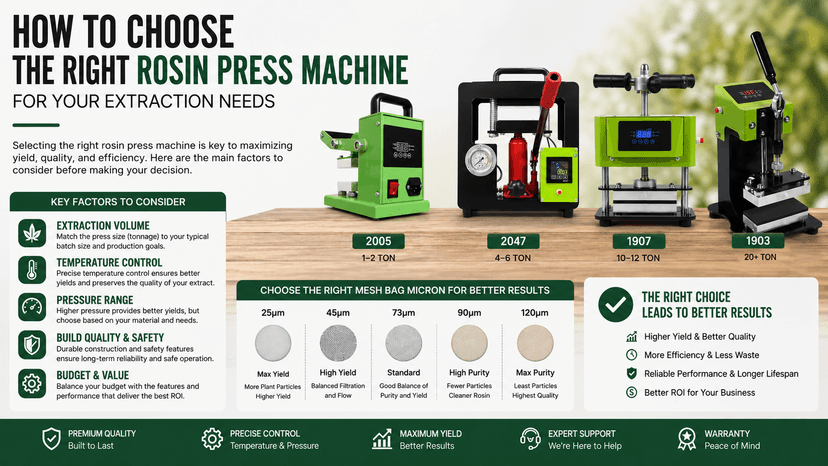
Compact 1-ton presses are generally significantly smaller than 10-ton, 20-ton, or industrial hydraulic machines.
This makes them particularly useful when production volume is limited or workspace is restricted.
Who Is a 1 Ton Rosin Press Designed For?
A 1-ton machine is normally most suitable for small-scale applications.
Typical users may include:
- Product development laboratories
- Small workshops
- Research applications
- Small-batch processors
- Specialty manufacturers
- Equipment distributors
- Training facilities
- Users evaluating a new pressing process
A 1-ton machine is generally not intended to replace a high-capacity commercial hydraulic press.
The advantage is instead its combination of compact dimensions, relatively simple operation, and sufficient force for smaller pressing areas.
Is 1 Ton Enough Pressure?
For small pressing areas, one ton can provide substantial pressure.
But the answer depends on the size of the material being pressed.
The basic relationship is:
Pressure = Force ÷ Area
A machine rated at 2,000 lb of force produces very different pressure depending on the effective pressing area.
For example:
If the pressing area is 2 square inches:
2,000 ÷ 2 = 1,000 PSI
If the pressing area is 5 square inches:
2,000 ÷ 5 = 400 PSI
If the pressing area is 10 square inches:
2,000 ÷ 10 = 200 PSI
These are theoretical calculations. Actual pressure can vary because of mechanical losses, machine geometry, material compression, and how force is applied.
The important point is that buyers should not evaluate a press only by its tonnage.
A well-designed 1 ton rosin press with an appropriately sized pressing area can be more useful for a small application than a larger machine that is poorly matched to the process.
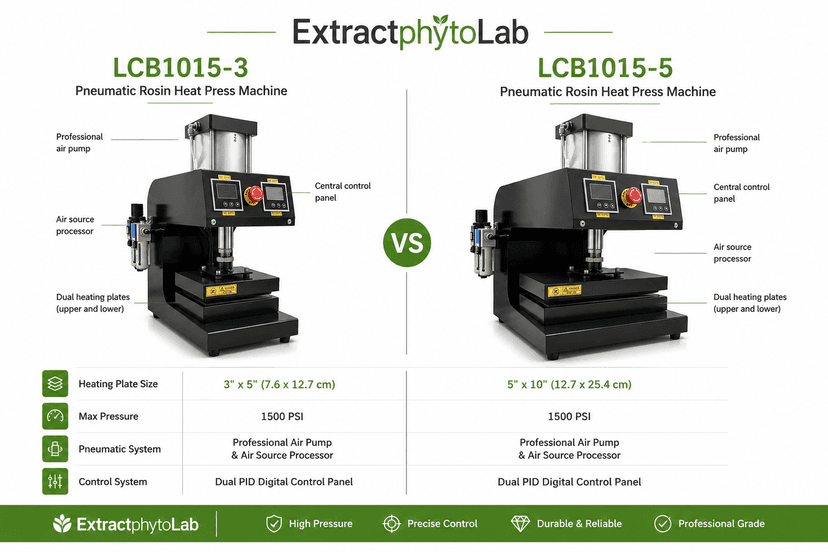
Typical Plate Sizes for a 1 Ton Rosin Press
Current 1-ton machines on the market use relatively compact heating plates.
Common configurations include approximately:
- 2 × 3 in
- 2.4 × 3.5 in
- 2.4 × 4.7 in
- 2.4 × 5.4 in
- Custom compact plate dimensions
The correct size depends on the material and intended batch size.
Current products demonstrate this variation clearly. Nectar uses approximately 5 × 7.6 cm plates on its 1-ton manual model, while Qnubu lists 6 × 12 cm plates and Graveda uses approximately 6 × 9 cm plates on its compact electric model.
Why Plate Size Matters
A larger plate provides more surface area, but it also distributes the available force across a greater area.
That creates an important trade-off.
Smaller Plates
Smaller plates can provide:
- Higher potential pressure per square inch
- Compact equipment dimensions
- Faster heating
- Lower power requirements
- Better suitability for small batches
Larger Plates
Larger plates can provide:
- More loading area
- Greater flexibility in material layout
- Larger individual pressing formats
But the available 1-ton force is spread over a larger surface.
For this reason, buyers should match plate dimensions to actual production needs rather than selecting the largest plate available.
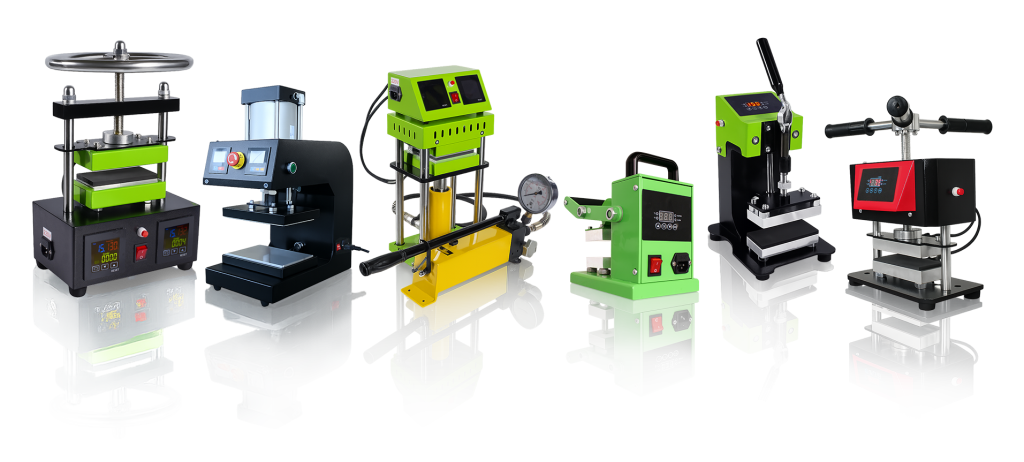
Manual 1 Ton Rosin Press
A manual 1 ton rosin press typically uses a lever, screw, rotary handle, or similar mechanical mechanism.
Manual machines are popular in the 1-ton category because they are relatively simple.
Advantages may include:
- Compact construction
- Low maintenance
- No hydraulic pump required
- Simple operation
- Lower equipment cost
- Easy transportation
Manual pressure also gives operators direct control over how force is applied.
The trade-off is that operating consistency depends more heavily on the user.
For occasional or low-volume production, this may not be a major problem.
For repeated commercial cycles, however, operator fatigue and variation should be considered.
Electric 1 Ton Rosin Press
An electric 1 ton rosin press uses an electric actuator, powered pressure system, or electric hydraulic mechanism.
The primary benefit is easier operation.
Depending on the machine, electric control may provide:
- Push-button pressure application
- Repeatable movement
- Less operator effort
- Digital temperature control
- Digital timing
- More consistent cycle operation
This configuration may be attractive for buyers who want a compact machine without manually applying pressure for each cycle.
Graveda, for example, currently markets a compact 1-ton electric press using an electrically driven pressure system with 6 × 9 cm plates. Similar compact electric configurations indicate that automation is becoming more common even in lower-tonnage machines.
Heated Plates
Heating performance is one of the most important specifications in a compact press.
A professional machine generally uses aluminum heating plates because aluminum combines:
- Good thermal conductivity
- Relatively low weight
- Fast heating response
- Good machinability
However, material alone does not determine heating quality.
Buyers should evaluate:
- Plate thickness
- Heater location
- Sensor position
- Surface flatness
- Temperature variation
- Warm-up time
A plate that reaches the selected temperature quickly but heats unevenly can create inconsistent processing conditions.
Dual Heated Plates
Many 1-ton machines use both upper and lower heated surfaces.
Dual heated plates provide heat from both directions and can help maintain more uniform process conditions.
Important points to compare include:
- Independent upper and lower heating
- Number of heating elements
- Temperature controllers
- Plate insulation
- Sensor accuracy
Some machines use individual temperature control for each plate, while others operate both plates through one control system.
For repeatable applications, independent monitoring can provide greater visibility into actual operating conditions.
Temperature Control
Current compact presses commonly use digital temperature controllers.
Depending on the model, typical maximum temperatures may range from approximately 150°C to 250°C.
However, the highest temperature rating is rarely the most important feature.
Commercial buyers should instead ask about:
- Temperature accuracy
- Stability during pressing
- Heat-up time
- Plate-to-plate variation
- Controller type
- Sensor type
- Temperature calibration
For repeatable processing, consistency is generally more valuable than having an unusually high maximum temperature.
Timer Control
A digital timer is another common feature on 1-ton presses.
Typical systems may allow operators to set the pressing cycle in seconds.
A timer helps create more consistent procedures because the operator can reproduce:
- Pressure duration
- Heating duration
- Release timing
This is especially useful when multiple operators use the same machine.
When selecting equipment for a standardized process, temperature, time, and pressure should be considered together.
1 Ton Manual vs. Electric Rosin Press
Both configurations can work well, but they serve slightly different priorities.
| Feature | Manual 1 Ton Press | Electric 1 Ton Press |
|---|---|---|
| Pressure operation | Hand operated | Powered |
| Operator effort | Higher | Lower |
| Mechanical simplicity | High | Moderate |
| Repeatability | Operator dependent | Typically better |
| Maintenance complexity | Lower | Higher |
| Typical cost | Lower | Higher |
| Portability | Often excellent | Depends on design |
| Best suited for | Occasional/small batch | Frequent small batch |
For occasional use, a manual machine can be sufficient.
For more frequent operation, electric pressure control may provide better efficiency.
1 Ton vs. 2 Ton Rosin Press
Moving from a 1-ton to a 2-ton machine approximately doubles the maximum theoretical force.
This can provide more flexibility for:
- Larger pressing areas
- Larger batches
- Higher pressure requirements
However, a 2-ton machine may also be larger and heavier.
A 1-ton press can remain the better choice when:
- Batch sizes are small
- Portability matters
- Workspace is limited
- High throughput is unnecessary
- Equipment simplicity is important
1 Ton vs. 5 Ton Rosin Press
A 5-ton machine offers approximately five times the available maximum force.
That makes it better suited to larger platen areas and higher-capacity workflows.
A typical comparison looks like this:
| Feature | 1 Ton | 5 Ton |
| Approx. max force | 2,000 lb | 10,000 lb |
| Equipment size | Compact | Medium |
| Portability | High | Moderate |
| Batch capacity | Small | Larger |
| Typical application | Testing / small batch | Light commercial |
| Pressure flexibility | Limited | Higher |
Buyers should therefore consider whether their production needs are likely to grow.
Purchasing a machine that is too small can create an early capacity limitation.
Purchasing a machine that is much larger than necessary can increase cost, weight, and space requirements without providing practical benefit.
Is a 1 Ton Rosin Press Suitable for Commercial Use?
It can be, but only for certain types of commercial use.
A 1-ton machine may be appropriate for:
- Sampling
- R&D
- Product testing
- Small specialty batches
- Demonstration equipment
- Retail demonstration
- Low-volume production
It is usually not the best choice for continuous high-throughput processing.
For larger commercial operations, buyers may need:
- Greater pressing force
- Larger heated plates
- Hydraulic or pneumatic operation
- Higher duty-cycle components
- Greater automation
This distinction is important because the word commercial does not always mean high-volume production.
A small professional operation may use a 1-ton machine effectively, while an industrial production facility may require 20 tons or considerably more.
Portable 1 Ton Rosin Press
Portability is one of the main advantages of a 1-ton design.
Current 1-ton products can weigh considerably less than large hydraulic machines.
When portability matters, compare:
- Overall dimensions
- Machine weight
- Carrying handle
- Power requirements
- Frame construction
- Controller location
A compact machine can be easier to:
- Transport
- Store
- Demonstrate
- Use on a small workbench
- Move between work areas
However, very lightweight construction should not compromise frame rigidity.
Frame Construction
Even a 1-ton press must maintain plate alignment while force is applied.
Important construction factors include:
- Frame material
- Steel thickness
- Joint strength
- Lever mounting
- Plate support
- Mechanical alignment
If the frame flexes excessively, force can be distributed unevenly.
For professional equipment sourcing, buyers should request actual machine photos and structural information rather than relying only on marketing renderings.
Voltage and Power Requirements
Compact presses are commonly offered in different voltage configurations.
Depending on the market, options may include:
- 110V / 120V
- 220V / 230V
- 50 Hz
- 60 Hz
Power consumption varies according to plate size and heating design.
For example, current compact 1-ton machines can range from relatively low-power heating systems to units using several hundred watts.
International buyers should always confirm:
- Voltage
- Frequency
- Plug type
- Power consumption
- Destination electrical standard
before placing an order.
What Should Buyers Look for in a 1 Ton Rosin Press?
Before purchasing, compare more than the product price.
A good specification checklist should include:
Maximum Force
Confirm whether the stated rating refers to true maximum force and how that force is generated.
Plate Dimensions
Choose dimensions appropriate for the intended pressing area.
Heating Configuration
Check whether both plates are heated and whether temperatures can be monitored independently.
Temperature Stability
Ask about temperature accuracy and variation across the plate surface.
Press Mechanism
Choose between:
- Manual
- Electric
- Hydraulic
- Other powered mechanisms
based on operating frequency.
Frame Rigidity
The machine should maintain alignment while loaded.
Timer
A digital timer can improve cycle repeatability.
Electrical Standard
Make sure voltage and frequency match the destination market.
Serviceability
Ask whether heaters, sensors, controllers, switches, and other components can be replaced.
Buying a 1 Ton Rosin Press for OEM or Wholesale Projects
Distributors and equipment brands may require more than a standard retail machine.
Potential OEM requirements can include:
- Custom branding
- Logo plates
- Different machine colors
- Private-label packaging
- Custom controller graphics
- Plug options
- Voltage customization
- Accessories
- Instruction manuals
Before requesting an OEM quotation, buyers should prepare:
- Target market
- Order quantity
- Expected annual volume
- Required voltage
- Plate size
- Pressure mechanism
- Branding requirements
- Packaging requirements
Providing detailed information allows suppliers to evaluate whether an existing machine can be modified or whether a custom configuration is needed.
Questions to Ask Before Requesting a Quote
A professional RFQ for a 1 ton rosin press should include enough information for the supplier to recommend the right configuration.
Ask:
- What is the actual maximum pressing force?
- What is the heated plate size?
- Are both plates heated?
- Can each plate temperature be controlled independently?
- What is the temperature range?
- What is the temperature accuracy?
- How is pressure applied?
- What voltage options are available?
- What is the machine weight?
- What replacement parts are available?
- Can branding or packaging be customized?
- What quantity is required for OEM production?
These questions are more useful than comparing machines only by price.
Frequently Asked Questions
How much pressure does a 1 ton rosin press provide?
A 1-ton press provides approximately 2,000 lb of maximum theoretical force, equivalent to roughly 907 kg-force or 8.9 kN.
Actual pressure at the material depends on pressing area and machine design.
Is 1 ton enough for a rosin press?
For small pressing areas and small batches, one ton can be sufficient.
For larger plates, larger batches, or high-volume commercial production, higher tonnage may be more appropriate.
What plate size is best for a 1 ton rosin press?
Compact plates are generally better matched to 1-ton machines because they concentrate the available force over a smaller area.
The correct dimensions depend on batch size and material format.
Is a manual or electric 1 ton rosin press better?
Manual presses are mechanically simple and usually less expensive.
Electric presses reduce operator effort and may provide more repeatable operation.
The best choice depends on how frequently the machine will be used.
Can a 1 ton rosin press be used professionally?
Yes, particularly for R&D, sampling, small-batch production, demonstrations, or specialist applications.
For continuous production, larger machines may offer better efficiency.
What should I include in an RFQ?
Provide:
- Required pressure capacity
- Preferred plate size
- Manual or electric operation
- Voltage
- Destination country
- Quantity
- Branding requirements
- Packaging requirements
This helps suppliers prepare a more accurate quotation.
Choosing the Right 1 Ton Rosin Press
A 1 ton rosin press can be a practical solution when compact size, portability, and controlled small-batch operation are more important than maximum production capacity.
Before choosing a machine, compare:
- Pressing area
- Heated plate size
- Temperature stability
- Manual versus electric operation
- Frame rigidity
- Timer controls
- Voltage
- Weight
- Maintenance
- OEM options
The best press is not necessarily the machine with the largest plates or the lowest price.
It is the machine whose pressure, heating system, dimensions, controls, and operating method are correctly matched to the application.
EXTRACTPHYTO recommends defining your required plate size, voltage, operating method, order quantity, destination market, and customization needs before requesting a quotation.
For equipment sourcing or OEM project evaluation, prepare a complete technical specification before contacting your supplier.