A 5 ton rosin press is a practical choice for buyers who need significantly more pressing force than compact 1-ton or 2-ton machines without moving into the size, weight, and cost of a 10-ton or 20-ton commercial press.
With approximately 10,000 lb of maximum theoretical force, a 5-ton machine provides enough pressure for larger heated plates, larger batches, and more frequent processing while still fitting comfortably into many workshops, laboratories, and small commercial production areas.
However, buyers should not choose a machine based on tonnage alone.
For commercial and B2B applications, plate size, effective pressing area, hydraulic design, pressure control, temperature stability, frame strength, voltage, duty cycle, and serviceability all affect long-term performance.
This EXTRACTLAB guide explains how to evaluate a 5 ton rosin press machine and what specifications should be compared before requesting a quotation.
What Is a 5 Ton Rosin Press?
A 5 ton rosin press is a heated pressing machine capable of generating approximately five tons of maximum mechanical force.
Five tons is approximately:
- 10,000 lb of force
- 4,536 kg-force
- 44.5 kN
Most machines in this category use a hydraulic system because hydraulic pressure provides a practical way to generate higher force in a relatively compact frame.
A typical 5-ton press may include:
- Steel press frame
- Hydraulic bottle jack or cylinder
- Upper and lower heated plates
- Digital temperature controllers
- Timer
- Heating elements
- Pressure gauge
- Electrical controls
- Safety components
Some machines use a manual hydraulic jack, while others use powered hydraulic systems.
Who Is a 5 Ton Rosin Press Designed For?
A 5-ton machine is commonly suitable for:
- Small commercial processors
- Extraction laboratories
- Product development facilities
- Specialty production
- Small workshops
- Frequent small-batch processing
- Equipment distributors
- Private-label equipment brands
- Buyers upgrading from 1-ton or 2-ton presses
This capacity offers a useful balance between compact equipment and heavier commercial machinery.
For many buyers, 5 tons represents the point where a press begins to provide enough force for more serious repeated production.
Is 5 Tons Enough for Commercial Use?
For many small and medium batch applications, yes.
Current 5-ton products are widely positioned for serious hobbyist, professional, laboratory, and light commercial use.
For example, Dulytek markets its DHP5 as a compact all-in-one hydraulic machine, while Rosineer positions the Mighty-5 around strong hydraulic pressure, pressure monitoring, and precise digital controls.
However, whether 5 tons is enough depends heavily on the pressing area.
Pressure Depends on Area
The simplified relationship is:
Pressure = Force ÷ Area
If a machine provides approximately 10,000 lb of force:
With a 5-square-inch pressing area:
10,000 ÷ 5 = 2,000 PSI
With a 10-square-inch pressing area:
10,000 ÷ 10 = 1,000 PSI
With a 20-square-inch pressing area:
10,000 ÷ 20 = 500 PSI
These values are theoretical.
Actual pressure can vary because of:
- Hydraulic losses
- Frame flex
- Mechanical efficiency
- Material compression
- Plate alignment
- Load distribution
This is why a professional buyer should evaluate effective pressure over the material area, not only the maximum tonnage printed on the machine.
Typical Plate Sizes for a 5 Ton Rosin Press
Current 5-ton presses commonly use medium-sized heated plates.
Typical configurations include:
- 2.4 × 4.7 in
- 3 × 4 in
- 3 × 5 in
- Other custom dimensions
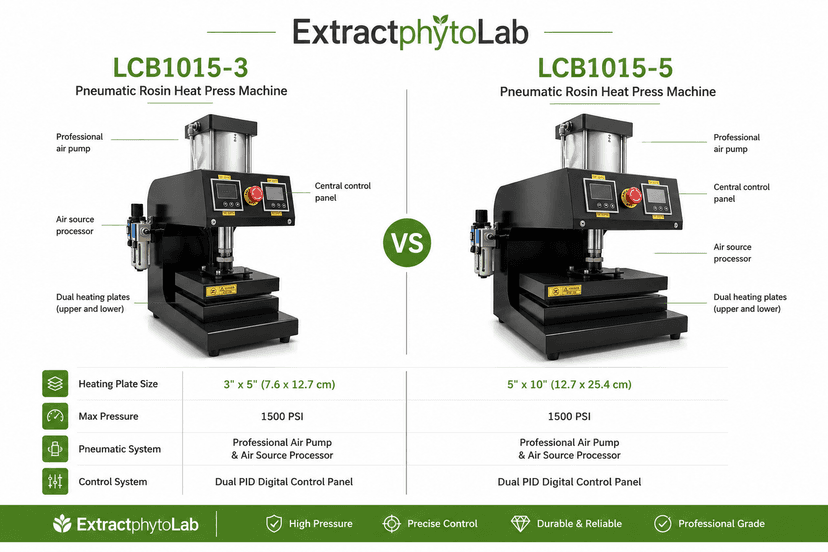
The Dulytek DHP5 uses approximately 2.4 × 4.7 inch dual heated aluminum plates, while the Rosineer Mighty-5 uses 3 × 4 inch aluminum plates. Dulytek’s DE10K 5-ton electric-hydraulic model uses larger 3 × 5 inch heated plates.
This range shows that 5-ton machines provide more flexibility than smaller compact presses.
Why Plate Size Matters
Larger plates provide more usable pressing area.
However, the same 10,000 lb of force is distributed over a larger surface.
For example:
A 3 × 4 inch plate has:
12 square inches
A 3 × 5 inch plate has:
15 square inches
If maximum force remains the same, theoretical pressure per square inch decreases as pressing area increases.
That does not mean larger plates are worse.
It means plate size should be selected according to:
- Batch size
- Filter bag dimensions
- Material loading
- Required pressure
- Production volume
- Press configuration
5 Ton Hydraulic Rosin Press
The 5 ton hydraulic rosin press is the most common configuration in this capacity range.
A hydraulic system converts pump pressure into strong linear force.
Typical designs may use:
- Manual bottle jack
- Integrated hydraulic jack
- External hand pump
- Electric hydraulic cylinder
Hydraulic systems are popular because they offer:
- High force
- Smooth pressure application
- Compact design
- Straightforward maintenance
- Good control
Manual Hydraulic 5 Ton Rosin Press
A manual hydraulic machine uses a hand-operated pump or bottle jack.
Advantages include:
- Simple mechanical design
- Lower cost
- No compressor required
- Relatively easy maintenance
- Good pressure control
- Compact footprint
Dulytek DHP5 and Rosineer Mighty-5 are examples of the type of compact all-in-one hydraulic design commonly seen in this category.
For small commercial workflows, this can be a practical solution.
Limitations of Manual Hydraulic Operation
Manual pumping may become inefficient when production volume increases.
Potential limitations include:
- Operator fatigue
- Slower cycle times
- Variation between operators
- More manual involvement
If production requires many cycles every day, an electric hydraulic system may provide better workflow efficiency.
Electric Hydraulic 5 Ton Rosin Press
A powered hydraulic machine uses electricity rather than manual pumping to generate pressure.
This can provide:
- Reduced operator effort
- Faster operation
- More consistent cycles
- Easier pressure adjustment
- Better suitability for repeated production
The Dulytek DE10K is an example of a 5-ton electrically powered hydraulic design.
Unlike a traditional bottle-jack machine, powered operation can allow users to apply and release pressure through controls rather than manual pumping.
For commercial environments, this difference can significantly affect productivity.
Manual vs. Electric 5 Ton Rosin Press
| Feature | Manual Hydraulic | Electric Hydraulic |
|---|---|---|
| Pressure source | Hand pump | Electric power |
| Operator effort | Higher | Lower |
| Equipment complexity | Lower | Higher |
| Initial cost | Usually lower | Usually higher |
| Cycle consistency | Operator dependent | Generally better |
| Maintenance | Simpler | More components |
| Best suited for | Small batch | Frequent commercial use |
The better option depends on production frequency rather than maximum force alone.
Heated Plate Material
Most 5-ton presses use aluminum heated plates.
Aluminum is commonly selected because it provides:
- Good thermal conductivity
- Fast heating
- Relatively low weight
- Easy machining
Some machines use stainless steel heated surfaces or other configurations.
Regardless of material, buyers should evaluate:
- Surface flatness
- Plate thickness
- Heater layout
- Insulation
- Sensor position
- Temperature distribution
Uniform temperature is more important than simply having thick or large plates.
Dual Heated Plates
Professional presses generally heat both upper and lower platens.
Dual heating helps maintain consistent processing conditions.
A high-quality machine should provide stable heat across both plates.
Important specifications include:
- Heater wattage
- Controller accuracy
- Plate-to-plate temperature variation
- Heating time
- Temperature recovery
- Sensor type
For repeated production, temperature recovery between cycles can be particularly important.
Dual-Channel Temperature Control
Many current 5-ton machines use dual-channel digital controllers.
This allows operators to monitor the upper and lower plates independently.
For example, Dulytek DHP5 uses a two-channel temperature and timer controller, while Rosineer Mighty-5 also uses independent digital control for temperature and time.
Dual-channel control can help operators identify temperature differences between the two platens and improve process consistency.
Temperature Range
Compact and commercial 5-ton presses can have different maximum temperature specifications.
Current machines may operate up to approximately:
- 150°C / 302°F
- 250°C / 482°F
- Other manufacturer-specific limits
However, maximum temperature alone is not the most important specification.
Buyers should focus on:
- Temperature accuracy
- Temperature uniformity
- Heating recovery
- Controller reliability
- Sensor accuracy
Stable temperature generally matters more than an unusually high maximum range.
Pressure Gauge
A pressure gauge is one of the most valuable features in a 5-ton commercial press.
A gauge allows operators to monitor actual hydraulic pressure rather than relying only on feel.
Benefits include:
- Repeatable settings
- Better process control
- Easier operator training
- Improved batch documentation
- More consistent pressure application
Rosineer Mighty-5 includes a real-time pressure gauge, while Dulytek also offers 5-ton models with pressure monitoring.
For commercial users, this feature is worth considering.
Replaceable Hydraulic Jack
Some 5-ton machines use a replaceable bottle jack.
This design can improve long-term serviceability.
If the hydraulic jack develops a leak or loses performance, it may be easier and more economical to replace the jack than repair the entire machine.
Buyers should ask:
- Is the hydraulic jack replaceable?
- Are replacement seals available?
- Can the cylinder be serviced?
- Is overpressure protection included?
Dulytek specifically promotes replaceable hydraulic jacks on its compact 5-ton systems.
Frame Construction
Five tons creates substantial structural load.
A 5-ton press therefore requires a rigid frame.
Important frame considerations include:
- Steel thickness
- Welding quality
- Reinforcement
- Cylinder mounting
- Plate mounting
- Base stability
- Frame deflection
If the frame flexes under pressure, plate alignment can change.
This may produce uneven pressure across the pressing area.
For B2B sourcing, buyers should request actual machine photos rather than relying only on renderings.
Plate Alignment
Upper and lower heated plates should remain parallel while pressure increases.
Poor plate alignment can cause:
- Uneven material compression
- Uneven heating
- Reduced consistency
- Increased wear
Ask suppliers whether plate alignment is checked during quality inspection.
For customized machines, alignment becomes even more important as platen dimensions increase.
5 Ton vs. 2 Ton Rosin Press
Moving from 2 tons to 5 tons provides 2.5 times the maximum theoretical force.
| Feature | 2 Ton | 5 Ton |
| Max theoretical force | 4,000 lb | 10,000 lb |
| Typical plate size | Compact | Medium |
| Hydraulic system | Optional | Common |
| Batch flexibility | Small | Greater |
| Commercial suitability | Light | Better |
| Machine weight | Lower | Higher |
A 2-ton press is often suitable for smaller batches and portability.
A 5-ton machine is better when users need more pressure reserve or larger plates.
5 Ton vs. 10 Ton Rosin Press
A 10-ton press provides approximately twice the available force of a 5-ton machine.
A 10-ton system can be preferable when:
- Larger plates are required
- Batch sizes increase
- Higher throughput is needed
- Greater pressure reserve is desirable
However, 10-ton machines are usually:
- Larger
- Heavier
- More expensive
- Less portable
For small and medium commercial workflows, 5 tons may provide a better balance.
5 Ton vs. 20 Ton Rosin Press
A 20-ton machine provides approximately four times the force.
This is more appropriate for:
- Larger commercial operations
- Larger pressing areas
- Higher production volume
- Industrial equipment setups
A 5-ton machine is usually better when:
- Space is limited
- Production volume is moderate
- Portability matters
- Lower equipment cost is preferred
Choosing higher tonnage than necessary can add cost without improving the process.
Is a 5 Ton Rosin Press Good for Small Commercial Production?
Yes.
This is one of the main applications for the 5-ton category.
A 5-ton machine can be suitable for:
- Daily small-batch production
- Product development
- Laboratory processing
- Small commercial operations
- Demonstration equipment
- Specialty production
However, buyers should consider duty cycle.
A machine designed for occasional use may not be ideal for continuous operation even if maximum pressure is sufficient.
What Is Duty Cycle?
Duty cycle describes how frequently equipment can operate without overheating or excessive wear.
Commercial buyers should ask:
- How many cycles per hour are expected?
- How quickly do plates recover temperature?
- How often does the hydraulic system require maintenance?
- Is the frame designed for repeated loads?
For high-frequency production, duty cycle can be more important than maximum tonnage.
Voltage Options
Many 5-ton presses are offered in:
- 110V / 120V
- 220V / 230V
- 50 Hz
- 60 Hz
Dulytek and Rosineer both offer configurations for North American and international markets.
Before ordering, confirm:
- Voltage
- Frequency
- Plug type
- Power consumption
- Electrical standard
This is particularly important for OEM and export orders.
Machine Weight and Footprint
A 5-ton machine is generally larger than a 1-ton or 2-ton press but can still fit on a standard workbench.
Current commercial examples typically weigh around:
- 30–40 lb for compact manual hydraulic machines
- Significantly more for powered hydraulic systems
When evaluating machine dimensions, consider:
- Workbench space
- Transport
- Storage
- Operator access
- Packaging size
Compact size is useful, but structural rigidity should not be sacrificed.
What Should Buyers Look for in a 5 Ton Rosin Press?
Before ordering, compare:
Pressing Force
Confirm actual maximum force and how it is generated.
Heated Plate Size
Make sure platen dimensions match the intended pressing area.
Hydraulic System
Choose between manual and electric hydraulic operation.
Pressure Gauge
A gauge can improve repeatability.
Temperature Control
Dual-channel control can improve monitoring.
Frame Strength
Look for heavy-duty steel construction.
Plate Alignment
The plates should remain parallel under load.
Voltage
Confirm compatibility with the destination market.
Spare Parts
Ask about replacement:
- Hydraulic jacks
- Heating elements
- Controllers
- Sensors
- Gauges
- Switches
OEM and Custom 5 Ton Rosin Press
Distributors and equipment brands may require customized equipment.
Possible OEM options can include:
- Custom logos
- Machine colors
- Private-label packaging
- Control panel graphics
- Instruction manuals
- Voltage options
- Plug types
- Custom platen dimensions
- Accessories
For more advanced projects, buyers may also request modifications to:
- Press frames
- Hydraulic systems
- Pressure gauges
- Controllers
- Heating plates
EXTRACTLAB works with B2B buyers sourcing extraction hardware and customized processing equipment.
What Information Should You Send for a 5 Ton Rosin Press Quote?
A detailed RFQ helps suppliers recommend the correct configuration.
Provide:
Plate Size
For example:
- 2.4 × 4.7 in
- 3 × 4 in
- 3 × 5 in
- Custom size
Hydraulic System
Specify:
- Manual hydraulic
- Electric hydraulic
- Other configuration
Pressure Gauge
Indicate whether pressure monitoring is required.
Voltage
Provide:
- 110V
- 220V
- Other
Production Volume
Explain whether the machine will be used for:
- Testing
- Small batches
- Daily commercial production
- Repeated processing
Quantity
Specify:
- Sample unit
- Small wholesale order
- Distributor order
- OEM order
Custom Requirements
Include:
- Logo
- Color
- Packaging
- Accessories
- Controller changes
- Custom plates
Frequently Asked Questions About 5 Ton Rosin Presses
How much force does a 5 ton rosin press provide?
A 5-ton press provides approximately 10,000 lb of maximum theoretical force, equivalent to about 4,536 kg-force or 44.5 kN.
Actual pressure at the material depends on effective pressing area and machine efficiency.
Is 5 tons enough for commercial use?
For small and medium batch commercial applications, 5 tons can be sufficient.
For larger plates, larger batches, or continuous industrial production, higher-tonnage machines may be more suitable.
What plate size is common on a 5 ton rosin press?
Current machines commonly use plates around 2.4 × 4.7 inches, 3 × 4 inches, or 3 × 5 inches.
The ideal size depends on the required pressing area.
Manual or electric hydraulic: which is better?
Manual hydraulic machines are simpler and more affordable.
Electric hydraulic machines reduce operator effort and are generally better suited to frequent production.
Do I need a pressure gauge?
A pressure gauge is not essential for basic operation, but it can significantly improve repeatability and process control.
For commercial applications, it is generally a useful feature.
Is a 5 ton press better than a 2 ton press?
A 5-ton machine provides more than twice the available force and can support larger pressing areas.
However, a 2-ton machine may still be preferable when portability and compact dimensions are priorities.
Should I choose 5 tons or 10 tons?
Choose according to plate area, batch size, production volume, and expected future capacity.
A 5-ton machine can be sufficient for small commercial production, while a 10-ton press provides more capacity for larger workloads.
Choosing the Right 5 Ton Rosin Press
A 5 ton rosin press offers a strong combination of compact size, hydraulic pressure, and commercial usability.
For many buyers, it represents a practical upgrade from 1-ton and 2-ton equipment without requiring the footprint of larger industrial machines.
Before purchasing, evaluate:
- Actual pressing force
- Plate dimensions
- Effective pressure
- Hydraulic system
- Pressure monitoring
- Temperature stability
- Frame construction
- Plate alignment
- Voltage
- Duty cycle
- Spare parts
- OEM options
EXTRACTLAB supports B2B buyers, distributors, and commercial processors sourcing extraction hardware and customized processing equipment.
For an accurate quotation, provide your required tonnage, plate size, hydraulic configuration, voltage, production frequency, destination market, quantity, and customization requirements.
Contact EXTRACTLAB to discuss your 5 ton rosin press project and request a factory quotation.