A 2 ton rosin press offers a practical middle ground between ultra-compact entry-level presses and larger hydraulic machines.
With approximately 4,000 lb of maximum theoretical pressing force, a 2-ton machine provides twice the available force of a 1-ton press while remaining compact enough for small workshops, laboratories, product testing, low-volume production, and portable processing applications.
However, the tonnage rating alone does not determine whether a machine is suitable for a specific process.
Buyers should also evaluate heated plate size, effective pressing area, temperature stability, pressure mechanism, frame strength, voltage, operating frequency, and maintenance requirements.
This guide from Honglin Cable explains what B2B buyers should consider when evaluating a 2 ton rosin press machine.
What Is a 2 Ton Rosin Press?
A 2 ton rosin press is a heated pressing machine capable of generating approximately two tons of maximum mechanical force.
Two tons of force is approximately:
- 4,000 lb
- 1,814 kg-force
- 17.8 kN
Most compact 2-ton presses combine this pressure with two heated aluminum plates.
Depending on the design, pressure may be generated through:
- Manual leverage
- Screw mechanisms
- Small hydraulic systems
- Powered mechanisms
Typical machines also include:
- Digital temperature control
- Upper and lower heating plates
- Timers
- Steel frames
- Heating elements
- Power controls
The compact size of a 2-ton machine makes it especially attractive when a larger 5-ton, 10-ton, or 20-ton press would be unnecessary.
Who Should Consider a 2 Ton Rosin Press?
A 2-ton machine can be suitable for:
- Small-batch processors
- Product development
- Laboratory testing
- Specialty production
- Equipment demonstrations
- Small workshops
- Low-volume commercial applications
- Distributors seeking compact equipment
- Buyers with limited workspace
It is generally positioned above a 1-ton machine in terms of available force but below larger hydraulic presses designed for high-throughput commercial production.
Is 2 Tons Enough Pressure?
For many small pressing areas, yes.
But the actual pressure depends on the surface area being pressed.
A useful simplified relationship is:
Pressure = Force ÷ Area
If a 2-ton machine provides approximately 4,000 lb of force:
With a 2-square-inch effective pressing area:
4,000 ÷ 2 = 2,000 PSI
With a 4-square-inch area:
4,000 ÷ 4 = 1,000 PSI
With an 8-square-inch area:
4,000 ÷ 8 = 500 PSI
These values are theoretical.
Actual pressure may be lower because of:
- Mechanical losses
- Frame flex
- Hydraulic losses
- Material compression
- Uneven load distribution
The key point is simple:
A 2-ton rating is meaningful only when considered together with pressing area.
Typical Plate Sizes for a 2 Ton Rosin Press
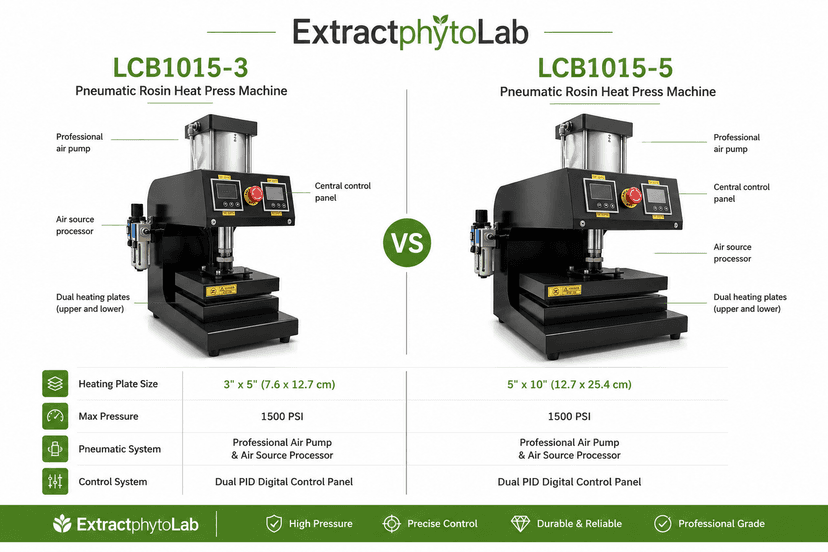
Current 2-ton machines commonly use compact plates.
Examples on the market include:
- 2.5 × 2.5 in
- 3 × 3 in
- 2 × 4 in
- Other compact custom dimensions
NugSmasher Mini currently uses 2.5 × 2.5 inch aluminum plates, while Dulytek lists a 3 × 3 inch plate configuration for its DM2 model. Mogobe also markets a 2-ton machine with 2.5 × 2.5 inch heated plates and PID temperature control.
These dimensions reflect the main design principle of lower-tonnage machines:
keep the plate area relatively compact so available force is not spread too thinly.
Why Plate Size Matters
A larger platen provides more loading area, but it reduces the theoretical pressure per square inch if machine force remains unchanged.
Consider two hypothetical 2-ton machines.
Machine A
Plate size:
2.5 × 2.5 in
Total plate area:
6.25 sq in
Machine B
Plate size:
4 × 5 in
Total plate area:
20 sq in
Both machines are rated at 4,000 lb maximum force.
But the same force is distributed very differently.
This is one reason why most successful compact 2-ton machines use relatively small heated plates.
2 Ton Manual Rosin Press
The 2 ton manual rosin press is one of the most common configurations currently ranking in Google.
Manual machines use:
- Lever mechanisms
- Hand-operated hydraulic systems
- Screw mechanisms
- Mechanical compression systems
Current products such as Dulytek DM2, NugSmasher Mini, and ROSITEK Colibri all demonstrate that the 2-ton category remains strongly associated with manual compact equipment.
Advantages of Manual Operation
A manual press typically offers:
- Simple construction
- Lower maintenance requirements
- Compact dimensions
- Lower equipment cost
- No air compressor
- Easy setup
For low-frequency operation, this can be an efficient solution.
Limitations
Manual equipment may be less suitable when:
- Hundreds of cycles are required
- Operator consistency is critical
- Production must be highly standardized
- Labor reduction is a priority
For these applications, powered or larger hydraulic equipment may be more appropriate.
Manual Hydraulic vs. Lever-Type 2 Ton Press
Not every manual 2-ton machine operates the same way.
Some rely on a mechanical lever, while others use a compact hydraulic system.
Lever-Type Press
A lever press can offer:
- Fast operation
- Simple maintenance
- Immediate pressure feedback
- Lightweight construction
However, achieving consistent maximum force may depend heavily on the operator.
Manual Hydraulic Press
A small hydraulic system may provide:
- Smoother force application
- Reduced operator effort
- Better pressure control
- Easier handling of higher loads
NugSmasher Mini, for example, is marketed as a compact manual hydraulic 2-ton machine.
The better configuration depends on intended use rather than tonnage alone.
Dual Heated Plates
Most professional 2-ton machines use heated upper and lower plates.
Dual heating can improve temperature consistency through the material.
Buyers should evaluate:
- Heater wattage
- Plate material
- Heater position
- Temperature sensor placement
- Temperature variation
- Warm-up time
Current examples typically use aluminum plates because aluminum combines:
- Good thermal conductivity
- Low weight
- Fast heat transfer
- Easy machining
NugSmasher Mini specifies dual 70W heaters, providing a total of approximately 140W of heating power.
PID Temperature Control
Temperature control is one of the most important performance characteristics.
Some compact machines use PID controllers to regulate plate temperature.
A PID controller continuously adjusts heater output to keep temperature near the selected set point.
Mogobe, for example, specifically markets its compact 2-ton machine with PID temperature control.
For buyers, important temperature specifications include:
- Operating range
- Temperature accuracy
- Warm-up time
- Upper/lower plate variation
- Sensor accuracy
- Controller replacement availability
The highest temperature rating is less important than consistent temperature.
What Temperature Range Should a 2 Ton Press Have?
Current machines vary.
For example, NugSmasher Mini lists an operating range of approximately 70°F to 350°F.
Other compact presses may use different temperature ranges.
When comparing machines, ask:
- What is the maximum temperature?
- How accurate is the controller?
- How quickly do the plates recover after loading?
- Is actual plate temperature calibrated against displayed temperature?
For repeatable production, temperature stability is more important than an unusually high maximum setting.
Frame Construction
Two tons is a substantial amount of mechanical force for a compact machine.
The frame must resist deformation while pressure is applied.
Important factors include:
- Structural steel thickness
- Weld quality
- Base stability
- Plate mounting
- Lever or jack attachment
- Frame alignment
Frame flex can cause the plates to become non-parallel.
This creates uneven pressure across the material.
Some current manufacturers specifically highlight solid structural steel construction as a way to minimize deflection under full load.
For B2B sourcing, request actual machine photos and frame specifications.
2 Ton vs. 1 Ton Rosin Press
The main difference is available force.
| Specification | 1 Ton | 2 Ton |
|---|---|---|
| Approx. maximum force | 2,000 lb | 4,000 lb |
| Typical plate area | Small | Small to medium |
| Portability | Very high | High |
| Pressure flexibility | Limited | Better |
| Typical use | Testing / very small batch | Small batch / light professional |
| Equipment footprint | Small | Small |
A 2-ton machine can provide more flexibility for buyers who want compact equipment but do not want to be limited to very small pressing areas.
For many small-scale users, it can represent a better long-term choice than a 1-ton machine.
2 Ton vs. 4 Ton Rosin Press
A 4-ton machine approximately doubles the maximum force again.
That provides more flexibility for:
- Larger plates
- Larger batches
- Higher pressure
- More frequent production
Current market lineups commonly position 2-ton machines as compact entry equipment and 4-ton models as the next step toward more serious production. ROSITEK, for example, lists both a 2-ton manual press and a 4-ton press in its range.
A 2-ton machine is typically preferable when:
- Compact size matters
- Production volume is low
- Small plates are sufficient
- Portability is important
A 4-ton machine may be better when production requirements are expected to increase.
2 Ton vs. 5 Ton Rosin Press
A 5-ton press provides approximately 10,000 lb of maximum theoretical force.
That is 2.5 times the force of a 2-ton machine.
A 5-ton press may provide:
- Larger plate options
- Greater batch flexibility
- More pressure reserve
- Better suitability for regular production
However, it usually also involves:
- Higher cost
- Greater weight
- Larger frame
- More hydraulic components
If the intended workload remains small, a 2-ton machine can be the more efficient choice.
Is a 2 Ton Rosin Press Good for Commercial Use?
It depends on what “commercial” means.
A 2-ton machine can be useful for:
- Small specialty production
- R&D
- Sampling
- Product testing
- Retail demonstrations
- Low-volume processing
It is generally not intended for continuous high-throughput industrial production.
If operators need to process large batches throughout the day, a larger hydraulic, pneumatic, or electric press may offer better efficiency.
Compact and Portable Design
Portability is one of the main advantages of the 2-ton category.
Current machines are often designed for:
- Workbenches
- Small rooms
- Mobile demonstrations
- Limited production areas
- Easy storage
NugSmasher Mini, for example, measures approximately 8 × 8 × 16 inches and weighs about 25.6 lb, illustrating the compact form factor typical of this category.
When portability matters, evaluate:
- Overall dimensions
- Total weight
- Base footprint
- Handle design
- Power cable
- Stability
Compact size should not come at the expense of frame strength.
110V vs. 220V
Electrical requirements depend on the destination market.
Dulytek currently offers its 2-ton DM2 in 110V for North America and 220V for Europe and Australia.
International buyers should confirm:
- Voltage
- Frequency
- Plug type
- Heating wattage
- Power cable standard
before ordering.
Voltage customization can also be an important consideration for OEM and distributor projects.
What Should Buyers Look for in a 2 Ton Rosin Press?
A useful comparison should include more than tonnage.
1. Plate Size
Make sure the plate area matches your intended batch size.
2. Actual Pressing Force
Ask how the stated 2-ton force is generated and whether the machine can reliably reach it.
3. Temperature Accuracy
Evaluate stability rather than only maximum temperature.
4. Plate Alignment
Upper and lower plates should remain parallel during pressing.
5. Frame Strength
A rigid steel frame helps reduce deformation.
6. Operating Method
Choose between:
- Mechanical manual
- Manual hydraulic
- Powered system
based on cycle frequency.
7. Voltage
Confirm destination-market electrical requirements.
8. Spare Parts
Ask whether heaters, controllers, sensors, handles, hydraulic components, and switches can be replaced.
OEM 2 Ton Rosin Press Projects
Distributors and private-label equipment brands may require customized machines.
Possible OEM options can include:
- Custom logo
- Private-label packaging
- Machine color
- Controller graphics
- Custom manuals
- Plug type
- Voltage
- Accessories
- Heated plate dimensions
Before requesting an OEM quotation, prepare:
- Order quantity
- Target market
- Required plate size
- Voltage
- Press mechanism
- Branding requirements
- Packaging requirements
Detailed RFQ information makes technical evaluation easier.
What Information Should You Include in a Quote Request?
When requesting pricing for a 2 ton rosin press, provide:
Machine Type
Specify whether you prefer:
- Manual mechanical
- Manual hydraulic
- Powered
Plate Size
Provide preferred dimensions.
For example:
- 2.5 × 2.5 in
- 3 × 3 in
- Custom
Voltage
Specify:
- 110V
- 220V
- Other
Quantity
Indicate:
- Sample unit
- Small wholesale order
- Distributor order
- OEM quantity
Destination Market
This helps determine:
- Voltage
- Plug type
- Packaging
- Compliance requirements
Custom Requirements
Include:
- Branding
- Color
- Packaging
- Accessories
- Controller changes
Frequently Asked Questions
How much force does a 2 ton rosin press produce?
A 2-ton press produces approximately 4,000 lb of maximum theoretical force, equal to around 1,814 kg-force or 17.8 kN.
Actual working pressure depends on machine design and effective pressing area.
Is a 2 ton rosin press better than a 1 ton model?
It provides approximately twice the available force, which can make it more flexible for slightly larger pressing areas.
However, a 1-ton press may still be sufficient for very small batches.
What is the typical plate size?
Current 2-ton machines commonly use plates around 2.5 × 2.5 inches or 3 × 3 inches, although other sizes are available.
Is manual or hydraulic better?
A manual lever design is simple and compact.
A small hydraulic system may make pressure application smoother and reduce operator effort.
The best choice depends on cycle frequency and budget.
Can a 2 ton press be used professionally?
Yes, particularly for sampling, small-batch production, product testing, and low-volume specialty applications.
For high-throughput production, a larger press is generally more efficient.
Is 2 tons enough for 3 × 3 plates?
A 2-ton machine can be paired with 3 × 3 plates, and current commercial products use this configuration.
Actual suitability depends on the effective pressing area and process requirements.
What voltage should I order?
Choose the voltage required by your destination market.
North American machines commonly use 110V/120V, while many European and Australian installations use 220V/230V.
Choosing the Right 2 Ton Rosin Press
A 2 ton rosin press is a practical choice for buyers who need more pressing force than a 1-ton machine without moving into the size, weight, and cost of larger commercial hydraulic systems.
Before choosing a machine, evaluate:
- Maximum pressing force
- Effective pressing area
- Heated plate dimensions
- Temperature accuracy
- Manual or hydraulic operation
- Frame rigidity
- Voltage
- Portability
- Spare parts
- OEM requirements
The best machine is not simply the one with the highest temperature rating or the largest heated plates.
It is the configuration whose force, plate area, heating system, frame construction, and operating method match the intended production workflow.
EXTRACTLAB supplies extraction hardware and works with B2B buyers, distributors, and commercial processors requiring compact pressing equipment, filtration products, and customized extraction solutions.
For a more accurate quotation, provide your preferred plate size, voltage, operating method, destination market, order quantity, branding requirements, and other customization needs.
Contact EXTRACTLAB to discuss your 2 ton rosin press project and request a factory quotation.