A high-quality Dry Sift Screen is more than a simple mesh frame. For growers, processors, herbal product makers, and material separation professionals, it is a practical tool designed to separate fine particles from dried plant material with accuracy, consistency, and control. Whether you are working with dry herbs, botanical resin glands, pollen-like particles, or other fine natural materials, the right screen can make a clear difference in purity, yield, and workflow efficiency.
At EXTRACTLAB, we manufacture durable dry sift screen sets built for users who need clean separation, stable mesh tension, and long-term performance. With carefully selected micron sizes, strong aluminum frames, and precision-stretched monofilament polyester mesh, our screens are designed to help users separate material into different grades without relying on water, solvents, or complex equipment.
This guide explains what a dry sift screen is, how it works, what technical specifications matter, and why choosing the right screen set can improve your final results.
What Is a Dry Sift Screen?
A Dry Sift Screen is a fine mesh sieve used to mechanically separate small particles from dried plant or herbal material. Instead of using liquid extraction, chemicals, or heat, dry sifting relies on gentle movement across mesh screens. Smaller particles fall through the screen openings, while larger plant fibers and unwanted material remain on top.
The process is simple, but the quality of the screen determines the quality of the separation. A loose, uneven, or poorly selected mesh can allow too much contamination to pass through. A properly built screen set, however, gives users more control over particle size, collection grade, and final purity.
Dry sift screens are commonly used in legal botanical processing, herbal collection, pollen separation, dry material grading, trimming support, and small-batch production environments. For commercial users, they are also useful for improving workflow efficiency by allowing multiple particle grades to be collected in one process.
Why Micron Size Matters
The most important factor in any dry sift screen is micron size. A micron is one millionth of a meter and is used to describe the opening size of the mesh. In simple terms, a larger micron screen allows larger particles to pass through, while a smaller micron screen captures finer material.
For dry separation, using only one screen often gives limited results. That is why professional users usually prefer a multi-screen set. A stack of different micron sizes allows material to be separated step by step. Larger screens remove bigger plant pieces first, while finer screens help refine the collected material into cleaner grades.
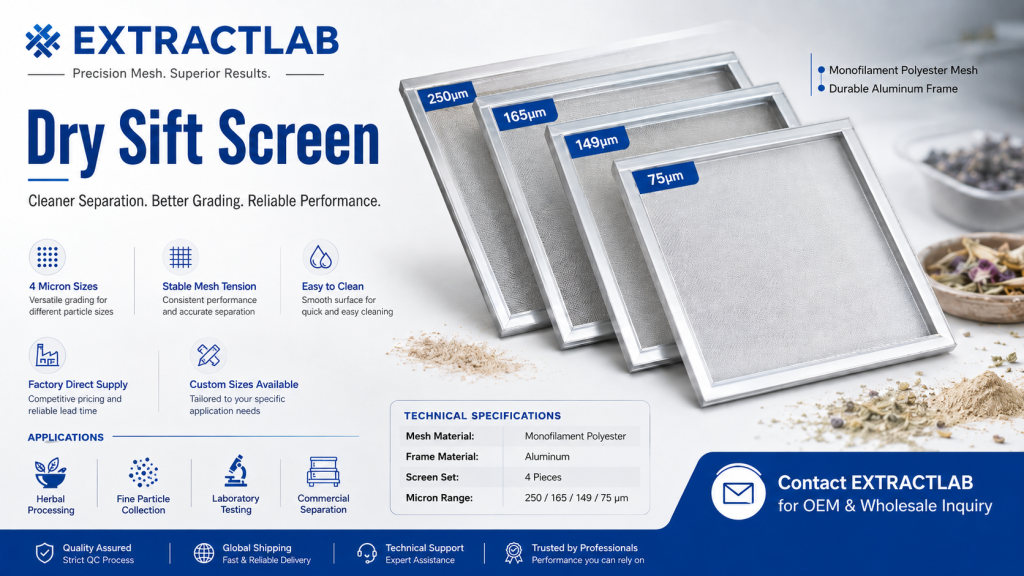
For example, a 250 micron screen is useful as a first-stage screen for faster separation and higher volume. Mid-range screens such as 165 micron and 149 micron help refine the material further. A 75 micron screen can be used for finer classification and cleaner collection.
This staged approach helps users balance yield and purity. Larger openings may increase collection volume, while smaller openings usually improve refinement. The best result often comes from using several screens together.
EXTRACTLAB Dry Sift Screen Set
EXTRACTLAB offers a professional 4-piece dry sift screen set designed for stable separation and practical daily use. Our standard set includes four carefully selected mesh grades:
Standard Mesh Configuration
| Screen Position | Micron Size | Lines Per Inch | Function |
|---|---|---|---|
| Top Screen | 250 micron | 60 LPI | Fast first-stage separation |
| Second Screen | 165 micron | 90 LPI | Medium particle grading |
| Third Screen | 149 micron | 110 LPI | Further refinement |
| Bottom Screen | 75 micron | 200 LPI | Fine collection and cleaner separation |
This combination is widely used because it gives users a complete separation range. Instead of forcing all material through one screen, users can classify particles into different grades and evaluate each fraction separately.
Product Advantages of EXTRACTLAB Dry Sift Screen
1. Four Micron Sizes for Better Control
A single screen can only provide one level of separation. EXTRACTLAB dry sift screen sets include four different micron sizes, allowing users to separate material more accurately. This is especially useful when the starting material varies in texture, dryness, particle size, or processing purpose.
With multiple screens, users can collect different grades instead of mixing everything together. This improves consistency and helps reduce unwanted plant matter in the final collection.
2. Durable Aluminum Frame
The frame is the foundation of a good dry sift screen. EXTRACTLAB uses strong aluminum frames designed to stay stable during repeated use. Aluminum offers an excellent balance of strength, weight, and corrosion resistance.
Compared with low-quality wooden or plastic frames, aluminum frames are easier to clean, more resistant to deformation, and better suited for long-term use. A stable frame also helps maintain screen tension, which is important for consistent separation.
3. Monofilament Polyester Mesh
The mesh surface plays a direct role in separation quality. EXTRACTLAB uses monofilament polyester mesh, which offers smooth openings, good dimensional stability, and reliable performance.
Monofilament mesh is preferred because the single-strand structure reduces particle trapping compared with twisted fibers. This makes cleaning easier and helps maintain a more consistent sifting surface over time.
4. Precision Stretching for Stable Tension
Mesh tension affects how material moves across the screen. If the mesh is too loose, particles may collect unevenly, and separation can become inconsistent. If the mesh is stretched properly, material moves more smoothly, and the screen performs more predictably.
EXTRACTLAB applies controlled stretching methods to ensure the screen surface is firm and even. This helps users achieve more consistent results during repeated production.
5. Large Working Area for Higher Efficiency
A larger screen surface allows users to process more material at one time. This is useful for trimming, collecting, and grading dry plant materials. It also reduces the number of repeated batches needed, saving time during production.
For growers, processors, and small manufacturers, a large working surface can improve workflow without requiring complicated machinery.
6. Easy to Use and Easy to Clean
A good dry sift screen should not make the process complicated. EXTRACTLAB screens are designed for practical use. The aluminum frame is smooth, the mesh surface is clean and flat, and the screen set can be stacked or used individually depending on the application.
After use, the screens can be cleaned carefully with appropriate dry cleaning methods or gentle maintenance tools, depending on the material processed.
Common Applications of Dry Sift Screens
Herbal Material Processing
Dry sift screens are often used to separate fine botanical particles from larger dried plant matter. This is useful for herbal product manufacturers, research users, and processors who need controlled particle classification.
Pollen and Fine Particle Collection
A fine mesh screen can help collect pollen-like material or small natural particles from dried sources. Different micron sizes allow users to separate coarse and fine fractions for different purposes.
Trimming and Collection Workflows
During trimming or dry handling, valuable fine particles may fall away from the main plant material. A dry sift screen set allows users to collect these particles instead of losing them. This improves material utilization and reduces waste.
Laboratory and Small-Batch Testing
For testing, sampling, or small-batch production, dry sift screens provide a simple mechanical separation method. They do not require pumps, solvents, water systems, or complex machines, making them suitable for controlled manual processing.
Commercial Botanical Separation
For commercial users, a multi-screen set can help standardize production. By using the same micron sequence for each batch, users can create repeatable grades and improve product consistency.
How to Choose the Right Dry Sift Screen
Choosing the best Dry Sift Screen depends on your material, production scale, and desired final grade. Here are the key points to consider.
Choose the Right Micron Range
If your goal is high yield, larger micron screens are useful for collecting more material quickly. If your goal is cleaner separation, smaller micron screens are important for refinement. A 4-screen set gives you flexibility because you do not have to choose only one size.
For most users, a combination of 250, 165, 149, and 75 micron screens provides a practical starting range for dry separation.
Check the Mesh Material
Polyester monofilament mesh is a strong choice for dry sifting because it offers clean openings, good stability, and easy maintenance. Avoid low-quality mesh that stretches unevenly, traps material, or wears quickly.
Look for Strong Frame Construction
A weak frame can bend, loosen, or affect screen tension. Aluminum frames are ideal for users who need a strong, lightweight, and durable structure.
Consider Screen Size
Larger screens are better for processing more material at once. Smaller screens may be easier to store and handle, but they can slow down production. Choose the size based on your working space and batch volume.
Work With a Reliable Manufacturer
A professional mesh manufacturer can provide better quality control, more customization options, and stable bulk supply. EXTRACTLAB supports standard and customized dry sift screen solutions for different users and markets.
Technical Specifications
Below is a typical EXTRACTLAB dry sift screen specification:
Product Name
Dry Sift Screen Set
Screen Quantity
4-piece set
Mesh Material
Monofilament polyester mesh
Frame Material
Aluminum frame
Standard Micron Sizes
250 micron / 165 micron / 149 micron / 75 micron
Lines Per Inch
60 LPI / 90 LPI / 110 LPI / 200 LPI
Common Use
Dry botanical separation, herbal particle grading, trimming collection, fine particle classification
Customization
Available upon request, including size, frame design, mesh specification, packaging, and bulk order requirements
Why Buy Dry Sift Screens from EXTRACTLAB?
EXTRACTLAB is not only a product supplier. We are a mesh manufacturer with experience in screen printing mesh, filtration mesh, and precision mesh products. This gives us a strong understanding of mesh tension, opening accuracy, material selection, and frame construction.
When you buy from EXTRACTLAB, you benefit from:
Factory Direct Supply
As a manufacturer, we can offer competitive pricing for wholesale buyers, distributors, and brand owners. Factory direct supply also makes customization easier and more flexible.
Stable Quality Control
We control the production process from mesh selection to stretching, framing, and inspection. This helps ensure each screen set meets practical performance standards.
Custom Sizes and OEM Support
Different markets may require different screen sizes, colors, packaging, or branding. EXTRACTLAB can support customized solutions for importers, distributors, online sellers, and professional buyers.
Bulk Order Capability
For customers who need regular supply, we can support large-volume production and export packaging. This makes our dry sift screens suitable for wholesalers and commercial product lines.
Professional Mesh Knowledge
Because mesh is our core business, we understand the details that affect performance: tension, opening size, frame stability, durability, and user handling. This allows us to provide products that are practical, not just visually appealing.
Tips for Better Dry Sifting Results
A good screen is important, but correct use also matters. For better results, keep your material properly dried, avoid aggressive pressure, and work in a clean environment. Gentle movement usually gives cleaner separation than forcing material through the mesh.
Use the screens step by step, starting with the larger micron size and moving toward finer screens. Collect each grade separately so you can compare quality and decide which fraction best matches your needs.
Always clean and store the screens carefully after use. Keeping the mesh free from trapped particles helps maintain performance and extends the life of the screen set.
Dry Sift Screen vs. Other Separation Methods
Dry sifting is popular because it is simple, clean, and efficient. Unlike wet separation methods, it does not require water, ice, drying time, or additional liquid handling. Unlike chemical methods, it does not rely on solvents.
This makes dry sift screens a practical choice for users who want a mechanical, low-equipment method for separating fine particles from dry material. The process is easy to understand, scalable for different batch sizes, and suitable for users who value natural separation methods.
For many users, the biggest advantage is control. By selecting the right micron screen and using a staged screen set, you can adjust the balance between yield and purity.
Conclusion: Choose a Professional Dry Sift Screen for Better Results
A Dry Sift Screen may look simple, but its performance depends on precise mesh selection, stable tension, durable frame construction, and practical design. For users who want cleaner separation, better material grading, and more efficient workflow, a professional 4-piece screen set is a smart investment.
EXTRACTLAB offers durable dry sift screen sets made with aluminum frames, monofilament polyester mesh, and practical micron combinations including 250, 165, 149, and 75 micron. Whether you need standard products, wholesale supply, or customized OEM solutions, we can help you find the right screen for your application.
Contact EXTRACTLAB for a Quote
Looking for a reliable Dry Sift Screen manufacturer or supplier?
Contact EXTRACTLAB today to discuss your required size, micron specification, quantity, packaging, and customization needs. Our team can provide professional recommendations and competitive factory pricing for your business.
Send your inquiry now and get the right dry sift screen solution for your market.