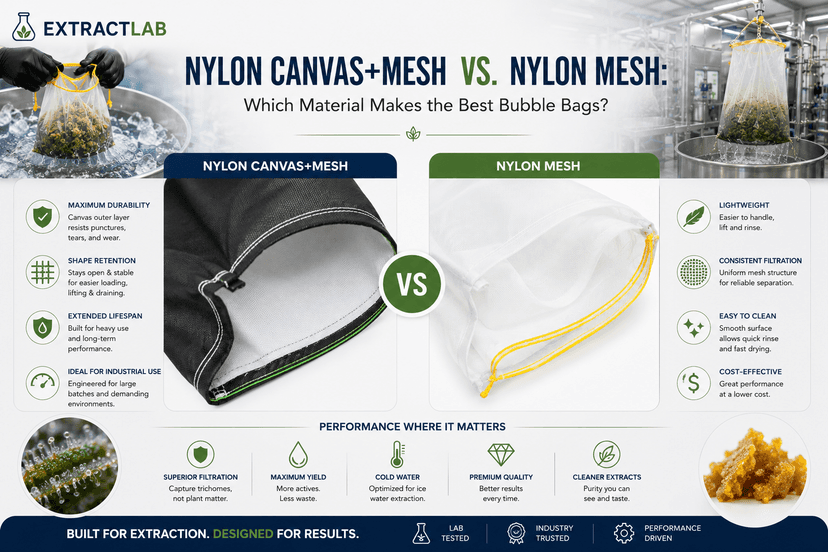
Solventless extraction workflows depend on controlled separation, durable filtration equipment, and consistent handling methods. Whether operators are working with dry ice or cold water, the purpose remains the same: separating resin glands from plant material while limiting contamination and preserving process efficiency. In this environment, bubble bags for hash serve as essential filtration tools that support resin collection across different production scales and extraction styles. The correct bag set can improve workflow consistency, reduce material loss, and help operators maintain cleaner separation during each processing cycle.
Different extraction methods place different demands on filtration equipment. Dry ice extraction requires bags that can tolerate cold, friction, and repeated shaking, while ice water extraction requires stable mesh, reliable drainage, and food-grade construction for contact with water and collected material. Buyers comparing the best bubble bags for dry ice hash with bubble bags for ice water hash should focus on micron accuracy, seam strength, mesh stability, and long-term durability. A properly selected system allows processors to adapt to different production goals without compromising operational control.
Bubble Bags for Dry Ice Hash Processing
Dry ice hash processing relies on extremely low temperatures and mechanical movement to separate brittle resin glands from plant material. As the material chills, resin becomes easier to dislodge through shaking or tumbling. In this application, the best bubble bags for dry ice hash should offer strong mesh construction and reinforced seams because the process creates repeated friction between frozen material, dry ice, and the filtration surface. Weak bags may stretch, tear, or lose filtration consistency after only a few cycles.
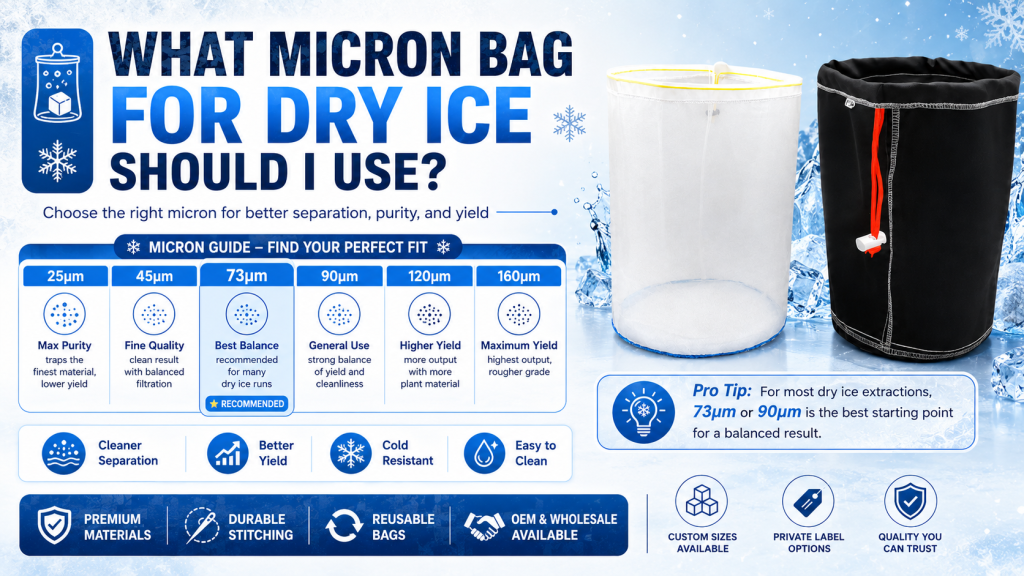
Unlike water-based extraction, dry ice processing does not use liquid as a carrier medium. Resin falls through the mesh directly onto a collection surface, which makes micron selection and bag handling especially important. If the mesh is too coarse, unwanted plant particles may pass through with the resin. If the mesh is too fine, collection may be slow and less efficient. For this reason, high-quality bubble bags for hash used in dry ice workflows should maintain stable openings under shaking pressure and cold conditions.
Dry ice extraction is often valued for its speed and simple setup. It requires fewer water-handling steps and can be useful for operators who want fast separation with limited drying requirements. However, the method can also increase the risk of plant contamination if agitation is too aggressive or the bag micron is not properly matched to the material. The best bubble bags for dry ice hash help reduce this risk by providing controlled filtration, durable mesh tension, and predictable particle separation during repeated movement.
Bubble Bags for Ice Water Hash Extraction
Ice water extraction uses cold water, ice, and agitation to separate resin from plant material. In this process, bubble bags hash ice workflows depend on maintaining low temperatures so resin glands become firm and detach cleanly. The mixture is then passed through a series of filtration bags, each capturing material according to its micron rating. This method is widely used because it provides more controlled separation and allows operators to collect different resin grades from a single wash.
Bubble bags for ice water hash must be designed for water exposure, repeated draining, and careful resin collection. Food-grade materials are important because the bags come into direct contact with ice, water, and extracted material. Smooth mesh surfaces help make resin easier to collect, while strong sidewalls and reinforced stitching prevent distortion when the bags are wet and loaded. Good drainage is also essential, as clogged or unstable mesh can slow production and affect final quality.
The correct bag sequence is a major part of ice water extraction. Larger micron bags are generally used to catch plant matter first, while smaller micron bags collect finer resin particles later in the stack. Wash bags for bubble hash should be selected according to the operator’s desired level of separation. A simple set may support basic collection, while a more complete set allows resin to be divided into multiple grades. In both cases, consistent micron performance is necessary for repeatable results.
Washing Machine Workflows and Equipment Integration
As extraction volume increases, many operators move from manual stirring to machine-assisted washing. Bubble hash bags for washing machine systems are used with compatible washers or agitation equipment to improve batch consistency and reduce manual labor. A washing machine can maintain more uniform movement than hand mixing, making it easier to standardize wash cycles across multiple batches. This is especially useful for facilities focused on repeatable output and cost efficiency.
A bubble bag hash washer is designed to agitate material in cold water while limiting the physical effort required from the operator. The washer helps detach resin through controlled movement, after which the water and resin mixture are filtered through bag stacks. In this workflow, the bags must withstand not only water and ice exposure but also higher-volume drainage and repeated use. Durable wash bags for bubble hash are therefore essential for long-term reliability.
When using bubble hash bags for washing machine setups, compatibility should be checked carefully. The bags must match the container size, drainage process, and intended batch volume. Oversized or poorly fitted bags can fold, restrict flow, or collect material unevenly. Reinforced seams and stable mesh become even more important because machine-assisted workflows often involve more frequent production cycles. A reliable bubble bag hash washer combined with properly selected filtration bags can improve throughput while maintaining cleaner separation.
Comparing Dry Ice and Ice Water Use Cases
Dry ice and ice water extraction both rely on bubble bags for hash, but they create different operational conditions. Dry ice processing is generally faster and requires less drying after collection, but it can generate more fine plant particles if the material is shaken too aggressively. Ice water extraction is more controlled and allows better resin grading, but it requires careful drying, water management, and more detailed cleaning after each wash.
For dry ice applications, the best bubble bags for dry ice hash should prioritize abrasion resistance, mesh strength, and cold-condition durability. The bag must tolerate frozen material moving against the filtration surface. For ice water extraction, bubble bags for ice water hash should prioritize food-grade construction, drainage performance, seam reinforcement, and easy resin release from wet mesh. These differences explain why buyers should avoid choosing bags based only on size or price.
Bubble bags hash ice workflows are often preferred when operators want more refined separation. Because the resin is suspended in water and filtered through multiple layers, the final material can be divided by micron grade. This provides more control over product classification. Dry ice processing may be better suited for speed-focused operations or for users seeking a simpler workflow, provided they understand how agitation affects purity.
In both scenarios, operator technique is as important as equipment selection. Excessive shaking in dry ice extraction or over-agitation in ice water washing can introduce unwanted plant material. High-quality wash bags for bubble hash improve separation, but they cannot fully compensate for poor handling. The most consistent results come from matching the extraction method, micron configuration, material condition, and processing time.
Quality, Maintenance, and Long-Term Value
Durability is a key purchasing factor for any filtration system. Bubble bags for hash should be made from food-grade materials with clearly marked micron ratings, strong stitching, and stable mesh panels. Bags used in dry ice workflows must resist friction and cold stress, while bags used in ice water workflows must maintain shape and filtration accuracy when wet. A bag that stretches, clogs, or tears can interrupt production and reduce process reliability.
Cleaning practices also affect performance. After ice water extraction, wash bags for bubble hash should be rinsed promptly with cold water to remove resin residue and plant particles. Bags should be dried completely before storage to prevent odor, mold, or material degradation. Dry ice bags should also be cleaned carefully after use to remove fine plant dust from the mesh. Proper maintenance helps preserve micron accuracy and extends service life.
For machine-assisted workflows, bubble hash bags for washing machine systems require regular inspection. Repeated production cycles can place stress on seams, handles, and mesh surfaces. Operators should check for clogged openings, loose stitching, or fabric distortion before each use. A well-maintained bubble bag hash washer and durable filtration bags can reduce downtime, support consistent output, and improve long-term cost efficiency.
Selecting the right bubble bags for hash depends on the intended extraction method, production scale, and quality target. Dry ice processing benefits from abrasion-resistant bags that handle cold mechanical movement, while ice water extraction requires food-grade filtration bags with stable drainage and accurate micron separation. Whether used with manual methods, bubble bags hash ice workflows, or a dedicated bubble bag hash washer, a reliable bag system supports cleaner resin collection, reduced maintenance issues, and dependable long-term performance.