In any filtration process, one factor determines the quality, efficiency, and consistency of the results more than anything else:
Micron size.
Many users focus on equipment, materials, or technique, but overlook the role of micron size in controlling the entire filtration system. Without a clear understanding of how micron sizes work, even the best equipment cannot deliver consistent outcomes.
This guide explains why micron size matters, how it affects filtration performance, and how to choose the right micron structure for your needs.
If you are comparing filtration setups, you can explore available options on the Bubble Hash Bags collection page.
What Is Micron Size in Filtration?
Micron size refers to the size of the openings in a filter mesh. It determines what particles can pass through and what particles are retained.
- Larger micron values allow larger particles to pass
- Smaller micron values capture finer particles
This simple principle forms the foundation of all filtration systems.
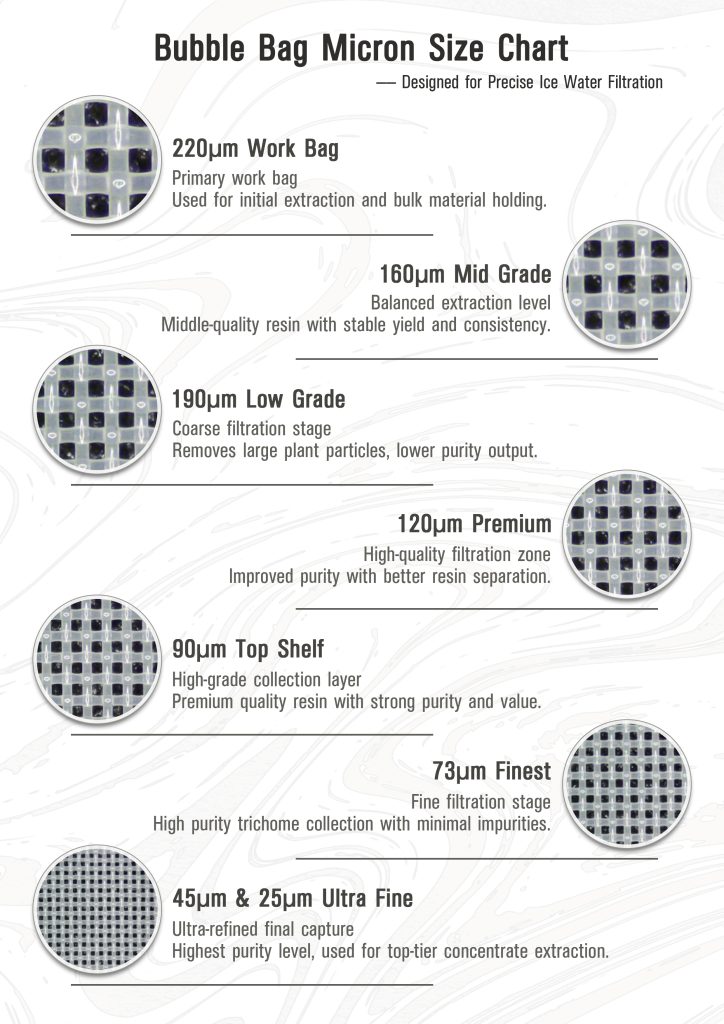
To understand how different micron sizes work together, refer to the Micron Filter Guide.
Why Micron Size Is the Core of Filtration
Micron size controls three key aspects of filtration:
Filtration Precision
Precision refers to how accurately a system separates particles by size.
Smaller micron sizes provide higher precision because they capture finer particles.
Larger micron sizes provide lower precision but allow faster processing.
Filtration Efficiency
Efficiency refers to how quickly and effectively the system processes material.
Larger micron filters improve flow rate and reduce resistance.
Smaller micron filters slow down the process but increase refinement.
Output Consistency
Consistency is the ability to achieve the same results repeatedly.
Using a structured micron system ensures predictable outcomes.
Without proper micron selection, results can vary significantly.
How Micron Size Affects Filtration Results
Micron size directly influences what happens during filtration.
If the micron is too large:
- Smaller particles pass through
- Filtration becomes less precise
- Output may include unwanted material
If the micron is too small:
- Flow rate decreases
- Filters may clog
- Processing time increases
The goal is to balance precision and efficiency.
The Importance of Multi-Stage Filtration
Using a single micron size limits your control over the process.
A multi-stage filtration system solves this problem by using different micron sizes in sequence.
Typical structure:
- Coarse filtration removes large particles
- Medium filtration separates mid-sized particles
- Fine filtration captures small particles
This layered approach improves both efficiency and accuracy.
You can explore multi-layer systems on the Bubble Hash Bags page.
Real-World Example of Micron Impact
Consider a filtration setup using three micron sizes:
- 120 micron
- 73 micron
- 25 micron
In this system:
The 120 micron layer removes larger materials and prepares the flow.
The 73 micron layer performs controlled separation.
The 25 micron layer captures the finest particles.
Each layer depends on the previous one. Removing or misusing a layer reduces overall performance.
Micron Size and Flow Rate
Flow rate is directly affected by micron size.
Larger micron filters allow faster flow because they offer less resistance.
Smaller micron filters slow down the process because they restrict movement.
This relationship is important when designing a filtration system.
A well-designed system balances flow and precision across multiple stages.
Micron Size and Clogging
Clogging is a common issue in filtration.
Fine micron filters are more likely to clog because they capture smaller particles.
Using a coarse pre-filter reduces the load on finer layers and prevents clogging.
This is another reason why multi-stage filtration is more effective than single-layer systems.
Choosing the Right Micron Structure
Selecting the right micron structure depends on your goal.
For Higher Efficiency
Use larger micron sizes in the early stages to maintain flow.
For Higher Precision
Use smaller micron sizes in later stages to refine the output.
For Balanced Performance
Combine multiple micron sizes in a structured sequence.
For practical recommendations, visit the Micron Filter Guide.
Common Misunderstandings About Micron Size
Many users misunderstand how micron size works.
One common misconception is that smaller micron sizes are always better. While they provide finer filtration, they also reduce efficiency.
Another mistake is using only one micron size. This limits control and reduces overall performance.
Some users also ignore the importance of sequencing. Even with the right micron sizes, incorrect order can disrupt the process.
How Micron Size Impacts Different Applications
Micron filtration is used in many industries.
In plant extraction, it controls particle separation.
In laboratory settings, it ensures precise filtering.
In industrial processing, it improves consistency and efficiency.
In all cases, micron size determines how effectively the system performs.
Tips for Optimizing Micron Filtration
To improve your filtration results:
Use multiple micron sizes instead of a single layer
Arrange filters from largest to smallest
Monitor flow rate and adjust accordingly
Maintain clean filtration equipment
Choose high-quality filter bags for consistent performance
Reliable equipment can be found on the Bubble Hash Bags page.