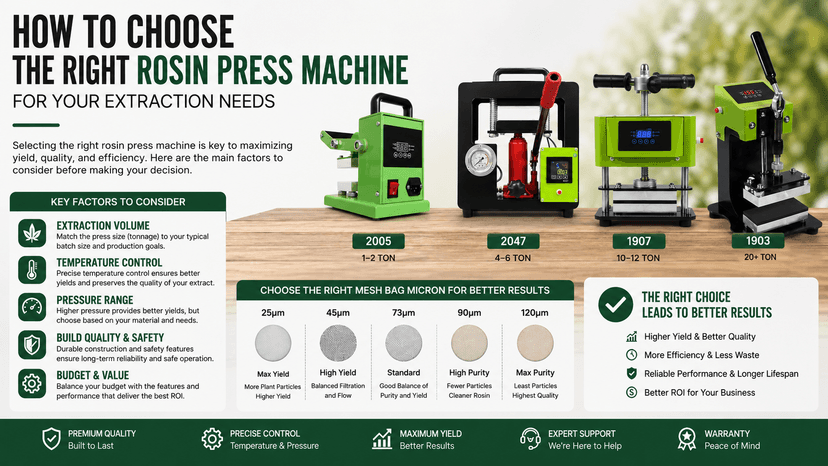
A 10 ton rosin press is a popular choice for processors that need more pressing force than compact 4-ton or 6-ton machines without moving into the size and cost of larger 20-ton commercial systems.
For small and medium commercial processing facilities, extraction laboratories, distributors, private-label brands, and equipment suppliers, a 10-ton machine can offer a practical balance of pressure capacity, platen size, machine footprint, and operating flexibility.
However, choosing the right press requires more than simply comparing tonnage.
Professional buyers should also evaluate:
- Heated platen size
- Effective pressing area
- Hydraulic system
- Pressure control
- Temperature stability
- Frame construction
- Voltage
- Production frequency
- Maintenance
- OEM customization
EXTRACTLAB supplies extraction hardware and filtration products for B2B, wholesale, OEM, and commercial applications.
This guide explains what to consider before purchasing a 10 ton hydraulic rosin press and how to determine whether this machine size fits your production requirements.
What Is a 10 Ton Rosin Press?
A 10 ton rosin press is a heated pressing machine capable of generating approximately:
- 20,000 lb of theoretical maximum force
- 9,070 kg-force
- 89 kN of force
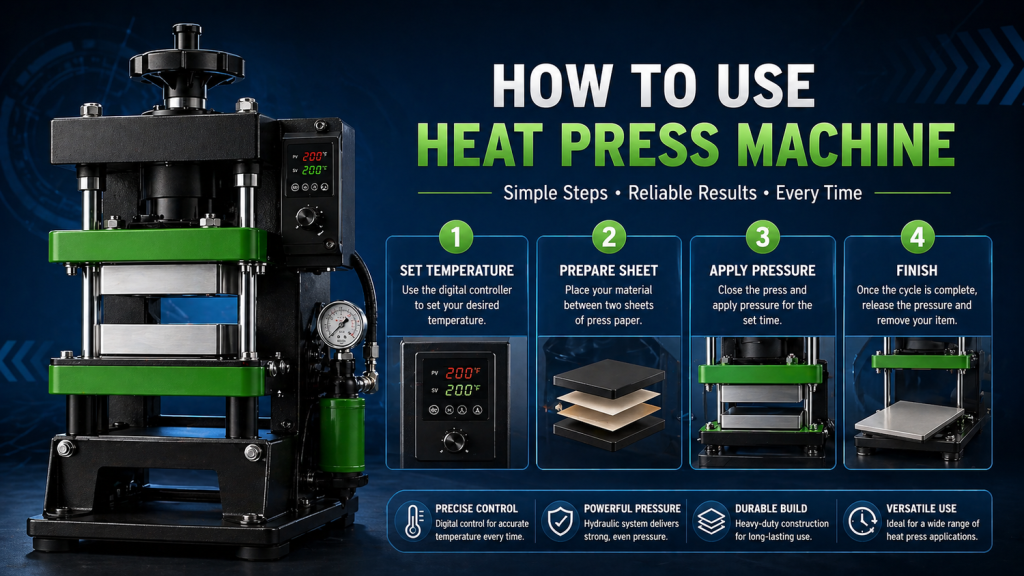
Most machines in this class use a hydraulic cylinder or ram combined with heated upper and lower platens.
A typical 10-ton system may include:
- Steel or reinforced aluminum frame
- Hydraulic ram or cylinder
- Manual or powered hydraulic pump
- Dual heated plates
- PID or digital temperature controller
- Heating elements
- Temperature sensors
- Pressure gauge
- Hydraulic hose and couplings
- Electrical control components
The machine may use an integrated hydraulic system or an external hydraulic pump depending on the design.
Who Should Choose a 10 Ton Rosin Press?
A 10-ton machine is generally well suited to buyers that have outgrown entry-level compact presses but do not yet require a heavy-duty 20-ton or larger industrial system.
Typical users include:
- Small commercial processors
- Medium-batch extraction facilities
- Extraction laboratories
- Product development facilities
- Equipment distributors
- Rosin equipment brands
- OEM buyers
- Processing businesses expanding production
A 10 ton rosin press machine can provide more platen flexibility and available force than a 6-ton system while remaining substantially more compact than many larger commercial presses.
10 Ton Hydraulic Rosin Press
The hydraulic configuration is one of the most common designs in this capacity range.
A 10 ton hydraulic rosin press uses hydraulic pressure to close the heated plates and apply controlled force to the material.
Hydraulic systems can be configured with:
- Manual hand pump
- External hydraulic pump
- Integrated hydraulic jack
- Electric hydraulic pump
Each option suits a different working environment.
Manual Hydraulic Pump
A hand-operated hydraulic pump offers:
- Simple operation
- Good pressure control
- Low system complexity
- Lower equipment cost
- Easy maintenance
This configuration can be appropriate for moderate production where cycle frequency is not extremely high.
The main disadvantage is operator effort.
For frequent commercial pressing, repeated manual pumping can reduce productivity.
External Hydraulic Pump
Some professional 10-ton machines separate the press frame from the hydraulic pump.
This allows buyers to choose a pump with the desired:
- Pressure gauge
- Hose length
- Operating handle
- Pressure rating
- Hydraulic connection
Current 10-ton commercial presses from Dabpress use this modular approach on certain models.
A removable or external pump can also simplify maintenance and component replacement.
Electric Hydraulic Pump
An electric hydraulic pump can reduce operator workload and improve cycle consistency.
It may be more appropriate for:
- Frequent daily operation
- Commercial production
- Higher cycle counts
- Reduced operator fatigue
- More standardized workflows
For larger B2B projects, buyers should confirm whether the hydraulic power unit is included or supplied separately.
How Much Pressure Does a 10 Ton Rosin Press Produce?
Ten tons equals approximately 20,000 pounds of maximum theoretical force.
However, maximum force does not equal actual pressure at the material.
The actual pressure depends on the effective pressing area.
A simplified formula is:
PSI = Applied Force ÷ Effective Pressing Area
For example:
If 20,000 lb is applied over 10 square inches:
20,000 ÷ 10 = 2,000 PSI
If the same force is distributed over 20 square inches:
20,000 ÷ 20 = 1,000 PSI
If it is distributed over 28 square inches:
20,000 ÷ 28 ≈ 714 PSI
This is why plate size and material footprint matter.
Commercial buyers should compare force, plate dimensions, and actual pressing area together, rather than choosing equipment by tonnage alone.
Common Heated Plate Sizes for a 10 Ton Rosin Press
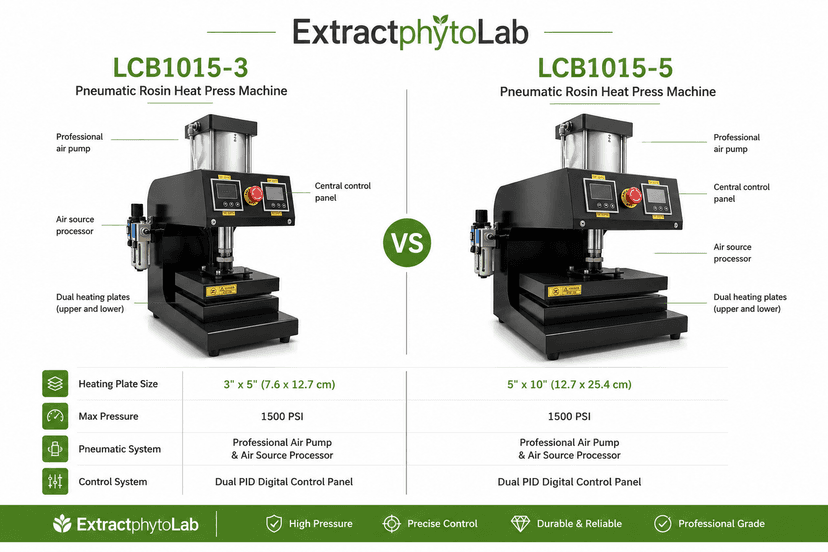
Current 10-ton products use several platen configurations.
Common examples include:
- 3 × 5 inch
- 4 × 7 inch
- 12 × 6 cm
- Custom sizes
Dabpress currently offers 10-ton systems using both 3×5-inch and 4×7-inch heated plates. Graveda’s current 10-ton model uses approximately 12×6 cm plates.
Each format has advantages.
3 × 5 Inch Plates
A 3 × 5 inch platen provides:
15 square inches of plate area
This compact configuration allows a 10-ton machine to maintain high available force over a relatively small working surface.
Advantages include:
- High force-to-area ratio
- Compact machine design
- Smaller batch workflows
- Easier pressure control
- Lower heating power requirements
Current 10-ton machines commonly use 3×5 heated plates for compact commercial configurations.
4 × 7 Inch Plates
A 4 × 7 inch platen provides:
28 square inches of plate area
This larger format gives buyers more usable pressing area.
It can be suitable for:
- Larger batches
- Larger filter bags
- Commercial processing
- Higher throughput
However, the same 10 tons of force is spread across a larger surface.
For that reason, buyers should ensure the machine delivers sufficient pressure for the intended material footprint.
Bigger Plates Are Not Automatically Better
A common sourcing mistake is selecting the largest plate available.
Larger plates offer more area, but pressure per square inch decreases when the same total force is distributed across a larger surface.
For example:
- 3 × 5 in = 15 in²
- 4 × 7 in = 28 in²
At the same 20,000 lb maximum force, the theoretical force per unit area differs substantially.
The correct platen size should match:
- Bag size
- Material amount
- Batch format
- Required pressure
- Production target
A professional 10 ton rosin press manufacturer should recommend platen size according to the application rather than simply offering the largest plate.
Dual Heated Plates
Most professional machines use heated upper and lower platens.
Dual heating helps provide controlled temperature from both sides.
Important platen factors include:
- Aluminum grade
- Surface flatness
- Heating element placement
- Temperature sensor location
- Plate insulation
- Heating uniformity
- Plate alignment
Some current 10-ton systems use anodized aluminum plates and independent heating components to improve heating consistency.
PID Temperature Control
A PID or digital temperature controller allows operators to select and monitor platen temperature.
When evaluating a machine, buyers should ask about:
- Temperature range
- Temperature accuracy
- Heating speed
- Upper platen control
- Lower platen control
- Sensor type
- Celsius / Fahrenheit display
- Controller replacement
Current 10-ton commercial presses often emphasize digital or PID temperature control as a core feature.
For commercial production, stable temperature is more important than an unusually high maximum temperature.
Pressure Gauge
A pressure gauge is highly useful for a 10-ton press.
A gauge helps operators:
- Monitor hydraulic pressure
- Repeat previous settings
- Standardize operating procedures
- Train staff
- Compare batches
- Document process parameters
Without a gauge, operators may know that the machine can reach 10 tons but may not know how much pressure is being applied during a specific cycle.
For commercial use, measurable pressure feedback improves repeatability.
Frame Construction
A 10-ton press must handle significant mechanical force.
The frame should remain rigid under load.
Important construction factors include:
- Steel thickness
- Aluminum grade
- Weld quality
- Reinforcement
- Hydraulic cylinder mounting
- Plate support
- Linear guidance
- Base stability
Current products use different approaches: some use reinforced steel frames, while others combine anodized 6061 aluminum with stainless steel components.
The key requirement is not the material name alone.
What matters is whether the frame maintains platen alignment under operating load.
Plate Alignment
Upper and lower heated plates should remain parallel during pressing.
Poor alignment can create:
- Uneven pressure
- Uneven material distribution
- Bag movement
- Inconsistent results
For commercial equipment sourcing, buyers should request:
- Real machine photos
- Close-up platen photos
- Operating videos
- Frame specifications
- Load-testing information
These provide more useful information than promotional renderings alone.
10 Ton Rosin Press for Commercial Use
A 10-ton machine can be a strong option for small and medium commercial processing.
Before purchasing, evaluate several operational factors.
Batch Size
Determine how much material will be processed per cycle.
Some current 3×5-inch 10-ton systems are positioned around moderate batch sizes, while larger 4×7 configurations are designed for greater capacity.
The most useful way to specify capacity is by:
- Bag dimensions
- Material footprint
- Pressing area
- Required throughput
rather than relying only on a gram rating.
Production Frequency
Consider how often the machine will operate.
A machine running five cycles per day has very different requirements from one running throughout an eight-hour shift.
For frequent use, evaluate:
- Pump durability
- Controller quality
- Heating recovery
- Frame temperature
- Hydraulic seals
- Operator workload
Heat Recovery
Commercial production requires the plates to return to the selected temperature efficiently between cycles.
Slow heat recovery can reduce throughput.
Ask the manufacturer about:
- Heater wattage
- Heating element quantity
- Temperature recovery
- Plate thickness
10 Ton vs. 6 Ton Rosin Press
A 10-ton machine offers approximately 67% more maximum theoretical force than a 6-ton machine.
| Specification | 6 Ton | 10 Ton |
|---|---|---|
| Theoretical maximum force | Approx. 12,000 lb | Approx. 20,000 lb |
| Typical positioning | Small commercial | Small / medium commercial |
| Plate flexibility | Moderate | Greater |
| Larger platen support | More limited | Better |
| Machine footprint | Smaller | Medium |
| Production flexibility | Moderate | Higher |
A 6-ton machine may still be preferable when compact size and smaller batches are the main priorities.
A 10-ton press provides more room for production growth.
10 Ton vs. 12 Ton Rosin Press
The difference between 10 and 12 tons may appear small, but the machine design can be more important than the nominal force rating.
A 12-ton machine provides roughly:
24,000 lb of theoretical force
compared with:
20,000 lb for a 10-ton machine
Current manufacturers position these machine sizes differently depending on frame design, plate size, and production philosophy. Dabpress, for example, currently markets its 10-ton system differently from its heavier-duty 12-ton equipment.
Buyers should therefore compare:
- Plate dimensions
- Frame construction
- Hydraulic architecture
- Pressure measurement
- Production volume
instead of comparing tonnage alone.
10 Ton vs. 20 Ton Rosin Press
A 20-ton machine provides approximately twice the theoretical maximum force of a 10-ton machine.
Choose a 20-ton system when:
- Larger platens are required
- Batch size is substantially larger
- Greater available pressure is necessary
- High-volume production is planned
A 10-ton machine may be better when:
- Production volume is moderate
- Equipment footprint matters
- Smaller platen sizes are sufficient
- Lower equipment cost is preferred
For many growing commercial operations, 10 tons can provide a practical middle ground.
DripTech and Gravity Flow Designs
Some 10-ton machines incorporate a tilting or gravity-flow configuration.
The press can be oriented so that extracted material moves away from the heated platen area.
Current Dabpress 10-ton products prominently use this design concept.
From a procurement perspective, buyers should evaluate:
- Frame stability when tilted
- Hydraulic hose routing
- Controller location
- Collection area
- Operator safety
A gravity-flow system can be useful, but it should not compromise machine stability.
Voltage Options
Depending on the target market, 10-ton presses may be configured for:
- 110V / 120V
- 220V / 230V
- 50 Hz
- 60 Hz
Before placing an order, provide:
- Destination country
- Voltage
- Frequency
- Plug type
Electrical specifications affect heaters, controllers, wiring, and power connections.
For OEM production, destination-market requirements should be confirmed before manufacturing begins.
How to Choose a 10 Ton Rosin Press Manufacturer
B2B buyers should evaluate the supplier as carefully as the equipment.
Manufacturing Capability
Ask whether the supplier can manufacture or modify:
- Press frame
- Heated platens
- Hydraulic system
- Control box
- Pressure gauge
- Electrical components
Customization
Common B2B requirements include:
- Custom plate dimensions
- 110V / 220V
- Custom machine color
- Private label
- Logo plate
- Custom controller
- Pressure gauge configuration
- Packaging
- Accessories
Quality Inspection
A 10-ton press should be inspected for:
- Hydraulic leakage
- Plate alignment
- Heating function
- Temperature accuracy
- Controller operation
- Pressure system
- Electrical wiring
- Frame condition
- Surface finish
Spare Parts
Ask about replacement:
- Heating elements
- Temperature sensors
- PID controllers
- Hydraulic pumps
- Hydraulic cylinders
- Hoses
- Gauges
- Switches
For distributors, spare-parts support is especially important.
OEM 10 Ton Rosin Press
A custom 10 ton rosin press can be suitable for equipment distributors and extraction brands that want their own product line.
OEM options may include:
- Custom logo
- Private-label nameplate
- Machine color
- Packaging
- Manual
- Controller design
- Plate dimensions
- Voltage
- Accessories
EXTRACTLAB works with B2B buyers that require extraction equipment, filtration products, and customized hardware.
For OEM projects, provide estimated quantity and technical requirements early in the discussion.
What Information Should You Send for a Quote?
For an accurate 10 ton rosin press quotation, provide:
Heated Plate Size
For example:
- 3 × 5 inch
- 4 × 7 inch
- Custom
Hydraulic Configuration
Specify:
- Manual hand pump
- External pump
- Electric hydraulic system
Pressure Gauge
State whether a gauge is required.
Voltage
Specify:
- 110V
- 220V
- Other
Include destination country.
Production Requirements
Describe:
- Batch size
- Cycles per day
- Commercial or laboratory use
Quantity
Indicate:
- One trial unit
- Wholesale quantity
- Distributor order
- OEM order
Branding
List:
- Logo
- Color
- Packaging
- User manual
- Labels
A detailed RFQ helps the manufacturer recommend a more suitable configuration.
Rosin Press Bags for a 10 Ton Press
The filter bag should be matched to:
- Heated plate size
- Material quantity
- Micron rating
- Pressing area
- Pressure level
EXTRACTLAB supplies rosin press bags and filter mesh products for commercial extraction applications.
Different micron ratings and bag dimensions can be selected according to the material and workflow.
For distributors, the press and consumables can also be sourced as a coordinated product package.
Frequently Asked Questions
How much force does a 10 ton rosin press produce?
A 10-ton press can theoretically generate approximately 20,000 pounds of force, or about 89 kN.
Actual working pressure depends on hydraulic settings and effective pressing area.
Is a 10 ton rosin press good for commercial use?
Yes.
A 10-ton system can be suitable for small and medium commercial processing, particularly when buyers need more capacity than compact 4-ton or 6-ton machines.
What plate size is best for a 10 ton press?
Both 3×5-inch and 4×7-inch configurations are currently used on commercial 10-ton machines.
The correct size depends on batch size, bag dimensions, and required pressure.
Does a 10 ton rosin press need an external pump?
It depends on the machine.
Some presses use integrated hydraulic systems, while others require an external manual or powered pump.
Always confirm whether the pump, gauge, hose, and couplings are included.
Should a 10 ton press have a pressure gauge?
For commercial use, a gauge is highly recommended because it helps operators reproduce pressure settings between batches.
Is 10 tons enough compared with 20 tons?
For moderate batch sizes and relatively compact platen areas, 10 tons can provide substantial force.
Larger commercial operations using larger plates may benefit from 20 tons or more.
Can EXTRACTLAB customize a 10 ton rosin press?
Custom projects can be evaluated based on platen dimensions, hydraulic system, voltage, control system, branding, packaging, quantity, and destination market.
Can I source rosin bags with the press?
Yes.
EXTRACTLAB supplies extraction filtration products and related hardware, allowing B2B buyers to source compatible presses and consumables together.
Source a 10 Ton Rosin Press From EXTRACTLAB
A 10 ton rosin press offers a useful balance between compact equipment and heavier commercial pressing systems.
Before selecting a machine, compare:
- Actual pressing area
- Heated platen dimensions
- Hydraulic configuration
- Pressure gauge
- Temperature control
- Frame rigidity
- Plate alignment
- Voltage
- Duty cycle
- Spare parts
- OEM options
EXTRACTLAB supplies extraction hardware and filtration products for B2B, wholesale, commercial, and customized projects.
If you are sourcing a 10 ton hydraulic rosin press, private-label machine, rosin filter bags, or a complete pressing solution, send your technical specifications for evaluation.
For a more accurate quotation, include your required plate size, hydraulic configuration, voltage, destination market, order quantity, expected workload, and customization requirements.
Contact EXTRACTLAB to request a 10 ton rosin press quotation and discuss your commercial extraction equipment project.