A 6 ton rosin press offers a practical balance between compact size, hydraulic pressing force, and precise temperature control.
For small processing facilities, commercial startups, testing laboratories, equipment distributors, and private-label brands, a 6-ton press can provide significantly more pressure than entry-level desktop machines without requiring the size, weight, or investment of a larger 12-ton or 20-ton system.
However, machine tonnage is only one part of the selection process.
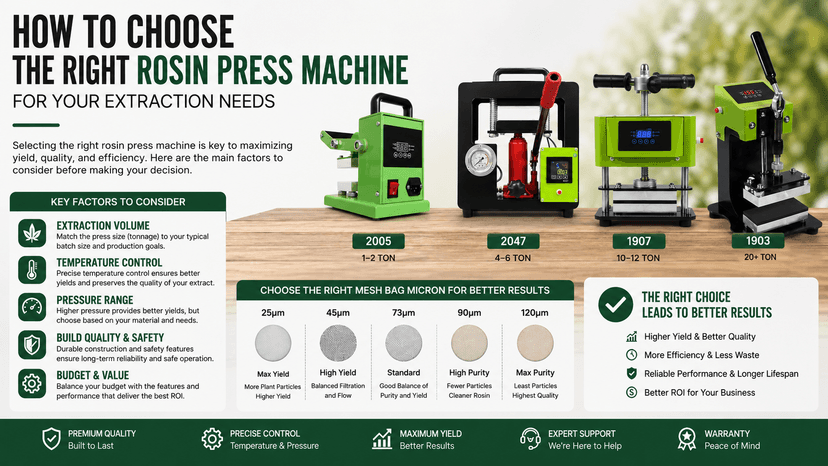
A professional buyer should also compare:
- Heated platen size
- Hydraulic system
- Pressure control
- Temperature accuracy
- Frame strength
- Voltage
- Batch capacity
- Machine footprint
- Spare parts
- OEM customization
EXTRACTLAB supplies extraction hardware and filtration products for commercial, wholesale, and customized processing applications.
This guide explains how to evaluate a 6 ton hydraulic rosin press and determine whether it matches your production requirements.
What Is a 6 Ton Rosin Press?
A 6 ton rosin press is a heated pressing machine capable of producing approximately:
- 12,000 lb of maximum theoretical force
- 5,440 kg-force
- 53.4 kN of force
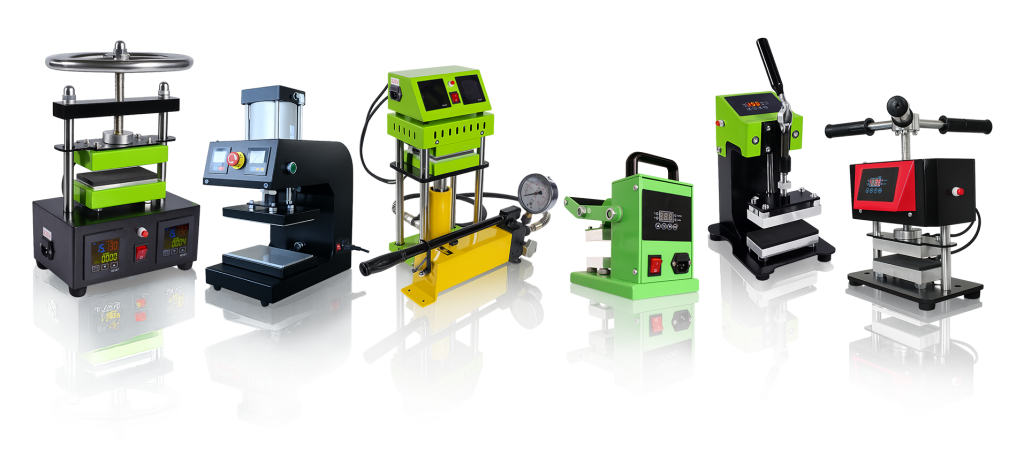
Most machines in this category use a hydraulic jack combined with upper and lower heated aluminum plates.
A typical 6-ton system may include:
- Reinforced steel frame
- Hydraulic bottle jack
- Dual heated platens
- Digital temperature controller
- Heating elements
- Thermocouples or temperature sensors
- Pressure adjustment mechanism
- Electrical control system
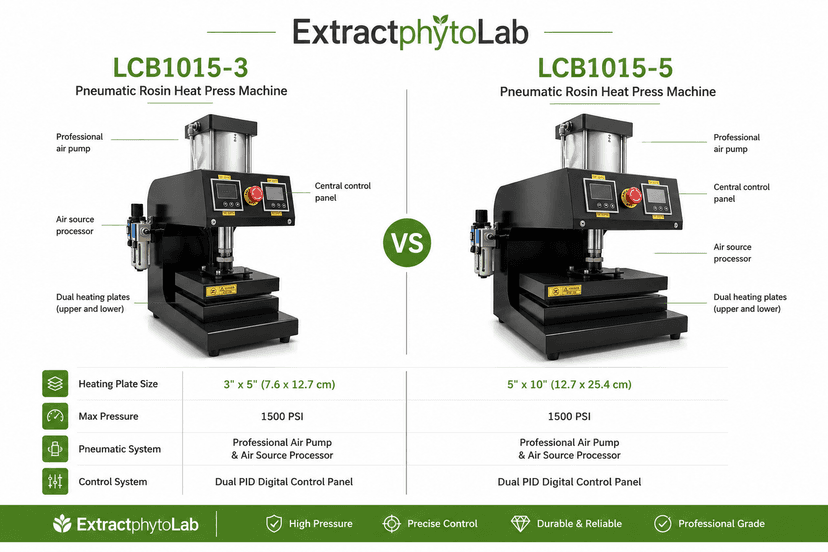
Current commercial products in this category commonly use approximately 3 × 5 inch heated plates, although other configurations are possible.
Who Is a 6 Ton Rosin Press Suitable For?
A 6-ton machine is generally positioned between small hobby presses and larger commercial hydraulic systems.
It can be suitable for:
- Small-batch commercial processing
- Botanical extraction laboratories
- Product development
- Sample production
- Small processing businesses
- Extraction equipment distributors
- Private-label brands
- Operators upgrading from smaller presses
A 6 ton machine can be particularly attractive when floor space is limited.
Compared with larger systems, it can provide useful hydraulic force while remaining compact enough for a workbench or small production area.
6 Ton Hydraulic Rosin Press
The most common configuration is a 6 ton hydraulic rosin press.
A hydraulic bottle jack generates pressure while the heated plates apply controlled temperature to the material.
The basic advantages of this design include:
- Simple mechanical construction
- Strong pressing force
- Compact dimensions
- Relatively low maintenance
- No external air compressor required
- Easy pressure adjustment
- Replaceable hydraulic components
For many small commercial users, this design provides a good balance between cost and performance.
Some current 6-ton machines use replaceable hydraulic bottle jacks, which can simplify long-term maintenance.
How Much Force Does a 6 Ton Rosin Press Produce?
Six tons is approximately 12,000 pounds of theoretical maximum force.
However, buyers should not evaluate performance only by tonnage.
The actual pressure at the material surface depends on the pressing area.
A simplified calculation is:
PSI = Applied Force ÷ Effective Pressing Area
For example:
If 12,000 lb is applied over 10 square inches:
12,000 ÷ 10 = 1,200 PSI
If the same force is distributed over 20 square inches:
12,000 ÷ 20 = 600 PSI
This shows why pressing area matters.
A larger heated plate does not automatically improve extraction performance if the effective pressure becomes too low.
For B2B equipment selection, available force and actual pressing area should always be evaluated together.
Typical Heated Plate Size
One of the most common platen configurations for a 6 ton press is:
3 × 5 inches
This size is used by several current commercial models from established brands.
A 3 × 5 inch platen provides:
15 square inches of total plate surface
However, the actual material pressing area may be smaller depending on bag dimensions and loading method.
Other custom platen dimensions may also be possible.
When selecting plate size, buyers should consider:
- Material quantity per cycle
- Filter bag size
- Pre-press mold dimensions
- Required pressure
- Available frame opening
- Production frequency
Why 3 × 5 Inch Plates Are Common on 6 Ton Machines
The 3 × 5 inch format provides a useful balance between usable pressing area and available force.
If the plates become substantially larger, the same six tons of maximum force must be distributed over more surface area.
For small commercial production, this can reduce effective pressure.
This is one reason why compact 6-ton machines frequently use relatively small heated plates rather than large industrial platens.
Dual Heated Plates
Most professional 6-ton machines use both upper and lower heated plates.
Dual heating helps provide controlled heat from both directions.
A quality platen system should provide:
- Even temperature distribution
- Stable surface temperature
- Fast heating response
- Reliable temperature sensors
- Good plate alignment
Aluminum is commonly used because of its thermal conductivity.
However, material alone does not determine plate quality.
The position and quality of the heating elements, temperature sensors, controller, and plate machining also affect performance.
Temperature Control
Accurate temperature control is one of the most important features of a compact hydraulic press.
Current 6-ton machines commonly use digital temperature controllers or PID-style control systems.
When comparing machines, ask about:
- Maximum temperature
- Minimum temperature
- Controller accuracy
- Upper and lower platen control
- Heating time
- Temperature variation
- Sensor type
- Celsius / Fahrenheit display
For commercial production, repeatability is often more important than an unusually high maximum temperature.
A machine that consistently maintains the selected operating temperature can be more useful than one with a higher temperature range but poor stability.
Pressure Gauge or No Pressure Gauge?
Some 6-ton machines are sold with a pressure gauge, while others rely on manual operator feedback.
A pressure gauge can help operators:
- Repeat previous settings
- Standardize production
- Train new operators
- Compare batches
- Document pressing parameters
For occasional operation, a gauge may not be essential.
For repeated commercial production, however, measurable pressure feedback can make process control easier.
Manual Hydraulic Operation
Most compact 6-ton machines use a hand-operated hydraulic jack.
The operator pumps the handle to increase pressure and releases the hydraulic valve after the pressing cycle.
Advantages include:
- Simple operation
- Low equipment complexity
- No compressor
- No powered hydraulic unit
- Easy maintenance
- Lower purchase cost
The main limitation is operator labor.
If hundreds of cycles need to be completed every day, a manual hydraulic system may become inefficient.
For high-throughput production, buyers may want to consider a larger electric-hydraulic or pneumatic system.
6 Ton Rosin Press for Small Commercial Production
A 6-ton machine can be suitable for small commercial operations when production volume is moderate.
Important considerations include:
Batch Size
Determine how much material will be processed per cycle.
Some current 6-ton machines are marketed for loads around 10–20 g depending on material type and pressing configuration, but actual suitable loads vary considerably by machine and process.
For commercial procurement, manufacturers should evaluate your actual bag size and pressing area rather than relying only on a stated gram capacity.
Cycles Per Day
A machine used five times per day has very different requirements from one used continuously.
If production frequency is high, evaluate:
- Hydraulic jack durability
- Heating recovery
- Controller reliability
- Operator workload
- Frame temperature
- Maintenance access
Available Workspace
Compact size is one of the main advantages of a 6-ton machine.
For laboratories, workshops, small processing facilities, and retail production environments, a compact footprint may be more valuable than having unused additional tonnage.
6 Ton vs. 4 Ton Rosin Press
A 4-ton machine can be sufficient for small batches.
Moving to 6 tons increases available force by 50%.
| Specification | 4 Ton | 6 Ton |
|---|---|---|
| Theoretical force | Approx. 8,000 lb | Approx. 12,000 lb |
| Typical positioning | Entry-level | Small commercial |
| Plate flexibility | Smaller | Greater |
| Machine size | Compact | Compact / medium |
| Pressure capacity | Lower | Higher |
| Commercial flexibility | Limited | Better |
For buyers processing regularly, the additional force can provide more flexibility without significantly increasing machine size.
6 Ton vs. 10 Ton Rosin Press
A 10-ton press provides approximately 20,000 lb of theoretical force compared with approximately 12,000 lb from a 6-ton system.
A 10-ton machine may be appropriate if:
- Larger plates are required
- Batch size is increasing
- Greater pressure is needed
- Production volume is growing
However, a 6-ton model may still be the better solution when:
- Workspace is limited
- Batch sizes are small
- Equipment needs to be portable
- Operating frequency is moderate
- Lower investment is preferred
Higher tonnage does not automatically mean better performance.
The correct capacity depends on the application.
6 Ton vs. 12 Ton Rosin Press
A 12-ton press provides approximately twice the maximum theoretical force of a 6-ton machine.
Larger 12-ton systems can support:
- Larger pressing areas
- Larger batches
- Higher production volume
- Heavier commercial workflows
A 6 ton press is generally better suited to compact and lower-volume processing.
For buyers planning future expansion, it is worth comparing expected production volume over the next one to three years before selecting machine size.
Voltage Options
International buyers should pay close attention to voltage.
Current 6-ton commercial presses are commonly available in configurations such as:
- 110V / 120V
- 220V / 230V
Rosineer, for example, currently offers its BOOST-6 in both 110V and 220V versions.
Before production, confirm:
- Destination country
- Voltage
- Frequency
- Plug type
- Rated power
Do not assume a standard machine is suitable for every market.
Frame Construction
Even at six tons, the frame must withstand significant mechanical force.
Buyers should inspect:
- Steel thickness
- Welding quality
- Frame reinforcement
- Jack mounting
- Platen support
- Alignment
- Machine base
- Surface coating
A rigid frame helps maintain parallel plate movement.
Excessive flex can create uneven pressure and affect repeatability.
For B2B sourcing, request real factory photos and machine videos rather than relying only on rendered images.
Safety Features
Safety should also be considered when comparing machines.
Depending on the design, features may include:
- Overpressure protection
- Enclosed hydraulic components
- Stable base
- Heat-resistant handles
- Electrical protection
- Insulated wiring
- Emergency controls
Some current 6-ton presses specifically highlight overpressure protection and enclosed hydraulic designs.
For wholesale or private-label projects, clarify applicable market requirements before placing an order.
How to Choose a 6 Ton Rosin Press Manufacturer
For B2B buyers, the supplier should be evaluated separately from the machine.
Important questions include:
Can the Manufacturer Customize the Machine?
Potential customization may include:
- Plate dimensions
- Machine color
- Voltage
- Plug type
- Controllers
- Pressure gauge
- Branding
- Packaging
- Accessories
Are Replacement Parts Available?
Important spare parts can include:
- Hydraulic jack
- Heating elements
- Thermocouples
- PID controllers
- Switches
- Power cables
- Pressure gauges
A replaceable hydraulic jack is particularly useful for extending machine service life.
Is OEM Branding Available?
Distributors and equipment brands may require:
- Private logo
- Nameplate
- Custom color
- Packaging design
- User manual
- Labels
- Accessories
For OEM projects, buyers should discuss MOQ and customization requirements before ordering.
OEM 6 Ton Rosin Press
A custom 6 ton rosin press can be a good product category for distributors who want a compact machine under their own brand.
Typical OEM options may include:
- Logo printing
- Custom nameplate
- Machine housing color
- Private-label packaging
- Voltage configuration
- Controller appearance
- Plate dimensions
- Accessories
- User manual customization
EXTRACTLAB works with B2B buyers that need extraction hardware for commercial, wholesale, and private-label applications.
For custom projects, send complete specifications before requesting a quotation.
What Information Should You Send for a Quote?
To receive an accurate quotation, provide:
Machine Capacity
Specify that you require:
6 ton
Heated Plate Size
For example:
- 3 × 5 inch
- Custom dimensions
Voltage
Specify:
- 110V
- 220V
- Other
Include destination country and frequency.
Pressure Gauge
Specify whether a pressure gauge is required.
Quantity
Indicate:
- 1 trial unit
- Small wholesale order
- Distributor order
- OEM order
- Annual purchasing volume
Branding Requirements
Specify:
- Logo
- Color
- Packaging
- Labels
- Manuals
Related Accessories
Tell the supplier if you also require:
- Rosin bags
- Pre-press molds
- Filter mesh
- Pressing accessories
A complete RFQ makes it easier to provide the correct machine configuration.
Rosin Press Bags for a 6 Ton Press
The filter bag is an important part of the pressing system.
Bag selection can depend on:
- Material type
- Micron rating
- Bag dimensions
- Seam construction
- Material strength
- Pressing pressure
A 6-ton machine may be used with different bag sizes depending on platen dimensions.
EXTRACTLAB supplies rosin press bags and filtration products for different extraction applications.
For wholesale projects, the machine and filtration consumables can be selected together.
Why Source the Press and Rosin Bags Together?
For distributors and commercial processors, sourcing compatible equipment and consumables from the same supplier can simplify purchasing.
Benefits can include:
- Easier size matching
- Compatible platen and bag dimensions
- Fewer suppliers
- Combined packaging
- OEM branding consistency
- More efficient repeat orders
This is particularly useful for businesses that sell complete extraction equipment packages.
Frequently Asked Questions
How much force does a 6 ton rosin press produce?
A 6-ton press can theoretically produce approximately 12,000 pounds of maximum force, or about 53.4 kN.
Actual usable pressure depends on the machine and effective pressing area.
Is a 6 ton rosin press enough?
For small-batch and light commercial processing, six tons can provide sufficient available force.
Larger commercial applications may benefit from 10-ton, 12-ton, or 20-ton machines.
What plate size is common on a 6 ton rosin press?
3 × 5 inch heated plates are common among current 6-ton hydraulic presses.
Other sizes may be possible depending on machine design.
Is a 6 ton rosin press suitable for commercial use?
Yes, particularly for small commercial operations, product testing, and moderate-volume production.
High-throughput operations may require larger or powered systems.
Is hydraulic or electric better?
A manual hydraulic machine is simpler and usually more economical.
Powered machines reduce operator workload and can be more appropriate for high-frequency production.
Should a 6 ton rosin press have a pressure gauge?
A gauge is not essential for basic operation, but it can improve repeatability by giving operators measurable pressure feedback.
This is particularly useful for commercial processes.
Can EXTRACTLAB customize a 6 ton rosin press?
Customization projects can be evaluated based on plate size, voltage, pressure system, controls, branding, packaging, quantity, and destination market.
Can I order rosin bags together with the press?
Yes. EXTRACTLAB supplies filtration and extraction hardware, allowing buyers to source compatible press equipment and consumables for commercial applications.
Source a 6 Ton Rosin Press From EXTRACTLAB
A 6 ton rosin press can be an effective solution for buyers who need more force than a compact entry-level machine while still wanting a relatively small equipment footprint.
When comparing machines, do not evaluate tonnage alone.
Consider:
- Heated platen size
- Effective pressing area
- Temperature accuracy
- Hydraulic design
- Pressure gauge
- Frame rigidity
- Voltage
- Batch requirements
- Production frequency
- Spare parts
- OEM customization
EXTRACTLAB supplies extraction hardware and filtration products for B2B, wholesale, commercial, and custom applications.
If you are sourcing a 6 ton hydraulic rosin press, private-label extraction machine, rosin bags, or a complete pressing solution, send your specifications for evaluation.
Include your required platen dimensions, voltage, destination market, quantity, branding requirements, and expected production volume.
Contact EXTRACTLAB for a 6 ton rosin press quotation and custom extraction equipment solution.