A 12 ton rosin press is designed for processors who need more pressing capacity than compact 4-ton, 6-ton, or 10-ton systems while still wanting a machine that is manageable for small and medium commercial production.
With approximately 24,000 lb of theoretical pressing force, a 12-ton hydraulic system can support larger heated platens, larger pressing areas, and heavier production workloads.
For extraction businesses, equipment distributors, private-label brands, laboratories, and commercial processors, a 12-ton machine often represents an effective step between compact tabletop presses and larger 20-ton industrial systems.
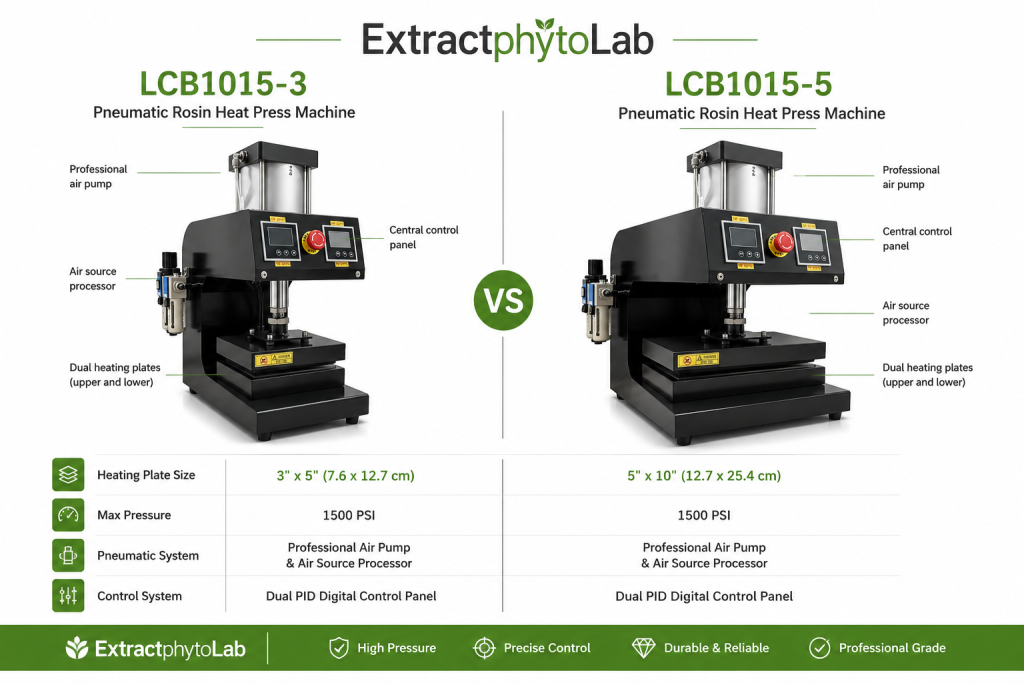
However, tonnage alone should never determine which machine to buy.
Professional buyers should also evaluate:
- Heated plate dimensions
- Effective pressing area
- Hydraulic system
- Pressure gauge
- Temperature control
- Heating power
- Frame construction
- Plate alignment
- Voltage
- Production frequency
- Spare parts
- OEM customization
EXTRACTLAB supplies extraction equipment, filter bags, filtration products, and related hardware for B2B and commercial processing applications.
This guide explains how to evaluate a 12 ton hydraulic rosin press before placing an order.
What Is a 12 Ton Rosin Press?
A 12 ton rosin press is a heated hydraulic pressing machine capable of generating approximately:
- 24,000 lb of theoretical maximum force
- 10,886 kg-force
- 106.8 kN of force
Most professional machines in this category combine:
- A reinforced press frame
- Hydraulic cylinder or bottle jack
- Upper and lower heated platens
- Temperature controllers
- Heating elements
- Pressure control components
- Electrical controls
Current commercial 12-ton presses commonly use larger 4 × 7 inch heated plates, making this capacity particularly suitable for processors moving beyond compact 3×5-inch systems.
Why Choose a 12 Ton Rosin Press?
A 12-ton press offers more available force than a 6-ton or 10-ton machine while remaining smaller than many 20-ton industrial systems.
It may be suitable for:
- Medium commercial processing
- Larger batch production
- Extraction laboratories
- Product development facilities
- Processing workshops
- Equipment distributors
- OEM equipment brands
- Private-label projects
For buyers using larger filter bags or pressing areas, the extra force can provide additional flexibility.
12 Ton Hydraulic Rosin Press
Hydraulic operation is the most common configuration in this machine class.
A 12 ton hydraulic rosin press uses hydraulic pressure to move the heated platens together.
Depending on the design, the machine may use:
- Integrated bottle jack
- External hydraulic hand pump
- Hydraulic cylinder
- Electric hydraulic pump
The correct configuration depends largely on production frequency.
Bottle Jack 12 Ton Rosin Press
One common design uses an integrated hydraulic bottle jack.
Advantages include:
- Compact structure
- Simple operation
- No external pump required
- Easy maintenance
- Relatively low equipment complexity
Some current commercial machines use replaceable bottle jacks, which can make long-term maintenance easier.
This type of system can work well for moderate commercial production.
The main disadvantage is manual operation.
If operators need to complete a large number of cycles every day, repeated pumping can reduce productivity.
External Hydraulic Pump System
Another design separates the hydraulic pump from the press frame.
The pump connects to the hydraulic cylinder through a high-pressure hose.
This configuration can provide:
- Easier pressure monitoring
- Improved ergonomic operation
- Replaceable pump components
- Better access for maintenance
- More flexible machine layout
Current 12-ton systems are available with external hydraulic pump configurations, and some pumps incorporate gauges rated around 10,000 PSI.
For B2B purchasing, always confirm whether:
- Pump is included
- Hose is included
- Pressure gauge is included
- Couplings are included
These components may be sold separately depending on the supplier.
How Much Pressure Does a 12 Ton Rosin Press Produce?
A 12-ton press provides approximately 24,000 lb of theoretical maximum force.
But actual pressure at the material depends on pressing area.
A simple calculation is:
PSI = Applied Force ÷ Effective Pressing Area
For example:
If 24,000 lb is distributed across 12 square inches:
24,000 ÷ 12 = 2,000 PSI
Across 20 square inches:
24,000 ÷ 20 = 1,200 PSI
Across 28 square inches:
24,000 ÷ 28 ≈ 857 PSI
These figures are theoretical and do not account for hydraulic losses, machine geometry, or actual applied force.
However, they demonstrate an important principle:
Pressing area matters as much as machine tonnage.
A professional buyer should therefore ask about both maximum force and effective working area.
4 × 7 Inch Heated Plates
One of the most common configurations for current 12-ton commercial presses is:
4 × 7 inch dual heated platens
A 4 × 7 plate provides:
28 square inches of surface area
Current Dabpress 12-ton machines use this format, positioning it as a larger commercial pressing surface compared with the 3×5-inch plates commonly found on smaller machines.
The larger plate area can support:
- Larger filter bags
- Multiple smaller pucks
- Larger batch configurations
- Higher commercial throughput
However, larger plates must also be matched with sufficient available pressure.
Why 4 × 7 Plates Work Well With 12 Tons
The 4×7 format provides considerably more working area than 3×5 plates.
Compare:
| Plate Size | Surface Area |
|---|---|
| 3 × 5 in | 15 in² |
| 4 × 7 in | 28 in² |
A 4×7 plate provides almost 87% more surface area than a 3×5 plate.
This additional area makes larger batches possible.
At the same time, additional hydraulic force is needed to maintain useful pressure across the larger material footprint.
This is one reason 12-ton machines are frequently paired with 4×7 plates.
Dual Heated Platens
Professional machines typically use heating in both upper and lower platens.
Dual heating helps provide more consistent thermal exposure.
Important factors include:
- Heating element placement
- Plate thickness
- Aluminum quality
- Sensor location
- Temperature recovery
- Plate insulation
- Surface flatness
The quality of the heating system matters just as much as the maximum temperature setting.
Heating Power
Heating wattage can influence:
- Warm-up time
- Heat recovery
- Temperature stability
- Production speed
Current commercial 12-ton systems may use approximately 1,200 watts of total heating power, often distributed across multiple heating rods.
For example, a system may use four heating elements totaling approximately 1,200W.
Higher wattage is not automatically better, but sufficient heater capacity can improve recovery between pressing cycles.
For commercial production, this can reduce downtime.
PID Temperature Control
A PID controller continuously monitors platen temperature and adjusts heater output to maintain the selected setting.
A quality commercial system should provide:
- Accurate temperature adjustment
- Stable operating temperature
- Fast recovery
- Reliable sensors
- Clear digital display
Some current 12-ton machines specify operating ranges up to approximately 399°F, although the actual processing temperature used will typically be determined by the material and workflow.
When sourcing a machine, ask about:
- Temperature range
- Accuracy
- Upper/lower control
- Sensor type
- Display units
- Controller replacement availability
Pressure Gauge
A 12 ton rosin press with pressure gauge can provide more useful process information than a machine without pressure feedback.
The gauge allows operators to:
- Monitor hydraulic pressure
- Repeat settings
- Develop standard operating procedures
- Train staff
- Compare production batches
This becomes increasingly valuable as machine capacity increases.
For commercial processing, measurable pressure is generally preferable to relying entirely on operator feel.
Heavy-Duty 4-Post Frame
Frame construction becomes increasingly important at higher force levels.
Many current 12-ton presses use a 4-post frame.
A four-post structure can help maintain:
- Plate parallelism
- Structural rigidity
- Smooth vertical movement
- Better load distribution
Current commercial products specifically market 4-post construction as a key feature for heavier-duty use.
When comparing machines, evaluate:
- Frame material
- Post diameter
- Plate support
- Weld quality
- Crossbeam thickness
- Cylinder mounting
- Base stability
The frame should remain rigid as pressure increases.
Why Plate Alignment Matters
The upper and lower heated platens should stay parallel.
Poor alignment can cause:
- Uneven pressure
- Uneven material thickness
- Filter bag movement
- Inconsistent pressing
- Increased component wear
For B2B purchasing, request actual operating videos rather than relying entirely on catalog photographs.
A video under load provides a better indication of frame stability and platen movement.
12 Ton Rosin Press for Commercial Production
A 12-ton machine is particularly suitable for buyers transitioning from small-batch processing to more consistent commercial production.
Important factors include:
Batch Capacity
Larger plates can accommodate greater material quantities.
Some current 12-ton commercial systems are positioned around approximately 28 g or greater depending on pressing format and material configuration.
However, buyers should not select a press based solely on a manufacturer’s gram rating.
Actual capacity depends on:
- Material type
- Bag size
- Pre-press dimensions
- Material density
- Pressing technique
- Desired pressure
For industrial purchasing, platen area is generally a more useful specification than an advertised gram capacity.
Production Frequency
Consider how frequently the machine will operate.
For example:
Light production
Several cycles per day.
Medium commercial production
Repeated operation throughout the day.
Heavy commercial production
Frequent or back-to-back pressing cycles.
For higher operating frequency, evaluate:
- Heater recovery
- Hydraulic durability
- Frame temperature
- Controller quality
- Pump ergonomics
- Component serviceability
Heat Recovery
Heat recovery describes how quickly the plates return to the selected temperature after a pressing cycle.
For commercial users, slow recovery can limit daily output.
Factors affecting recovery include:
- Heater wattage
- Plate thickness
- Plate mass
- Controller design
- Insulation
This is one reason heating power deserves attention when comparing commercial machines.
12 Ton vs. 10 Ton Rosin Press
The difference between 10 and 12 tons is approximately 4,000 lb of theoretical available force.
| Specification | 10 Ton | 12 Ton |
|---|---|---|
| Theoretical maximum force | Approx. 20,000 lb | Approx. 24,000 lb |
| Typical positioning | Small/medium commercial | Medium commercial |
| Common plate options | 3×5 / 4×7 | 4×7 |
| Larger-batch suitability | Good | Better |
| Pressure reserve | Moderate | Higher |
| Equipment size | Medium | Medium/heavy |
The additional 20% theoretical force can be useful when larger plates and material footprints are used.
However, machine design matters more than the tonnage difference alone.
12 Ton vs. 6 Ton Rosin Press
A 12-ton machine provides approximately twice the theoretical maximum force of a 6-ton press.
A 6-ton machine may be more suitable for:
- Smaller batches
- Compact workspace
- Lower production frequency
- Smaller 3×5 plates
A 12-ton machine may be more appropriate for:
- 4×7 plates
- Larger batches
- Commercial workflows
- Higher throughput
- Production expansion
Buyers expecting future growth may benefit from choosing additional capacity.
12 Ton vs. 20 Ton Rosin Press
A 20-ton machine provides substantially more available force.
However, not every commercial processor needs 20 tons.
Choose 12 Ton When:
- 4×7 plates are sufficient
- Batch size is moderate
- Equipment footprint matters
- Production volume is medium
- Lower capital cost is preferred
Consider 20 Ton When:
- Large plates are required
- Higher pressure reserve is necessary
- Batch size is significantly larger
- Heavy production is planned
The correct choice depends more on actual pressing area than the tonnage number alone.
12 Ton Bottle Jack vs. Hydraulic Cylinder
Both configurations can produce substantial force.
Bottle Jack
Advantages:
- Compact
- Simple
- Economical
- Easy replacement
- No external pump
Suitable for moderate production.
Hydraulic Cylinder
Advantages:
- External pressure gauge options
- Easier pump operation
- More modular system
- Better suited to repeated use
- Compatible with powered pumps
Often preferred for more commercial workflows.
Neither system is automatically superior.
The best option depends on cycle frequency, maintenance expectations, and budget.
Voltage Options
Heating systems normally require electrical power even when pressure is manually hydraulic.
Possible configurations include:
- 110V / 120V
- 220V / 230V
- 50 Hz
- 60 Hz
International buyers should provide:
- Destination country
- Voltage
- Frequency
- Plug type
Voltage affects:
- Heating elements
- Controllers
- Wiring
- Power cables
Electrical configuration should always be confirmed before production.
What Should You Look for in a 12 Ton Rosin Press Manufacturer?
For B2B sourcing, evaluate both equipment specifications and supplier capability.
Product Engineering
Ask about:
- Frame construction
- Plate dimensions
- Hydraulic system
- Heating system
- Temperature controls
- Gauge configuration
Quality Control
Inspection should include:
- Plate alignment
- Heating performance
- Temperature accuracy
- Hydraulic leakage
- Gauge operation
- Wiring
- Frame integrity
- Surface finish
Spare Parts
Ask whether the supplier can provide replacement:
- Hydraulic jack
- Hydraulic pump
- Cylinder
- Pressure gauge
- Heating elements
- Sensors
- PID controllers
- Electrical switches
A serviceable machine can reduce long-term ownership cost.
OEM 12 Ton Rosin Press
Equipment distributors and extraction brands may require a custom 12 ton rosin press under their own branding.
Depending on project requirements, possible OEM options may include:
- Custom logo
- Nameplate
- Machine color
- Packaging
- User manual
- Plate dimensions
- Voltage
- Temperature controller
- Pressure gauge
- Accessories
EXTRACTLAB works with B2B buyers sourcing extraction equipment and filtration products for wholesale and custom projects.
For OEM inquiries, providing technical requirements early helps determine whether a standard configuration or customized machine is more appropriate.
What Information Should You Send for a Quote?
When requesting a quotation for a 12 ton rosin press, provide the following information.
Heated Plate Size
For example:
- 4 × 7 inch
- Custom dimensions
Hydraulic System
Specify:
- Bottle jack
- External hand pump
- Electric hydraulic pump
Pressure Gauge
State whether pressure monitoring is required.
Heating Power
Specify any particular heating or warm-up requirements.
Voltage
Provide:
- 110V
- 220V
- Other
Include frequency and destination market.
Order Quantity
Specify whether you need:
- One test machine
- Wholesale order
- Distributor quantity
- OEM production
Customization
List requirements such as:
- Logo
- Machine color
- Packaging
- Controller
- Manual
- Accessories
A detailed request allows a manufacturer to provide a more accurate configuration and quotation.
Rosin Filter Bags for a 12 Ton Press
Higher-force machines require filter bags that are properly matched to the pressing process.
Bag selection depends on:
- Material type
- Micron rating
- Bag dimensions
- Seam construction
- Material strength
- Pressing area
Common micron options may include:
- 25 μm
- 37 μm
- 45 μm
- 73 μm
- 90 μm
- 120 μm
- 160 μm
The correct micron rating depends on the material being processed and desired filtration level.
EXTRACTLAB supplies rosin filter bags in different micron ratings and dimensions for commercial processing.
Source the Press and Filter Bags Together
For equipment distributors, sourcing the machine and consumables together can simplify procurement.
Benefits may include:
- Matching bag and platen dimensions
- Simplified supplier management
- OEM branding
- Combined shipping
- Easier repeat orders
- Complete extraction kits
This can be particularly useful for private-label brands building a complete equipment product line.
Frequently Asked Questions
How much force does a 12 ton rosin press produce?
A 12-ton press can theoretically generate approximately 24,000 lb of maximum force, equivalent to roughly 106.8 kN.
Actual pressure at the material depends on hydraulic settings and pressing area.
Is a 12 ton rosin press good for commercial use?
Yes.
A 12-ton system can be well suited to medium commercial production because it provides substantial force and can support larger platen configurations such as 4×7 inches.
What plate size is common on a 12 ton rosin press?
4×7-inch dual heated plates are common among current commercial 12-ton machines.
Is 12 ton better than 10 ton?
Not necessarily.
A 12-ton machine offers approximately 20% more theoretical maximum force, but platen size, frame design, heating performance, and hydraulic configuration are equally important.
Is 12 ton enough compared with 20 ton?
For many medium commercial workflows using 4×7 plates, 12 tons can provide substantial available force.
Larger pressing areas or heavy industrial production may benefit from a 20-ton system.
Should I choose a bottle jack or hydraulic cylinder?
Bottle-jack machines are compact and straightforward.
Cylinder-and-pump systems can provide better pressure monitoring and may be more suitable for frequent commercial operation.
Does a 12 ton press need a pressure gauge?
A gauge is strongly useful for commercial production because it allows operators to monitor and repeat hydraulic pressure settings.
Can EXTRACTLAB supply custom 12 ton rosin presses?
Custom projects can be evaluated according to machine configuration, platen dimensions, voltage, hydraulic system, controls, branding, quantity, and packaging requirements.
Can I source rosin press bags with the machine?
Yes.
EXTRACTLAB supplies filtration products and extraction hardware, allowing commercial and wholesale buyers to source compatible equipment and consumables.
Source a 12 Ton Rosin Press From EXTRACTLAB
A 12 ton rosin press offers a strong balance between compact commercial equipment and larger industrial pressing systems.
Its additional force makes it especially suitable for larger heated plates and medium commercial production.
Before purchasing, evaluate:
- Heated plate dimensions
- Effective pressing area
- Hydraulic system
- Pressure gauge
- Heating power
- Temperature control
- Frame construction
- Plate alignment
- Voltage
- Production frequency
- Spare parts
- OEM requirements
EXTRACTLAB supplies extraction equipment, filtration products, rosin press bags, and related hardware for B2B, commercial, wholesale, and customized applications.
If you are sourcing a 12 ton hydraulic rosin press, private-label press, rosin bags, or a complete extraction equipment package, provide your specifications for evaluation.
For an accurate quotation, include required plate dimensions, hydraulic configuration, voltage, destination market, order quantity, production requirements, and branding needs.
Contact EXTRACTLAB to request a 12 ton rosin press quotation and discuss your commercial extraction equipment project.