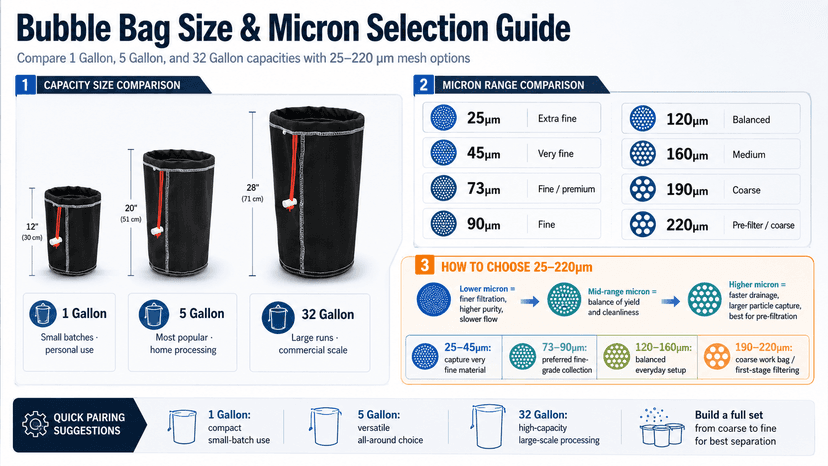
No matter which type of bubble bags you use – 1 gallon, 5 gallon, 10 gallon, 20 gallon or 32 gallon – you will encounter difficulties in choosing the right size.
Understanding micron sizes is essential for anyone working with filtration systems. However, many beginners and even intermediate users struggle with one key concept: how to properly read and apply a micron size chart.
A micron chart is more than just a reference table. It is a practical tool that helps you:
- Choose the right filtration setup
- Improve separation efficiency
- Control the quality of your final output
Without a clear understanding of micron sizes, it becomes difficult to achieve consistent and repeatable results.
In this guide, we will explain how a bubble hash micron chart works, how to interpret it correctly, and how to apply it in real filtration scenarios.
What Is a Micron Size Chart?
A micron size chart is a structured reference that lists different micron levels and their corresponding filtration roles. Each micron value represents the size of openings in the mesh material.
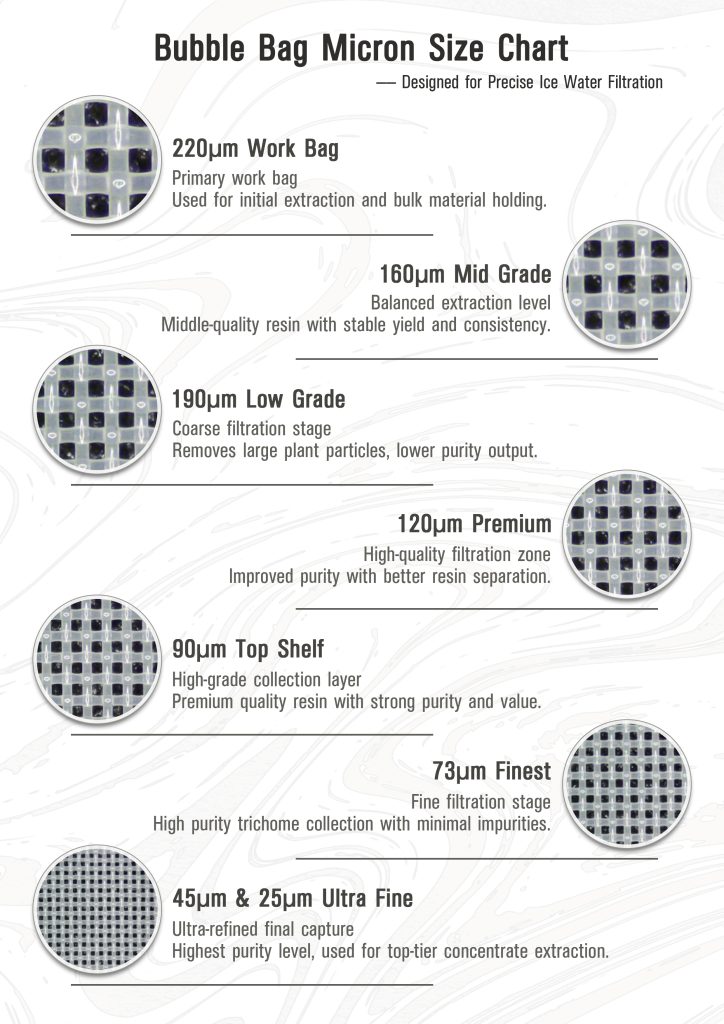
The chart helps users understand:
- Which particles will pass through
- Which particles will be retained
- How filtration progresses across layers
In simple terms, the chart acts as a blueprint for building an effective filtration system.
Standard Micron Size Chart
Below is a commonly used micron size chart for filtration bag systems:
| Micron Size | Filtration Level | Function |
|---|---|---|
| 220μm | Very Coarse | Removes large debris |
| 160μm | Coarse | Initial filtration stage |
| 120μm | Medium | General separation |
| 90μm | Medium-Fine | Controlled filtration |
| 73μm | Fine | Precision separation |
| 45μm | Very Fine | Micro filtration |
| 25μm | Ultra Fine | Final capture stage |
Each micron size plays a specific role in the filtration process. Skipping or misusing one layer can affect the entire system.
For a deeper explanation of how to choose micron sizes, see the Micron Filter Guide.
How to Read the Micron Chart Correctly
Many users misunderstand micron charts by focusing only on individual numbers. The key is to understand the relationship between them.
Filtration works as a sequence, not as isolated steps.
- Larger micron sizes act as pre-filters
- Medium micron sizes perform separation
- Smaller micron sizes refine the result
Instead of asking which single micron is best, the better question is:
How should different micron sizes work together?
Why Multiple Micron Sizes Are Necessary
Using a single micron bag limits your ability to control filtration. A multi-layer system provides several advantages:
First, it improves efficiency. Large particles are removed early, preventing clogging in finer layers.
Second, it increases precision. Each layer captures a specific range of particle sizes.
Third, it enhances consistency. Results become more predictable and repeatable.
A typical multi-stage filtration setup follows this order:
- 220μm as the top layer
- 120μm for primary separation
- 73μm for fine filtration
- 25μm for final collection
This structure ensures a gradual and controlled filtration process.
You can explore complete multi-stage systems on the Bubble Hash Bags page.
Practical Example of a Filtration Setup
To better understand how the micron chart is applied, consider the following example:
Step 1: Coarse Filtration
The 220μm bag removes large contaminants and unwanted materials.
Step 2: Primary Separation
The 120μm bag separates mid-sized particles.
Step 3: Fine Filtration
The 73μm bag captures smaller particles with higher precision.
Step 4: Final Refinement
The 25μm bag collects the finest remaining particles.
Each step depends on the previous one. Skipping a layer reduces control and affects results.
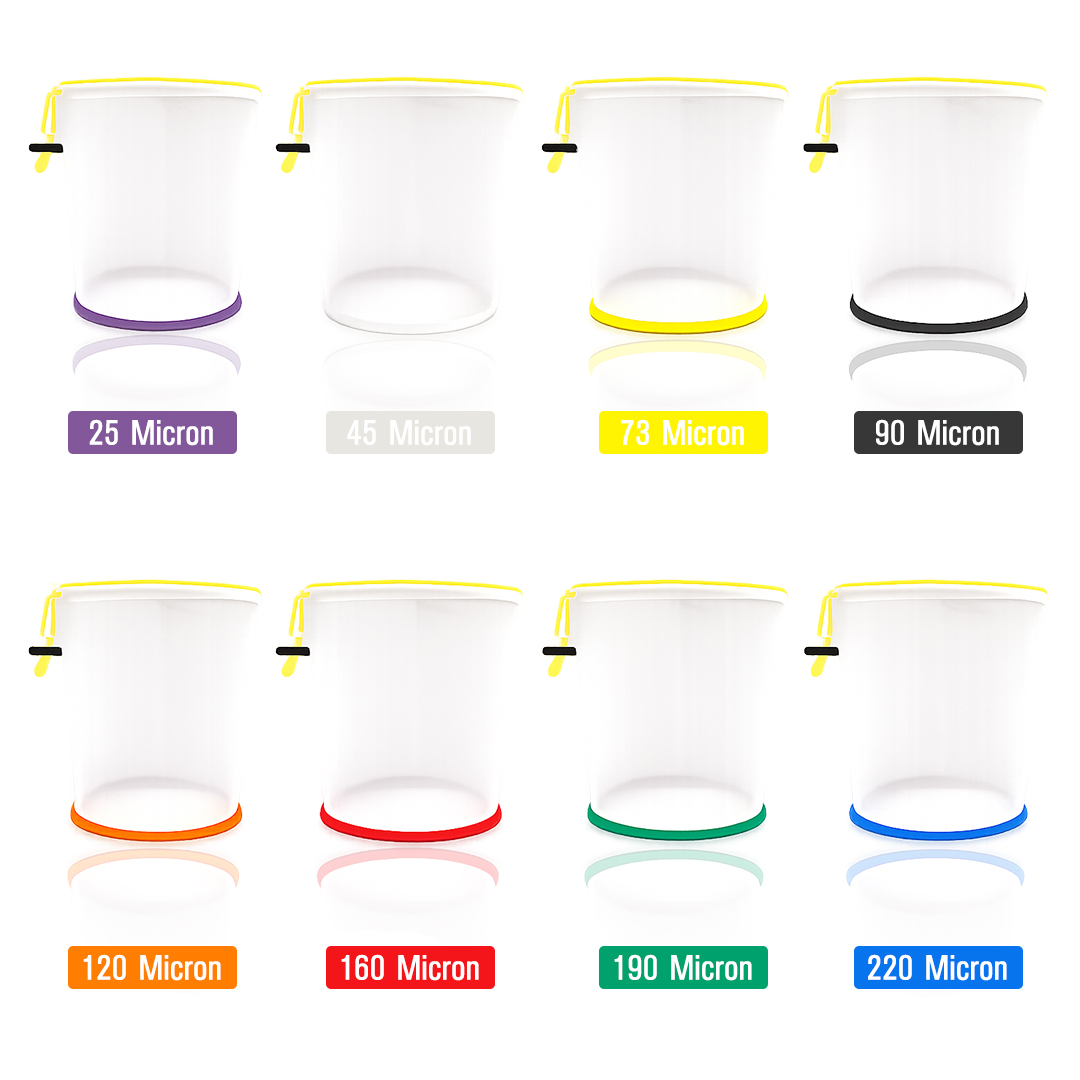
Choosing the Right Micron Combination
Not every user needs the same setup. The ideal micron combination depends on your goals.
If your goal is higher yield, you may prioritize larger micron sizes such as 120μm and 160μm. This allows more material to pass through but reduces precision.
If your goal is higher purity, smaller micron sizes such as 73μm and 25μm are more effective. These provide finer filtration but may reduce total output.
For most users, a balanced approach using multiple micron sizes is the best solution.
Common Misconceptions About Micron Charts
There are several misunderstandings that can lead to poor filtration performance.
One common mistake is assuming that smaller micron sizes are always better. While finer filtration increases purity, it can also reduce efficiency and slow down the process.
Another misconception is that more bags always produce better results. While additional layers can improve separation, they must be used correctly and in the proper order.
Some users also ignore the importance of material quality. Even if the micron size is correct, poor-quality mesh can lead to inconsistent filtration.
Factors That Affect Filtration Performance
Micron size is important, but it is not the only factor that determines performance.
Temperature plays a significant role. Lower temperatures generally improve separation and reduce unwanted mixing.
Handling technique is also critical. Aggressive processing can damage particle structure and reduce filtration efficiency.
Material type affects how particles behave during filtration. Different materials require slightly different approaches.
Maintenance is often overlooked. Dirty or clogged bags reduce accuracy and slow down the process.
For maintenance tips, refer to the Filter Bags cleaning guide.
How to Optimize Your Filtration System
To get the best results from your micron setup, consider the following strategies:
Use a structured layering system based on the micron chart. Avoid random combinations.
Start with fewer bags if you are a beginner, then expand your system as you gain experience.
Monitor your results and adjust micron combinations based on performance.
Invest in high-quality filtration bags to ensure consistent micron accuracy.
How Many Micron Sizes Do You Need?
The number of micron sizes you need depends on your experience level and requirements.
Beginners typically use 3 to 5 bags. This provides enough control without adding complexity.
Intermediate users often use 5 to 8 bags to achieve more precise separation.
Professional systems may include a full range of micron sizes for maximum control and flexibility.
Applications of Micron Filtration Systems
Micron-based filtration is widely used in various industries and applications.
These include plant extraction processes, herbal processing, essential oil production, laboratory filtration, and solventless extraction methods.
In all these applications, the goal is the same: to separate particles based on size with accuracy and efficiency.
Conclusion
A bubble hash micron chart is not just a reference table. It is a practical framework for building an effective filtration system.
By understanding how different micron sizes work together, you can:
- Improve filtration efficiency
- Achieve better separation results
- Maintain consistent performance
The key is to think in layers, not individual numbers.
When used correctly, a micron chart becomes one of the most powerful tools in any filtration process.
Call to Action
If you are looking to improve your filtration setup, start with the right equipment.
Explore our Bubble Hash Bags collection to find high-quality multi-micron systems designed for precision and durability.
If you are unsure which micron sizes to choose, visit our Micron Filter Guide for a complete breakdown and expert recommendations.