In the rapidly maturing landscape of solventless concentrates, the “Gold Rush” for purity has moved beyond professional labs and into the hands of boutique producers and home connoisseurs alike. If you’ve spent any time in the community recently, you know that rosin has officially claimed the crown. It is pure, potent, and free of the chemical residues associated with BHO or PHO extraction.
However, the quality of your “liquid gold” is dictated by one critical piece of hardware: your press. If you are wondering how to choose the right rosin press machine for your extraction needs, you aren’t just looking for a tool; you are looking for the precise intersection of heat, pressure, and surface area. In this guide, we will break down the science of the squeeze to ensure your investment pays off in high-terpene yields.
1. Defining Your Scale: Hobbyist, Prosumer, or Commercial?
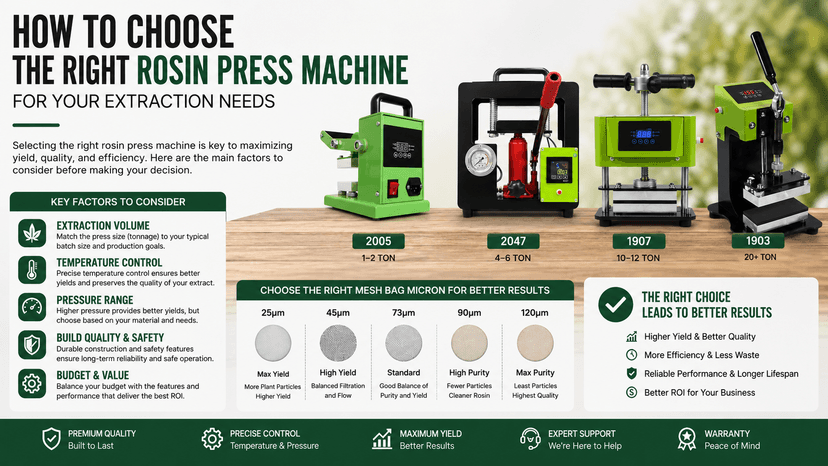
Before diving into technical specs, you must define the volume of material you intend to process. In 2026, the market is categorized into three distinct tiers:
The Hobbyist (Personal Use)
If you are processing a few grams of flower or dry sift from your personal tent every few weeks, a manual or small hydraulic “tabletop” press is your best entry point. These are portable, quiet, and budget-friendly.
-
Target Weight: 1–7 grams per squish.
The Prosumer (The Artisan Maker)
You demand 5-star “full melt” results and process weekly batches. You likely need a machine that offers more consistent pressure than a manual lever. A 10-ton hydraulic or a mid-range electric press is usually the sweet spot here.
-
Target Weight: 7–28 grams per squish.
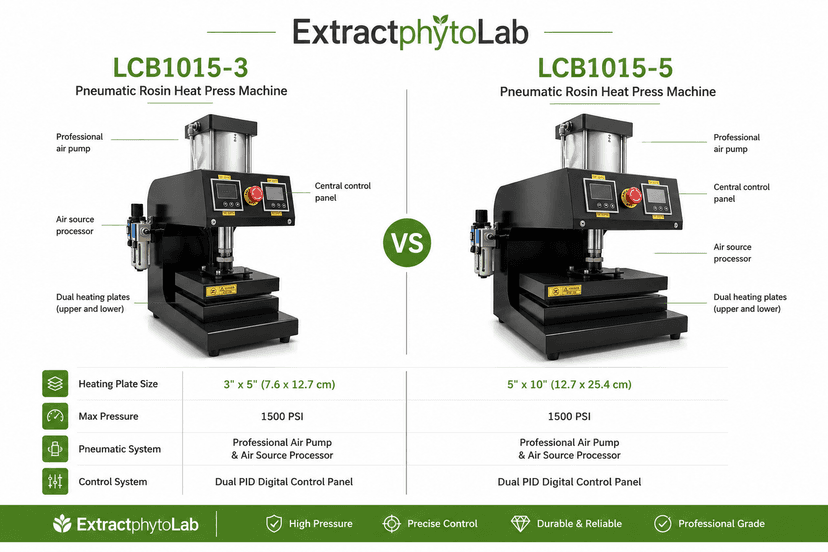
The Commercial Lab
Efficiency and throughput are your metrics for success. You need a pneumatic or large-scale electric press capable of running all day with digital precision and repeatable results for consistent branding.
-
Target Weight: 50+ grams per squish, multiple times an hour.
2. The Four Pillars of Rosin Press Technology
To understand how to choose the right rosin press machine, you must understand the “engine” behind the pressure.
Manual Rosin Presses
Manual presses rely on a pull-down lever or a twist-style mechanism.
-
Pros: Most affordable, no external pumps needed, highly portable.
-
Cons: Physical effort required; difficult to achieve consistent, high PSI on larger loads. Best for flower, less ideal for hash.
Hydraulic Rosin Presses
The most popular choice in 2026. These use a hydraulic jack (either hand-pumped or foot-operated) to apply massive force.
-
Pros: High pressure-to-cost ratio. You can easily find 10-ton to 20-ton options.
-
Cons: Can be messy if a seal leaks; hand pumping can become tedious in a commercial setting.
Pneumatic Rosin Presses
Driven by an air compressor, these are the “set it and forget it” machines.
-
Pros: Incredible consistency. With a push of a button, you get the exact same pressure every time. Perfect for scaling a business.
-
Cons: Requires a separate (often noisy) air compressor; higher initial price point.
Electric Rosin Presses
The modern standard for clean-room labs. These use electric motors to drive the plates.
-
Pros: No pumps, no oil, no compressors. They are the quietest and most compact professional machines available.
-
Cons: Typically have a lower maximum tonnage than hydraulic systems, but usually sufficient for most hash extraction.

3. The Science of Heat Plates: Size and Shape Matter
A common mistake when learning how to choose the right rosin press machine is assuming that “bigger is always better.” In reality, plate size is a double-edged sword.
Square vs. Rectangular
Most pros in 2026 prefer rectangular plates (e.g., 3″ x 5″ or 4″ x 7″). Why? Because a narrower plate allows the oil to escape the heat zone faster. The longer the rosin sits on a $200^\circ F$ plate, the more terpenes you lose to evaporation and oxidation.
Material: Aluminum vs. Stainless Steel
-
Aluminum: The industry standard. It heats up quickly and maintains a very even temperature distribution across the entire surface.
-
Stainless Steel: More durable, but has poor thermal conductivity, which can lead to “hot spots” that burn your oil. Stick with high-grade 6061 aluminum for the best results.
4. Calculating the “Real” PSI: Platen vs. Bag
This is where most beginners get confused. When a machine says it is a “20-ton press,” that refers to the total force. But what matters is the PSI at the bag.
To calculate your needs:
-
Take the total tonnage (e.g., 10 tons = 20,000 lbs).
-
Divide it by the surface area of your rosin bag (not the plates).
-
If you are pressing a 2″ x 4″ bag (8 sq inches), your 10-ton press is delivering 2,500 PSI.
Pro Tip: For flower, you want 1,000–2,000 PSI. For hash/sift, you only need 300–800 PSI. If you apply too much pressure to hash, you’ll force plant lipids and waxes into your oil, ruining the purity.
5. Temperature Control: The “Low and Slow” Revolution
As we move into 2026, the trend has shifted toward lower temperatures to preserve the volatile “live” terpene profiles. When choosing a press, ensure it has:
-
Dual PID Controllers: You want to control the top and bottom plates independently. A $2$-degree difference can actually change the consistency of your rosin from “shatter” to “budder.”
-
Accuracy: Cheap machines often have a $10$-degree variance. Look for machines with high-quality thermocouples.
6. Portability and Build Quality
Are you a “garage scientist” or do you have a dedicated lab?
-
Frame Strength: Look for “H-Frame” or “A-Frame” designs made of solid steel. Under 20 tons of pressure, a poorly built frame will flex, causing uneven extraction and potentially dangerous mechanical failure.
-
Weight: Professional 20-ton hydraulic units can weigh over 100 lbs. If you need to move your gear frequently, look for a compact electric or a high-end manual “bolt-down” model.
7. ROI Analysis: Is a Professional Press Worth It?
If you are processing high-quality flower that costs $200/oz, a 5% increase in yield (from 15% to 20%) means you are getting an extra 1.4 grams of rosin per ounce. At 2026 market prices ($50+/gram), the machine pays for itself in just a few weeks of consistent use.
Furthermore, a professional press allows you to create “Mechanical Fractionation” (THC-A diamonds), a high-value product that is impossible to make with a hair straightener or a low-end manual clamp.
8. Maintenance: Keeping Your Press in Elite Condition
Once you’ve figured out how to choose the right rosin press machine, you need to keep it running.
-
Hydraulic Fluid: Check levels every 6 months if you use a bottle jack.
-
Platen Cleaning: Use 99% ISO alcohol while the plates are still slightly warm to wipe away any sticky overflow immediately.
-
Calibration: Once a year, use a laser thermometer to ensure your digital readout matches the actual plate temperature.
FAQ: Essential Questions Before You Buy
Q: Do I need a 20-ton press for flower?
A: Not necessarily. A 10-ton press is usually more than enough for flower. However, having “headroom” means you don’t have to max out the machine, which extends the life of the hydraulic seals.
Q: Can I use a shop press from a hardware store?
A: You can “DIY” it with heated plates, but you will lack the precision temperature control and safety features of a purpose-built rosin press. In 2026, the price of dedicated presses has dropped so much that DIY is rarely worth the hassle.
Q: Is an electric press better than a hydraulic one?
A: If you value a quiet, oil-free environment and don’t mind a slightly higher price, electric is superior. If you want raw power for the lowest price, hydraulic is the winner.
Conclusion: The Final Squeeze
In the end, knowing how to choose the right for your extraction needs comes down to honesty. Be honest about your volume, your budget, and your desired end product.
If you want world-class “Live Rosin,” prioritize temperature accuracy and rectangular plates. If you want a fun hobby tool, prioritize portability and ease of use. The solventless revolution is here to stay, and with the right press in your lab, you are no longer a consumer—you are a producer of the finest concentrate on earth.
[Ready to see the top-rated presses of 2026? View our Comparison Chart Here.]